
What is CNC turning and milling and how to choose the right process for your project
CNC turning and CNC milling are two of the most widely used CNC machining processes in modern manufacturing. Both processes use computer numerical control (CNC) technology to produce high-precision parts with excellent repeatability. However, CNC turning and CNC milling operate in fundamentally different ways and are suitable for different part designs and manufacturing requirements.
Understanding what CNC turning and CNC milling are, as well as how to choose the right machining process for your project, is essential for achieving the best balance between cost, precision, and production efficiency. This article explains the differences between CNC turning and CNC milling and provides clear guidance on how to select the right process based on your part design and application.
What is CNC milling?
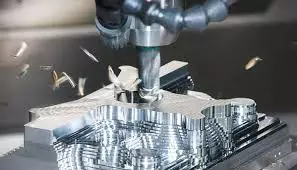
CNC milling is a machining process in which a rotating multi-point cutting tool removes material from a stationary workpiece.
The cutting tool moves along multiple axes to create precise holes, slots, pockets, and complex geometries.
Unlike CNC turning, CNC milling keeps the workpiece fixed while the tool performs the cutting operation. This makes CNC milling particularly suitable for parts with complex shapes, flat surfaces, cavities, and intricate details. Modern CNC milling machines typically operate with three axes (X, Y, and Z), while advanced systems can use four or five axes to machine complex features without repositioning the workpiece.
CNC milling is widely used across industries such as aerospace, automotive, medical, and industrial manufacturing. It can machine a wide range of materials, including metals, plastics, and composites. With ongoing advancements in CNC software and automation, modern milling machines offer high accuracy, improved efficiency, and consistent quality for both custom parts and mass production.
What is CNC Turning?
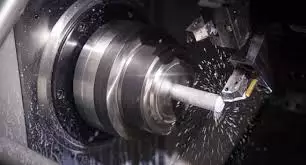
CNC turning is a machining process where the workpiece rotates while a single-point cutting tool removes material to create cylindrical or axisymmetric parts.
This process is performed on a CNC lathe and is known for its high efficiency and precision when machining round components.
During CNC turning, the cutting tool moves along controlled axes while the rotating workpiece allows continuous and stable material removal. This makes CNC turning ideal for producing parts such as shafts, bushings, pins, and threaded components. The process delivers excellent surface finishes and tight tolerances with high repeatability.
Modern CNC lathes often feature multi-axis capabilities and live tooling, allowing additional operations such as drilling, threading, and light milling. CNC turning supports a wide range of materials, including metals, plastics, and wood, making it suitable for both high-volume production and custom manufacturing.
What is the difference between CNC turning and milling?
Although both CNC turning and CNC milling are precision machining processes, they differ in operation, tooling, and typical applications.
Workpiece movement:
In CNC milling, the workpiece remains stationary while the cutting tool moves along multiple axes. In CNC turning, the workpiece rotates at controlled speeds while the cutting tool removes material.
Cutting tools:
CNC milling uses multi-point cutting tools such as end mills, face mills, and drills, allowing it to perform complex operations like slotting, contouring, and pocketing. CNC turning uses single-point cutting tools that are ideal for shaping round and tubular parts.
Machining complexity:
CNC milling is better suited for complex geometries, multi-face parts, and intricate designs. CNC turning is more efficient for producing symmetrical and cylindrical components. While advanced CNC lathes can perform limited milling operations, they are generally less flexible than CNC milling machines for complex shapes.
Axes and efficiency:
CNC milling machines commonly operate with three to five axes, enabling multi-directional machining. CNC turning typically uses fewer axes but offers faster production speeds for cylindrical parts due to continuous rotation.
Operational instructions for CNC milling and CNC turning
Below we will talk about the machining operations that can be performed by CNC milling and CNC turning services respectively, which can be performed with high precision using CNC equipment.
CNC milling operations
You can use this machining process to create various shapes and features on the workpiece. These machines can perform different tasks such as boring, face milling, drilling, and angle milling.
- Boring: This process is used to enlarge the holes that have been drilled. Commonly used in engine components.
- Face milling: In this type of operation, you create a smooth, even surface by cutting shallow surfaces on the workpiece.
- Drilling: You can drill holes in a surface using a CNC drilling machine. This operation requires the use of a specialized drill bit to ensure an accurate diameter and depth.
- Perimeter milling: In this operation, the cutting tool moves along the edge of the material, shaping the outer features of the workpiece.
- Thread milling: You can use a CNC milling machine to machine internal or external threads on a material. This is a better alternative to traditional tapping.
- Slot milling: This operation is used to create keyways or grooves on a material. It is a machining operation used for machined parts.
CNC Turning Operations
There are many tasks you can perform using a CNC turning center. This can help you machine a variety of features on a workpiece. The following are common operations that a CNC turning center can handle.
- Turning: Turning refers to removing material to make it cylindrical. When turning a material, it is done according to the length of the workpiece.
- Facing: A common operation that creates a flat surface by removing material from the end of a workpiece.
- Drilling: This requires using a CNC lathe to drill a hole in the axis of the workpiece. You can use a special drill to achieve this.
- Drilling: Using a tool to enlarge the hole to a certain size.
- Threading: Threading is used to cut external or internal threads on the workpiece for fastening.
- Grooving: In this operation, a cutting tool is used to make grooves on the surface of the workpiece.
- Knurling: This involves adding patterns to the surface of the workpiece.
What are the differences between CNC milling machines and CNC lathes and what parts do they consist of?
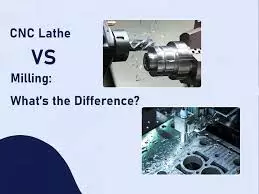
CNC milling machines and CNC lathes are two very different processing processes that achieve the purpose of manufacturing precision parts by using different CNC equipment. The following components are essential to ensure the smooth operation of CNC equipment. All of these components work together to help you create CNC machined parts with complex contours or geometries.
What parts does a CNC milling machine consist of?
CNC milling machines have many core components that help you achieve precise and complex cuts. The main components of this machine tool include:
- Spindle: This part of the machine clamps and rotates the cutting tool so that it can cut the workpiece.
- Control Panel: The control panel is the heart of the machine. This is where you enter programs, make adjustments, and regulate the machining process.
- Cutting Tools: There are many types of cutting tools, including drills, end mills, and face mills. These tools can help you create the shapes you want.
- Table: This part of the machine is used to hold the workpiece and move it in various directions. The way the machine is configured will determine the direction of the table.
- Axes: Some axes determine the movement of the table and cutting tools. These axes are called X, Y, and Z axes. In some advanced machine tools, they can also be A and B axes.
- Coolant System: Coolant in CNC machines works by minimizing friction and heat.
Components of CNC Lathes
There are many important components of a CNC lathe. Each component plays a vital role in achieving precise cuts. These components include:
- Chuck: This machine component is used to hold the workpiece in the correct position. Some CNC lathes come with chucks for holding smaller parts.
- Spindle: The spindle rotates the workpiece using a controlled speed, thus ensuring precise cuts.
- Bed and carriage: The bed ensures stability, while the carriage drives the cutting tool to rotate with the workpiece.
- Turret: The turret switches different cutting tools during the machining process.
- Cutting tool: This part of the CNC lathe removes material and refines the workpiece by moving along various axes.
- Control panel: The control panel in the CNC lathe helps to enter the program and make necessary adjustments.
How to Choose the Right CNC Machining Process for Your Project
Choosing between CNC turning and CNC milling depends primarily on part geometry, complexity, and production requirements.
- Choose CNC turning if your part is primarily cylindrical or axisymmetric, such as shafts, rods, bushings, or fasteners. CNC turning offers higher efficiency and lower cost for round parts.
- Choose CNC milling if your part has complex geometries, flat surfaces, cavities, or features on multiple faces. Milling is ideal for brackets, housings, plates, and irregular shapes.
- Use a combination of CNC turning and milling when a part has a cylindrical base with secondary features such as flats, slots, or cross-holes. This approach is common in real-world manufacturing and helps balance cost and functionality.
- Consider tolerance requirements, production volume, and material type when selecting the machining process, as these factors directly impact cost and lead time.
By evaluating your part design first and aligning it with the appropriate machining method, you can ensure optimal manufacturing efficiency and product quality.
Advantages and Disadvantages of CNC Milling vs. CNC Turning
The above article has described the differences between the two in terms of technology, machining operations, and equipment components. Because of this, the two processes have their own advantages and disadvantages in the process of precision part manufacturing. Below we will talk about the advantages and disadvantages of each manufacturing process.
Advantages and Disadvantages of CNC Milling
CNC milling is one of the most popular machining processes and is widely used in various applications. This machining process is known for its accuracy and efficiency and can be used to machine micro-workpieces to achieve tolerance control. It is the first choice for large-scale production due to its consistency and high accuracy. In addition, it integrates automation functions, reducing the need for human intervention. This helps minimize errors and improve efficiency. Furthermore, milling is widely used in various industries due to its versatility and efficiency. CNC milling machines can process different materials, and you can use them for different applications such as industrial, medical, aerospace, and automotive.
Despite the many advantages of CNC milling, there are also many challenges. Cost is a major concern for most manufacturers. The machine tools and programming are expensive. Another disadvantage is that only skilled operators can operate, process, and program them. Machine tool maintenance is also a major concern for manufacturers. Despite these disadvantages, the accessibility and efficiency of CNC milling continue to improve.
CNC Turning Advantages and Disadvantages
CNC turning has many advantages. In today’s manufacturing industry, this machining method is popular for its high precision and efficiency. With CNC lathes, you can get parts with consistent quality no matter how tight the tolerances are. The machining process uses automation, which helps speed up the production process and reduce human intervention.
CNC turning is also a versatile machining process that you can integrate to create simple or complex axisymmetric items. Therefore, it is widely used in various industries. Although all these advantages make it widely adopted, they also have some disadvantages. These disadvantages include high setup costs, as well as the cost of purchasing and programming the machine tools. Since CNC turning integrates automation, it still requires skilled operators for programming and maintenance. Tool wear is also a major disadvantage, especially when machining hard materials. These materials increase production costs because more effort and time are required. Despite some of the disadvantages of CNC machining, it is still an effective way to manufacture complex parts.
CNC Turning vs. Milling: Which One Should You Choose?
CNC milling and CNC turning are two important machining processes. However, the choice of CNC turning or milling depends on the complexity, shape, and manufacturing requirements of the part. Milling should be used when dealing with parts with complex geometries, intricate details, cavities, flat surfaces, etc. It also utilizes multi-point cutting tools to remove material. Therefore, it is ideal for areas that require complex and high-precision designs. In addition, milling machines also have multi-axis capabilities, which helps to manufacture 3D shapes and complex parts.
CNC milling can be used to machine irregular and flat surfaces and shapes. It is suitable for machining shafts, spindles, brackets, custom bushings, custom tools, etc. It is a very efficient mass production process with fast cycle times and excellent surface finish. When dealing with parts that require a large number of cutting angles and complex shapes, milling is a better choice. However, when dealing with cylindrical parts that require high efficiency and precision, CNC turning should be selected.
Why Choose Xtproto’s CNC Turning and CNC Milling Services
Xtproto provides reliable CNC turning and CNC milling services designed to meet high standards of precision, efficiency, and consistency. With advanced equipment, experienced engineers, and streamlined online quoting, Xtproto supports both complex custom parts and high-volume production. Our CNC milling services handle intricate geometries with tight tolerances, while our CNC turning services deliver smooth, accurate cylindrical components for a wide range of applications.