
CNC Plastic Machining Guide: Materials, Design Rules and Cost Tips
In the rapidly shifting landscape of modern manufacturing, a common question persists: In an era dominated by high-speed 3D printing and additive technologies, why does CNC plastic machining remain the gold standard for mission-critical components?
The answer lies in material integrity and mechanical precision. While 3D printing is excellent for rapid prototyping, it often struggles with isotropic strength and ultra-tight tolerances. Precision CNC machining for plastics, however, allows engineers to utilize the full physical properties of engineering-grade polymers—achieving surface finishes and dimensional stabilities that additive methods simply cannot match.
Why Machining Plastics is a Specialist’s Game
Machining polymers is fundamentally different from machining metals like aluminum or steel. While metals dissipate heat through the material itself, plastics act as insulators. This creates unique challenges:
- Thermal Expansion: Plastics expand significantly more than metals when heated.
- Elasticity: Polymers can “spring back” during cutting, affecting final dimensions.
- Chip Formation: Managing continuous “ribbon” chips to prevent entanglement and surface scarring.
As we move through 2026, the demand for high-performance plastic components in medical devices, aerospace manifolds, and semiconductor equipment has never been higher. This guide explores how to navigate these complexities to produce superior, cost-effective parts.
Material Intelligence: Selecting the Right Polymer
Choosing the right substrate is the most critical decision in CNC plastic machining. Unlike metals, where “grade” usually refers to strength, plastic selection involves balancing thermal stability, chemical resistance, and moisture absorption.
Below is a breakdown of the 2026 industry standards for engineering polymers, categorized by their mechanical performance and “machinability.”
High-Performance Polymers (The “Super Plastics”)
These materials are utilized in extreme environments, such as aerospace engines, medical implants, and semiconductor vacuum chambers.
- PEEK (Polyetheretherketone): The king of high-performance plastics. PEEK offers incredible mechanical strength and can withstand temperatures up to 250°C (482°F). It is highly resistant to radiation and chemicals but requires specialized tooling due to its hardness.
- Torlon (PAI): Offers the highest strength of any unreinforced thermoplastic. It is the go-to for high-load bearings and seals where thermal expansion must be kept to an absolute minimum.
- Ultem (PEI): Known for its high dielectric strength and flame resistance, making it the standard for electrical connectors and aircraft interiors.
General Engineering Plastics (The Workhorses)
These are the most common materials found in industrial machinery and automotive components.
- POM (Delrin/Acetal): Often called “the machinist’s favorite.” Delrin has excellent dimensional stability, low friction, and high impact resistance. It produces crisp, clean chips and holds tight tolerances better than almost any other plastic.
- Nylon 6/6 (Polyamide): Extremely tough and wear-resistant. However, engineers must account for hydroscopic expansion—Nylon absorbs moisture from the air, which can change its dimensions after machining.
- PTFE (Teflon): Unrivaled for low-friction applications. However, its “softness” makes it prone to deformation during clamping, requiring custom fixtures.
Comparative Material Performance Matrix (2026 Reference)
| Material | Density (g/cm3) | Tensile Strength (MPa) | Max Operating Temp (∘C) | Machinability Rating |
| PEEK | 1.32 | 100 | 250 | Moderate |
| Delrin (POM) | 1.41 | 70 | 90 | Excellent |
| Nylon 6/6 | 1.14 | 80 | 100 | Good |
| Ultem 1000 | 1.27 | 105 | 170 | Difficult |
| Polycarbonate | 1.20 | 65 | 115 |
Common Challenges in CNC Plastic Machining
To the uninitiated, cutting plastic seems easier than cutting steel. To the expert, it is often more difficult. The “secret” to precision CNC plastic parts lies in managing internal stress and heat—two factors that do not exist in the same way for metals.
Solving the Warping Problem: Annealing and Stress Relief
The most common complaint in plastic machining is dimensional instability. A part may be perfect on the CNC bed but “taco” (warp) 24 hours later.
- The Cause: Most plastic stock (extrusions or sheets) contains internal stresses from the manufacturing process.
- The Fix: Professional shops utilize pre-machining and post-machining annealing. This involves heating the plastic to a specific temperature below its melting point, holding it, and cooling it slowly. This stabilizes the molecular structure, ensuring the part stays flat and within tolerance.
Thermal Management in Non-Conductive Materials
Unlike aluminum, which carries heat away in the chip, polymers are thermal insulators. The heat generated at the tool tip stays at the tool tip.
- Localized Melting: If your feed rate is too slow or your RPM too high, the plastic will gum up or melt, ruining the surface finish.
- Tooling Geometry: We utilize high-rake, polished carbide tools specifically designed for plastics. These “razor-sharp” edges slice through the material with minimal friction, reducing heat buildup.
Preventing “Clamping Distortion”
Plastics have a low modulus of elasticity, meaning they are easy to compress.
- The Problem: If you tighten a standard vise on a thin-walled POM or HDPE part, the material deforms. You machine it while it’s squeezed; when you open the vise, the part springs back, and your dimensions are suddenly “off.”
- The Solution: Use vacuum chucks, custom soft jaws, or “sacrificial” mounting plates. These methods distribute clamping pressure evenly, preventing the “crush” effect.
Burr Control: The Battle with Ductility
Ductile plastics like UHMW-PE or Polypropylene don’t “chip”—they tear. This leaves “fuzz” or burrs at the edges.
Expert Tip: We use “climb milling” strategies and cryogenic deburring (cooling the part to sub-zero temperatures to make the burrs brittle) to achieve medical-grade edge quality without manual scraping.
Design for Manufacturability (DFM) for Plastics
Designing for CNC plastic machining is not the same as designing for aluminum. To keep costs low and precision high, engineers must adhere to “Plastic-First” design rules.
The Golden Rules of Plastic DFM:
- Internal Radii vs. Sharp Corners: Avoid 90-degree internal corners. Always specify a radius. Not only does this allow for standard end-mill use, but it also prevents stress concentration, which causes plastic parts to crack under load.
- Wall Thickness Consistency: While plastics are versatile, extremely thin walls (under 0.8mm) tend to vibrate or “chatter” during machining, leading to poor surface finishes. Aim for a minimum wall thickness of 1.5mm for structural integrity.
- Threaded Inserts vs. Direct Tapping: For high-wear parts, avoid tapping threads directly into soft plastics like HDPE or PP. Instead, design for ultrasonic or heat-stake inserts. For harder plastics like PEEK or Delrin, direct tapping is viable but requires specialized thread geometries.
- Tolerance Realism: In 2026, we see many designs requesting $\pm0.01mm$ for Nylon parts. Due to moisture absorption and thermal drift, this is often physically impossible. A more realistic “Standard Precision” for engineering plastics is $\pm0.1mm$, with “High Precision” reaching $\pm0.02mm$ under controlled environments.
Advanced CNC Techniques for 2026
The industry has moved beyond simple 3-axis milling. To stay competitive, high-end facilities are adopting technologies that treat polymers with the same sophistication as aerospace alloys.
AI-Adaptive Machining
Modern CNC controllers now use AI-driven feedback loops to monitor spindle load in real-time. Because plastic density can vary slightly between batches (especially in recycled or glass-filled resins), the AI automatically adjusts feed rates to prevent “gumming” or tool deflection.
Cryogenic Machining (The Cold Advantage)
For ultra-soft elastomers or “gummy” plastics (like TPU or soft Silicones), we utilize Liquid Nitrogen (LN2) cooling. By freezing the material at the point of cut, the plastic behaves like a brittle solid, allowing for incredibly clean cuts and mirror-like surface finishes that were previously impossible.
5-Axis Simultaneous Milling for Complex Geometries
From intricate medical manifolds to lightweight UAV structural frames, 5-axis machining allows us to reach complex angles in a single setup. This reduces “stack-up errors” caused by re-fixturing and significantly lowers the cost-per-part for complex designs.
Advanced Surface Finishing: From Matte to Mirror-Clear
In the world of precision CNC plastic machining, the “as-machined” surface is often just the beginning. Depending on your industry—be it medical, optical, or automotive—the post-processing stage defines the final performance of the component.

Vapor Polishing for Optical Clarity
For materials like Polycarbonate (PC) and Acrylic (PMMA), achieving transparency is a common requirement.
- The Process: The part is exposed to a chemical solvent vapor (such as Weld-On 4) which slightly melts the surface at a molecular level, flowing out microscopic tool marks.
- The Result: A high-gloss, optically clear finish that is essential for fluid manifolds, light pipes, and medical sight glasses.
Chemical Etching and Texture
When aesthetics or “grip” are more important than clarity, chemical etching provides a uniform, matte finish. This is particularly effective for consumer electronics and handheld industrial tools where reducing glare and fingerprint visibility is a priority.
Media Blasting: The Functional Matte
For parts that require bonding or painting, bead blasting with fine glass or ceramic media creates a controlled surface roughness. This increases the surface area for adhesives, making it a critical step for composite-to-plastic assemblies.
Cost Optimization: How to Get Better Quotes in 2026
To maximize the ROI of your CNC plastic projects, you must look beyond the material price. In 2026, the most cost-effective parts are those designed with “Operational Efficiency” in mind.
1.Standardize Your Raw Stock: Whenever possible, design your parts to fit within standard plate or rod dimensions. Custom-cast blocks add significant lead time and cost.
2.Limit Tight Tolerances to Critical Features: Do not specify $\pm0.02mm$ for the entire part if only one bearing bore requires it. In plastics, every extra “zero” in your tolerance doubles the inspection time and scrap risk.
3.Optimize for Minimum Setups: Use 5-axis machining or design parts that can be completed in two operations. Every time a machinist has to touch the part to flip it, the cost increases.
4.Leverage Volume Scaling: While CNC has higher setup costs than 3D printing, the “run cost” is much lower. Moving from 10 units to 100 units can often reduce the price-per-part by 40% or more.
Conclusion: Partnering for Precision
The future of CNC plastic machining is defined by a sophisticated blend of traditional craftsmanship and digital innovation. As bio-based polymers and AI-driven production cycles become the new industry norm, choosing a manufacturing partner who truly understands the unique “behavior” of polymers is no longer optional—it is a competitive necessity. Unlike metals, plastics require a nuanced approach to thermal management and chip evacuation to prevent deformation during the CNC machining process.
Whether you are developing a complex PEEK medical implant or a high-volume Delrin gear assembly, the key to project success lies in a deep focus on DFM (Design for Manufacturability), internal stress relief, and material intelligence. By integrating these principles into your CNC machining workflow, you ensure that every component achieves the perfect balance of structural integrity and dimensional precision.
Ready to bring your polymer designs to life? Our facility specializes in high-end CNC plastic machining tailored to your most rigorous specifications. From rapid prototyping to full-scale industrial runs, we provide the technical expertise needed to master even the most challenging materials. Upload your CAD files today for an instant quote and experience the gold standard in modern CNC machining
FAQ
Can plastic be CNC machined, and is it better than injection molding?
Absolutely. CNC plastic machining is a highly effective method for producing high-precision parts without the expensive tooling costs of injection molding. It is ideal for low-to-medium volumes and allows for tighter tolerances and the use of high-performance materials that are difficult to mold.
What is the best plastic for CNC milling?
The “best” material depends on your application. For general-purpose prototypes, ABS CNC machining is the standard due to its balance of strength and cost. For high-wear industrial parts, Delrin (POM) or Nylon are the best plastics for machining because they are self-lubricating and hold dimensions exceptionally well.
What is the easiest plastic to CNC?
Delrin (POM) is widely considered the easiest and best plastic for CNC milling. It is a rigid thermoplastic that chips cleanly rather than melting or “gumming up” the C N C machine tools. This allows for faster production speeds and a superior surface finish compared to softer plastics like LDPE.
Can you machine parts from a CNC plastic sheet?
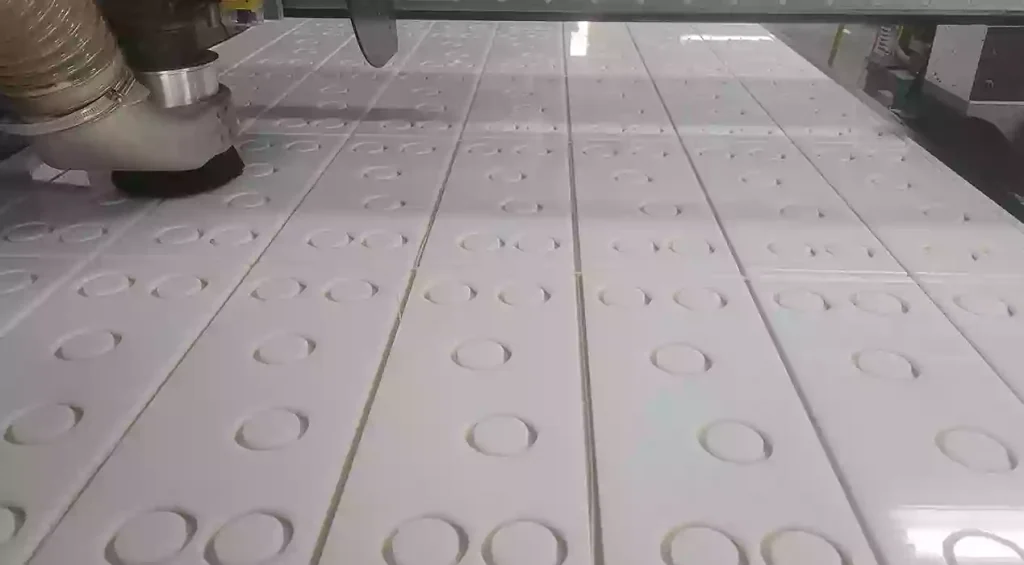
Yes. We frequently use CNC plastic sheet stock to create flat components, panels, and enclosures. By using vacuum table workholding on our C N C machine, we can ensure that thin plastic sheets remain perfectly flat during the milling process, preventing the warping that often occurs with traditional clamping.