
Military CNC Machining Applications: Beyond the Basics of Defense Manufacturing
In the high-stakes world of modern defense, the margin for error is non-existent. Military CNC Machining Applications represent the bridge between advanced engineering blueprints and battlefield-ready hardware, where components must perform under extreme thermal stress and kinetic impact that would destroy standard industrial parts. From hypersonic aerospace structures to the sensitive electronics used in tactical communications, the focus is always on achieving zero-defect reliability and total part interchangeability. As defense technology evolves toward autonomous systems and lightweight armor, the ability to precision-machine exotic alloys while maintaining strict ITAR and AS9100D compliance has become a strategic necessity rather than just a manufacturing service. This guide explores how these critical applications are shaping the next generation of air, land, and sea defense systems through unparalleled accuracy and material expertise.
Aerospace and Hypersonic Applications
Aerospace remains the most demanding arena for military CNC machining applications, specifically in the development of next-generation propulsion systems and high-stress structural airframes. The rapid advancement of hypersonic technology now requires the precision machining of nickel-based superalloys like Inconel 718 and Cobalt-Chrome, materials that must maintain their structural integrity while enduring aerodynamic heating exceeding 1000°C. High-performance 5-axis CNC milling is the only viable method for producing complex geometries such as integrated blisks and turbine blades, where aerodynamic efficiency depends entirely on achieving sub-micron surface finishes and perfect balance. Beyond the engine, CNC precision is utilized to create lightweight titanium bulkheads and landing gear components that significantly reduce the overall weight of the aircraft without sacrificing the extreme fatigue resistance required for high-G maneuvers or carrier-based landings. Every cut in these aerospace applications must be verified against rigorous AS9100D standards, ensuring that mission-critical components survive the harshest flight envelopes imaginable while providing the reliability expected by modern air forces.
Land Systems and Armor Protection
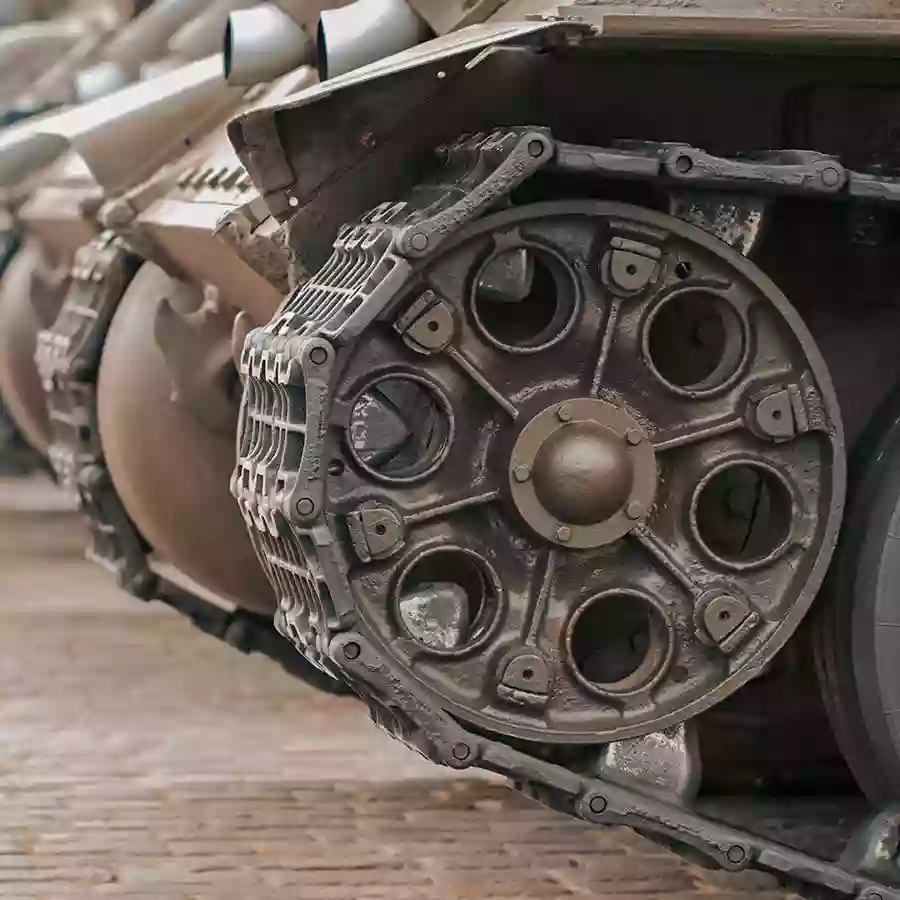
Modern ground warfare places extremely high demands on structural toughness, which can only be met by precision-machined components. In the field of military CNC machining applications for land systems, the focus is shifting towards high-torque transmission system components, modular weapon interfaces, and advanced armor integration. Heavy-duty transmission gears and suspension links in infantry fighting vehicles must be machined from high-strength alloy steel to withstand the enormous kinetic energy generated by off-road combat maneuvers. Furthermore, the increasing prevalence of remote weapon stations requires CNC milling of complex turret rings and sensor housings to achieve zero-backlash movement, ensuring that aiming optics remain calibrated even under severe vibrations. As armored platforms move towards modularity, CNC machining provides the high-precision consistency required for field-replaceable components, allowing damaged parts to be replaced immediately without customization. This manufacturing precision is also reflected in lightweight ballistic protection systems, where specially machined aluminum and composite reinforced frames are seamlessly integrated with the vehicle chassis, optimizing the balance between crew protection and tactical mobility on the battlefield.
Naval and Submarine Systems
Naval engineering presents a unique set of challenges where military CNC machining applications must prioritize extreme corrosion resistance and acoustic stealth. For submarine systems, the precision machining of specialized alloys like Monel, Inconel, and aluminum bronze is critical for components that must endure decades of exposure to high-pressure saltwater environments. CNC technology is the primary driver behind the production of complex propulsion systems and quiet-running propellers, where achieving a perfect hydrodynamic surface finish is essential to minimize cavitation and maintain a low acoustic signature. Beyond propulsion, CNC-milled pressure housings for deep-sea sensors and sonar arrays must be manufactured to exacting tolerances to ensure hermetic seals at depths where even a micron-scale deviation could lead to catastrophic hull compromise. These naval applications also extend to carrier-based catapult systems and high-torque winch components, where the combination of material strength and geometric accuracy ensures the reliable launch and recovery of aircraft in the most corrosive maritime conditions on Earth.
Technical Depth: Precision Standards and Tolerances
The effectiveness of these military CNC machining applications is fundamentally rooted in the ability to maintain absolute consistency across extreme production tolerances. In defense manufacturing, “precision” is defined by the necessity for total part interchangeability in the field, where a deviation of 0.005 mm can be the difference between a functional weapon system and a mechanical failure. Utilizing advanced 5-axis synchronous machining allows for the creation of complex monolithic structures that eliminate the weak points associated with traditional welded assemblies, significantly increasing the structural fatigue life of mission-critical hardware. This technical rigor extends to the surface integrity of the finished part, where controlled stress relief and precision grinding prevent the microscopic stress fractures that lead to catastrophic failure under high-G or high-thermal loads. By integrating real-time tool-wear monitoring and automated in-process probing, high-tier manufacturers ensure that every batch of components meets the exact spectral and mechanical requirements demanded by modern military specifications, providing a level of reliability that standard industrial processes simply cannot replicate.
Quality Assurance and Strategic Compliance
In the defense sector, the integrity of military CNC machining applications is validated through a rigorous framework of certification and uncompromising traceability. Compliance with ITAR (International Traffic in Arms Regulations) and AS9100D is not merely a bureaucratic requirement but a foundational security measure that ensures the protection of sensitive technical data and the reliability of the global defense supply chain. Every component undergoes a serialized journey from the initial raw material heat number to the final non-destructive testing (NDT) report, providing a digital twin of the manufacturing process that guarantees material authenticity. High-tier facilities employ advanced metrology, including coordinate measuring machines (CMM) and laser scanning, to verify that the complex internal geometries of mission-critical parts align perfectly with original CAD specifications. This exhaustive quality ecosystem ensures that when a component reaches the field, it possesses the verified structural properties and dimensional accuracy required to function in the most hostile operational environments on Earth.
Conclusion: Engineering the Future of Defense
The evolving landscape of global security continues to drive the demand for increasingly sophisticated military CNC machining applications. As we move toward a future defined by hypersonic speeds, autonomous naval platforms, and AI-integrated electronic warfare, the reliance on subtractive manufacturing precision has never been more absolute. The ability to transform exotic superalloys into high-tolerance, mission-critical hardware is the silent engine behind modern tactical superiority. Achieving this level of excellence requires more than just advanced machinery; it demands a deep integration of material science, rigorous ITAR compliance, and a “zero-failure” manufacturing philosophy. For defense contractors and aerospace engineers, selecting a manufacturing partner that understands these unique operational stresses is the final, most critical step in ensuring that theoretical designs become reliable battlefield realities.
Frequently Asked Questions about Military CNC Machining
What primarily drives the cost of military CNC machining applications?
The cost is driven by material complexity, tight tolerances, and compliance overhead. Processing exotic alloys like Titanium or Inconel 718 increases tool wear and cycle times. Furthermore, the administrative costs of maintaining ITAR and AS9100D traceability and rigorous quality reporting are factored into the final price.
Why is defense-grade machining more expensive than commercial CNC services?
Commercial machining focuses on speed, whereas military CNC machining prioritizes absolute reliability. The higher price reflects exhaustive Quality Assurance (QA) processes, including CMM reports, non-destructive testing (NDT), and raw material heat-number traceability required for national security.
How does production volume affect the unit price for mission-critical parts?
While higher volumes reduce per-unit costs, defense projects often involve substantial “First Article Inspection” (FAI) and setup fees. The value in military CNC machining applications often lies in low-to-medium volume, highly complex prototypes where precision and rapid iteration are more critical than mass-market economies of scale.
Can “Design for Manufacturing” (DfM) help reduce military machining costs?
Yes. Collaborating with a specialized defense manufacturer during the design phase can identify cost-saving opportunities. By optimizing internal radii for standard tooling or adjusting non-critical tolerances, engineers can reduce machining hours without compromising the part’s tactical performance or structural integrity.
What specific certifications should I look for in a military CNC machining partner?
A qualified partner must hold AS9100D (Aerospace Quality Management) and ISO 9001:2015 certifications at a minimum. For US-based or international defense contracts involving controlled items, ITAR Registration is a legal requirement. These certifications guarantee that the manufacturer follows a standardized quality management system capable of meeting the extreme demands of military CNC machining applications.