
PEEK vs. Titanium in CNC Machining: Which is Superior for High-Precision Medical Components?
When selecting the optimal material for high-performance applications—particularly within the stringent confines of medical implants and aerospace engineering—the debate often centers on two industry gold standards: PEEK (Polyetheretherketone) and Titanium (specifically Grade 5 Ti-6Al-4V). While Titanium has long been the foundational choice due to its exceptional mechanical strength and established track record, the emergence of high-performance polymers like PEEK has introduced a critical paradigm shift. The decision is no longer just about which material is “stronger,” but rather which aligns more precisely with the physiological or structural requirements of the specific environment.
From an engineering perspective, this choice involves a complex trade-off between the rigid durability of metal and the bone-like modulus and radiolucency of advanced thermoplastics. As CNC machining technology has evolved to handle these materials with micron-level precision, understanding the nuanced differences in their physical properties, biocompatibility, and long-term stability has become essential for developers looking to push the boundaries of modern design.
Material Properties: Beyond Biocompatibility
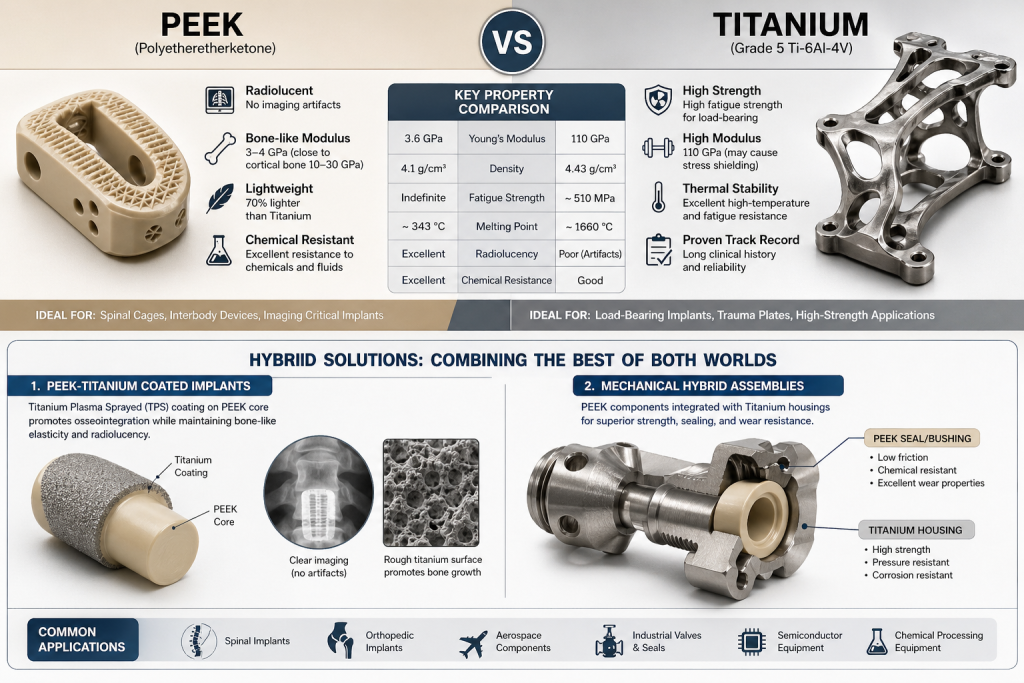
While both materials are renowned for their biocompatibility, their mechanical behaviors offer distinct advantages depending on the clinical or structural objective. Titanium is the definitive choice for load-bearing requirements, but its high Young’s Modulus (approximately 110 GPa) often creates a significant mismatch with natural human bone (10–30 GPa). This disparity can lead to “stress shielding,” where the metal implant carries the bulk of the physiological load, potentially causing bone density loss in the surrounding tissue over time.
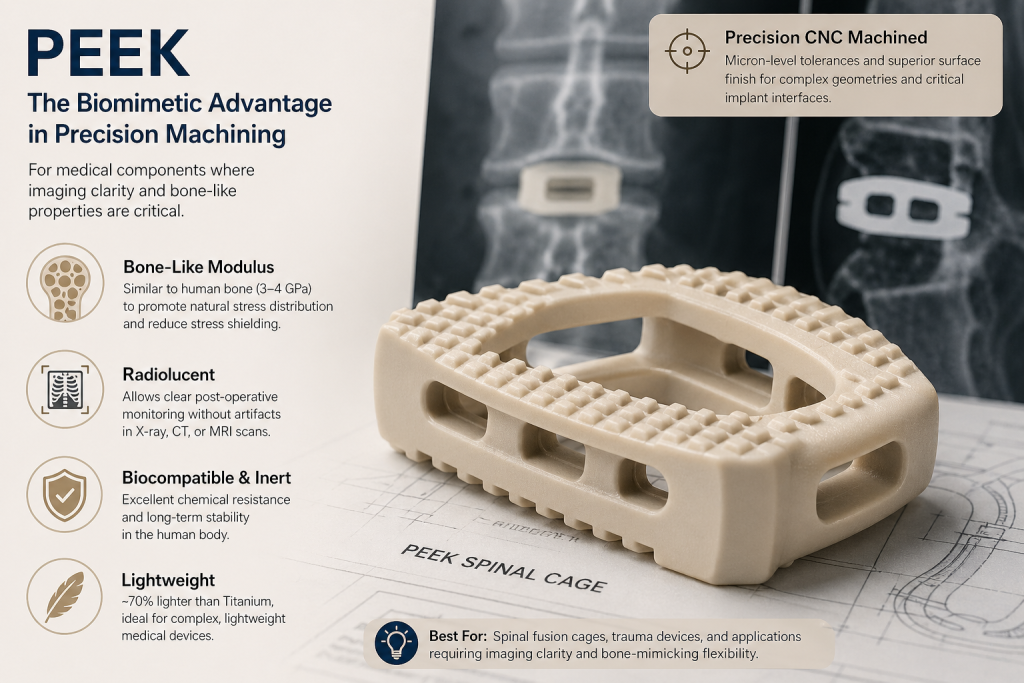
In contrast, PEEK offers a modulus that closely mimics cortical bone, promoting a more natural stress distribution and encouraging long-term bone remodeling—a critical factor in the success of spinal fusion and orthopedic devices.
Beyond mechanics, the Radiolucency of PEEK is a transformative feature. Unlike Titanium, which produces significant “artifacts” or shadows under X-ray, CT, and MRI scans, PEEK is radiolucent. This allows surgeons to clearly monitor healing progress and bone growth through the implant without visual obstruction. However, where extreme environmental resistance is required—such as in high-temperature aerospace valves or high-impact structural components—Titanium’s thermal stability and fatigue resistance remain unmatched.
CNC Machining Challenges: Precision and Process Control
Transitioning from raw material properties to a finished component requires a deep understanding of how PEEK and Titanium react to the stresses of subtractive manufacturing. From an engineering standpoint, the two materials represent opposite ends of the machining spectrum. Titanium is notoriously difficult to machine due to its low thermal conductivity and work-hardening characteristics. During CNC milling, heat does not dissipate through the chips but remains concentrated at the cutting edge, necessitating sophisticated high-pressure cooling systems and specialized carbide tooling to maintain dimensional integrity and surface finish.
PEEK, while softer, presents a different set of challenges centered on thermal expansion and internal stress. Unlike metals, PEEK has a high coefficient of thermal expansion, meaning that even a slight temperature fluctuation during the machining process can cause the part to drift out of tolerance. Furthermore, the inherent stresses within extruded PEEK shapes can lead to significant warping after material is removed.
Achieving micron-level precision in PEEK machining requires a rigorous approach to stress relieving and annealing cycles—both pre- and post-machining—to ensure long-term dimensional stability. While Titanium demands power and rigidity from the CNC platform, PEEK demands thermal management and delicate tool path strategies to prevent the “gumming” of the material or the loss of critical tolerances.
Application-Specific Analysis: Defining the Use Case
The choice between PEEK and Titanium is rarely binary; it is dictated by the specific functional environment the component must inhabit. In the medical sector, the transition toward spinal interbody fusion cages has leaned heavily toward PEEK because its radiolucency allows for the clear assessment of osseointegration. However, in cases of maxillofacial reconstruction or high-load orthopedic trauma plates, Titanium remains the preferred choice due to its superior fracture toughness and ability to withstand the repetitive mechanical stresses of the human musculoskeletal system.
In the aerospace and semiconductor industries, the criteria shift toward weight and chemical stability. For components such as thermal insulators or fluid handling connectors, PEEK provides a critical advantage: it is 70% lighter than Titanium while offering exceptional resistance to aggressive chemicals and plasma environments. Conversely, in the “hot zones” of an aircraft engine or structural airframe fasteners, Titanium’s high melting point and creep resistance are indispensable.
Ultimately, the application determines whether the design prioritizes the biomimetic flexibility of a high-performance polymer or the uncompromising structural rigidity of a biocompatible metal.
The Cost-Benefit Equation: Beyond the Price of Raw Material
From a procurement and project management perspective, the financial comparison between PEEK and Titanium extends far beyond the initial cost per kilogram. While PEEK is significantly more expensive as a raw material—often costing several times more than Titanium Grade 5—the total cost of ownership is heavily influenced by the complexities of the CNC machining process itself.
Titanium’s high cost is driven by the extended machine cycle times. Its toughness and low thermal conductivity necessitate slower cutting speeds and frequent tool replacements, which increases the “hourly rate” of production. In contrast, while PEEK allows for faster material removal rates, the high cost of the stock material means that waste management becomes a critical financial factor. Any error in the machining strategy or a failure to account for material warping results in a costly loss of high-value scrap.
Furthermore, the secondary processes required for each material add unique layers to the budget. For Titanium, this might include specialized surface treatments like anodizing or acid etching to enhance bone integration. For PEEK, the primary hidden cost lies in the thermal stabilization (annealing) cycles required to ensure the part does not lose its dimensions over time. Ultimately, PEEK often presents a more cost-effective path for complex, lightweight geometries, while Titanium remains the more economical choice for high-strength components where material waste can be minimized.
Hybrid Solutions: Can You Have Both?
In the pursuit of perfect component performance, the industry is increasingly moving away from an “either/or” mentality, exploring hybrid solutions that leverage the strengths of both PEEK and Titanium. These integrated designs aim to combine the structural rigidity of metal with the biocompatibility and radiolucency of high-performance polymers.
One prominent example is the development of PEEK-Titanium composite implants. By utilizing specialized coating technologies, such as Titanium Plasma Spraying (TPS), engineers can create a PEEK core that mimics bone elasticity while maintaining a roughened titanium surface to promote faster osseointegration. This “best of both worlds” approach addresses the potential lack of surface bonding in pure PEEK while avoiding the stress-shielding risks of solid titanium.
Beyond coatings, mechanical hybrid assemblies are becoming more common in aerospace and industrial valve applications. These often feature PEEK seals or bushings integrated into Titanium housings. This configuration utilizes Titanium’s strength to handle high-pressure loads while relying on PEEK’s low coefficient of friction and chemical resistance to provide a superior sealing interface. These hybrid strategies represent the next frontier in material science, where the goal is to optimize the interface between metal and polymer to achieve unprecedented levels of reliability and functional longevity.
Conclusion: Navigating the Trade-offs for Optimal Design
Deciding between PEEK and Titanium is rarely a matter of identifying a superior material, but rather identifying the priority of the application. If the design requires maximum structural load capacity, extreme thermal resilience, or a long-standing clinical history of mechanical fixation, Titanium remains the unrivaled industry standard. Its ability to provide high fatigue strength in a relatively compact form factor makes it indispensable for high-stress environments.
However, as engineering shifts toward biomimetic design and weight optimization, PEEK has become the logical alternative. For medical devices where post-operative imaging and bone-like flexibility are paramount, or for aerospace components where every gram saved translates to fuel efficiency, PEEK offers a unique combination of structural adaptability and chemical resistance that metals cannot match.
Ultimately, the success of the component depends as much on the manufacturing strategy as it does on the material choice. Whether you opt for a standalone material or a hybrid integration, ensuring that PEEK is properly annealed to prevent warping, or that Titanium is machined with precision cooling to maintain its metallurgical integrity, is the final bridge between a conceptual design and a functional reality. By balancing mechanical requirements, imaging needs, and total production costs, engineers can leverage the unique strengths of both materials to push the next generation of innovation.
Frequently Asked Questions (FAQ)
Is PEEK strong enough to replace Titanium in structural medical implants?
It depends on the load profile. PEEK is ideal for applications requiring a modulus similar to human bone (like spinal cages) to prevent stress shielding. However, for high-load-bearing joints (like hip or knee replacements) or trauma plates where extreme fracture toughness is required, Titanium remains the preferred material due to its higher fatigue limits.
Why is the CNC machining cost for PEEK so high despite it being a plastic?
The cost is driven by two factors: the high price of the raw medical-grade resin and the complex secondary processes. PEEK requires specific annealing cycles before and after machining to ensure dimensional stability. Without these steps, the material tends to warp, leading to high scrap rates.
Can PEEK and Titanium be used together in a single assembly?
Yes. Hybrid assemblies are common in both medical and aerospace fields. Examples include PEEK bushings inside Titanium housings for low-friction rotation, or Titanium-coated PEEK implants that combine bone-mimicking elasticity with the superior osseointegration properties of a metal surface.
How do you prevent contamination when machining medical-grade Titanium and PEEK?
Strict process control is essential. We use dedicated tooling and specific non-aromatic coolants to prevent chemical contamination. For PEEK components, we often employ dry machining or deionized water cooling to maintain the high purity required for surgical standards.
Which material offers better long-term stability in harsh chemical environments?
PEEK offers exceptional chemical resistance across a wider range of aggressive fluids and is virtually inert. While Titanium is highly corrosion-resistant due to its oxide layer, it can be susceptible to specific acids. For most aerospace and semiconductor fluid-handling applications, PEEK is the superior choice for chemical longevity.