
Selecting the Best Stainless Steel Grade for CNC Machining: A Technical Guide
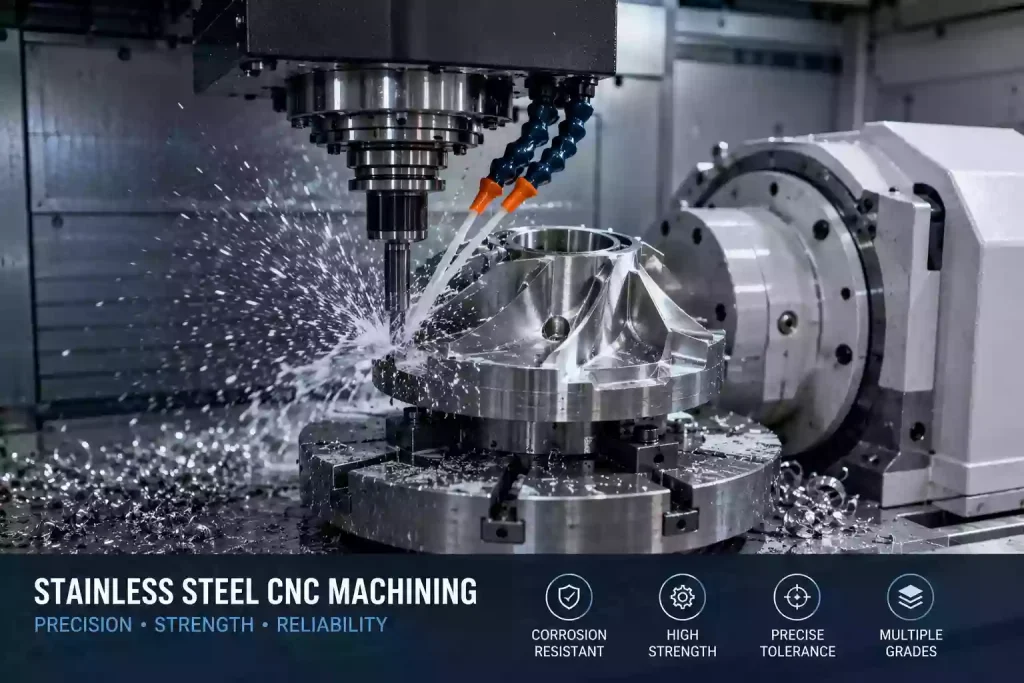
Stainless steel is not a single material choice, but a broad family of engineered alloys designed to perform under different mechanical, thermal, and corrosive conditions. In CNC machining, its performance is largely defined by its metallurgical composition—particularly elements such as chromium, nickel, and molybdenum—which directly influence corrosion resistance, strength, and cutting behavior.
From a manufacturing perspective, stainless steel selection is not simply about choosing the strongest or most corrosion-resistant grade. It is a trade-off between four critical factors: corrosion resistance, mechanical strength, machinability, and total production cost. A material optimized for harsh marine environments may introduce excessive tool wear and machining difficulty, while a highly machinable grade may not provide sufficient long-term durability in corrosive or high-load applications.
This guide breaks down the key stainless steel families and commonly used grades in CNC machining. It also explains how different metallurgical structures—such as austenitic, martensitic, and duplex phases—affect machining performance, cost efficiency, and final part reliability, providing a practical framework for selecting the most suitable alloy based on both functional requirements and manufacturability.
Understanding the Five Families of Stainless Steel
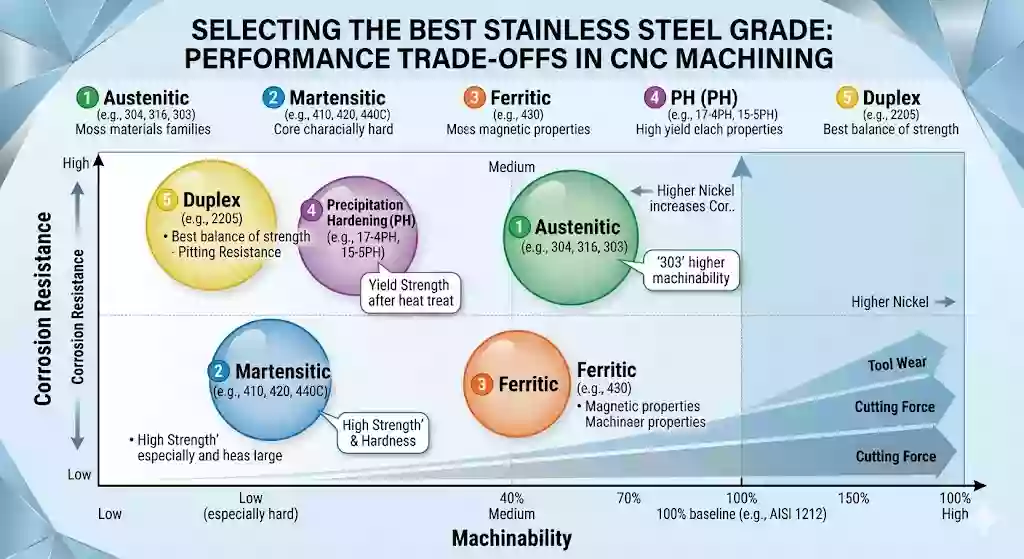
To select the correct grade, one must first understand the metallurgical structure of the alloy. Stainless steels are categorized into five primary families based on their crystalline structure, which is determined by their chemical composition—specifically the balance of ferritizers (like chromium) and austenitizers (like nickel).
Austenitic Stainless Steel (300 Series)
Austenitic grades are the most widely used stainless steels in CNC machining. Their structure is stabilized by high nickel and chromium content, making them non-magnetic and exceptionally corrosion-resistant.
- Engineering Characteristics: Excellent toughness and ductility across a wide temperature range. Typical grades include 304, 316, and the free-machining 303.
- Machining Logic: These alloys have a high work-hardening rate. When the cutting tool deforms the surface, the material grain structure compresses and hardens significantly. This requires rigid setups, sharp tooling, and constant feed rates to prevent the tool from “glazing” the surface rather than cutting it.
- Best Use: General industrial components, medical devices, and food processing equipment.
Martensitic Stainless Steel (400 Series)
Martensitic steels are characterized by higher carbon content and lower chromium compared to the 300 series. This specific chemistry allows them to be hardened through heat treatment (quenching and tempering).
- Engineering Characteristics: High strength and superior hardness. They are magnetic and offer moderate corrosion resistance. Typical grades include 410, 420, and 440C.
- Machining Logic: In their annealed state, they machine similarly to high-carbon alloys. However, once heat-treated to higher Rockwell hardness, they become abrasive, requiring specialized carbide tooling and reduced cutting speeds to manage tool wear.
- Best Use: Cutting tools, high-wear shafts, and precision mechanical fasteners.
Ferritic Stainless Steel
Ferritic alloys maintain a “body-centered cubic” (BCC) grain structure. They are high in chromium but contain very little nickel, making them a cost-effective alternative for certain environments.
- Engineering Characteristics: Good resistance to stress corrosion cracking and oxidation. They are magnetic and common in automotive applications (e.g., Grade 430).
- Machining Logic: While easier to machine than austenitic grades due to lower work-hardening, they can produce “stringy” chips. Optimized chip-breaker geometries are essential to prevent bird-nesting around the spindle.
- Best Use: Automotive trim, industrial housings, and appliance components.
Precipitation Hardening (PH) Stainless Steel
PH grades are chromium-nickel alloys that include elements like copper or aluminum to allow for “age hardening.”
- Engineering Characteristics: They offer a unique combination of austenitic-level corrosion resistance and martensitic-level strength. Typical grades include 17-4 PH and 15-5 PH.
- Machining Logic: These materials are typically machined in a solution-treated (Condition A) state, where they are relatively soft. After machining, they undergo a low-temperature aging process, which achieves high mechanical properties with minimal dimensional distortion or scaling.
- Best Use: Aerospace components and high-load structural parts.
Duplex Stainless Steel
Duplex alloys feature a balanced microstructure of approximately 50% austenite and 50% ferrite.
- Engineering Characteristics: They provide nearly double the yield strength of austenitic steels and superior resistance to localized corrosion (pitting). The most common grade is 2205 Duplex.
- Machining Logic: Due to their high yield strength and low thermal conductivity, Duplex grades require significantly higher cutting forces. They are prone to rapid tool edge degradation if high-pressure cooling and high-performance coatings are not utilized.
- Best Use: Offshore oil and gas, chemical processing, and marine systems.
Key Factors for Material Selection: An Engineering Framework
Choosing a stainless steel grade is a balance between functional performance and manufacturing feasibility. In practice, material selection is determined by a combination of environmental conditions, mechanical requirements, and process constraints rather than a single property.
The following five factors represent the core engineering considerations used in stainless steel selection.
Corrosion Environment
Corrosion resistance is the primary reason stainless steel is selected, but its performance varies significantly depending on the environment.
For indoor or mildly corrosive conditions, Grade 304 is generally sufficient, offering reliable resistance to oxidation and common atmospheric corrosion.
In chloride-rich environments such as marine or offshore applications, localized corrosion (pitting) becomes a major risk. Grade 316 improves resistance due to its molybdenum content (2–3%), while Duplex 2205 is often used in more aggressive environments where higher resistance to pitting is required.
In chemical processing environments, selection depends on acid or alkali concentration, temperature, and exposure duration. In these cases, higher-alloy stainless steels or specialized grades may be required to prevent localized or intergranular corrosion.
Mechanical Strength and Hardness
Mechanical performance requirements vary depending on whether the part is load-bearing, wear-prone, or both.
For structural or high-load components, precipitation-hardening steels such as 17-4 PH are commonly used due to their high tensile strength after heat treatment.
For wear-critical components, hardness becomes the dominant factor. Grades such as 440C can reach high hardness levels after heat treatment, making them suitable for applications involving friction, cutting, or repetitive contact.
For ductility-driven applications, austenitic grades (such as 304 and 316) remain preferred due to their ability to deform without fracture, especially in impact or forming conditions.
Operating Temperature and Stability
Temperature has a direct impact on both mechanical stability and corrosion behavior.
In cryogenic environments, austenitic stainless steels maintain toughness and avoid brittle fracture, making them suitable for low-temperature applications.
In high-temperature environments, prolonged exposure can lead to scaling or reduced corrosion resistance. Stabilized grades such as 321 or 310 are designed to maintain performance under thermal stress by improving resistance to carbide precipitation and oxidation.
Surface Finish and Functional Requirements
Surface requirements often influence both material choice and post-processing strategy.
In medical, pharmaceutical, or semiconductor applications, surface cleanliness is critical. Low-carbon grades such as 316L are commonly used because they support passivation and electropolishing processes, enabling smoother and more stable surface conditions.
For non-functional or aesthetic components, ferritic stainless steels can achieve acceptable surface finishes at lower material cost, making them suitable for decorative or consumer-facing applications.
Magnetic Requirements
Magnetic behavior can be a critical constraint in electronic, sensing, or medical applications.
Austenitic stainless steels such as 304 and 316 are generally non-magnetic in the annealed state. However, cold working or heavy machining can introduce slight magnetic response.
Ferritic and martensitic grades are inherently magnetic due to their crystal structure. These materials are selected when magnetic response is required or when non-magnetic behavior is not a design constraint.
Machinability and Its Direct Impact on Production Cost
In CNC machining, material cost is not defined by raw stock price alone. A more accurate measure is machinability—how efficiently a material can be cut while maintaining tool life, surface quality, and dimensional stability.
For stainless steel, machinability is generally lower than aluminum or carbon steel due to higher cutting resistance, poor heat dissipation, and a strong tendency toward work hardening.
Machinability Rating of Common Stainless Steels
Machinability is often compared against AISI 1212 steel (100% baseline).
- 303 Stainless Steel (~75–80%)
Sulfur improves chip breaking and reduces cutting resistance, making it suitable for high-volume CNC turning and cost-sensitive parts. - 304 Stainless Steel (~45%)
A general-purpose grade with strong work-hardening behavior, requiring more stable cutting conditions and lower feed tolerance. - 316 Stainless Steel (~35%)
Higher toughness and molybdenum content improve corrosion resistance but significantly reduce machinability and increase tool wear.
Work Hardening and Process Stability
Austenitic stainless steels such as 304 and 316 tend to harden during machining. When the cutting tool compresses the material surface, the grain structure deforms and increases in hardness ahead of the tool path.
If cutting conditions are unstable—such as low feed rate or tool dwell—the surface can harden faster than it is being removed. This leads to accelerated tool wear, poor surface finish, and in some cases tool failure.
For this reason, stable chip load and continuous cutting engagement are critical in stainless steel machining.
Heat Management and Tool Wear
Stainless steel has low thermal conductivity, meaning heat is not effectively dissipated through the material. Instead, most heat concentrates at the tool–chip interface.
This can lead to:
- Built-up edge (BUE) formation on cutting tools
- Accelerated tool wear
- Surface finish instability
To control this, machining typically requires high-performance carbide tooling, coated inserts, and high-pressure coolant systems. These factors directly contribute to overall production cost.
Machining Time vs. Total Cost
While raw material cost differences between aluminum and stainless steel are relatively small, machining time can vary significantly.
For example:
- Aluminum (6061): faster cutting speeds, shorter cycle time
- Stainless steel (316L): slower cutting speeds, higher tool wear, longer cycle time
In many cases, stainless steel parts can require 2–3 times more machining time compared to aluminum components of similar geometry.
Design Sensitivity and Cost Impact
Part geometry has a strong influence on machining cost when using stainless steel.
Features such as deep holes, thin walls, or tight internal corners increase tool load and reduce machining efficiency. In these cases, selecting a free-machining grade such as 303 or 416 can significantly reduce total production cost, even if raw material price is slightly higher.
In practical manufacturing, material selection is often less about unit price and more about total machining efficiency.
High-Performance Stainless Steel Grades: A Technical Deep Dive
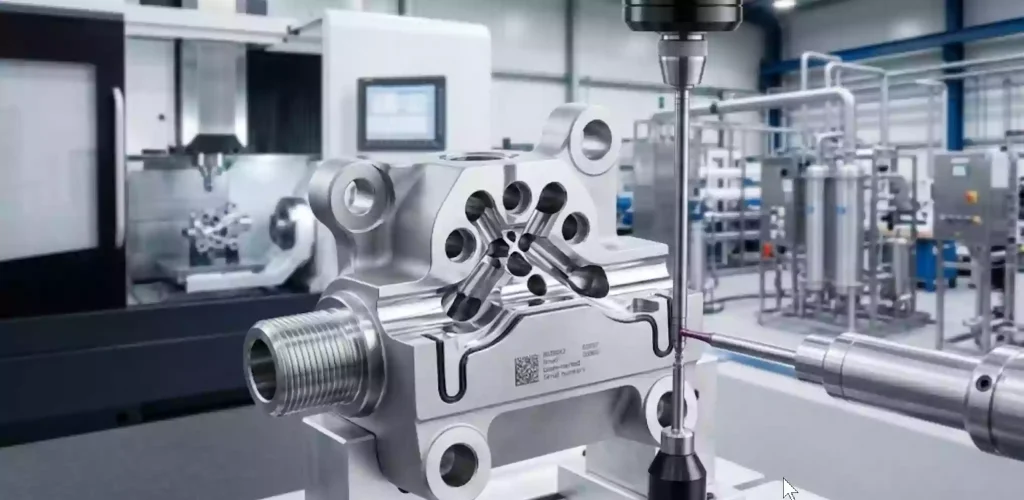
In CNC machining, stainless steel selection is not a question of material quality, but of balancing machinability, corrosion resistance, and mechanical performance. Each grade represents a different trade-off between production efficiency and service environment.
The 300 Series Trade-Off: 303 vs 304 vs 316
These three grades account for most stainless steel machining applications. The decision typically comes down to machining efficiency versus environmental resistance.
Grade 303 — Machining Efficiency Priority
303 is designed for production efficiency. The addition of sulfur modifies chip formation, allowing material to break cleanly during cutting.
It is typically selected when reducing cycle time and tool wear has a greater impact on cost than maximum corrosion resistance.
However, this same modification reduces structural integrity and makes it unsuitable for welded or high-pressure applications.
Grade 304 / 304L — General Engineering Standard
304 is the baseline stainless steel used across most industrial applications. Compared to 303, it is more resistant to corrosion but significantly more difficult to machine due to work hardening behavior.
304L is used when welding is required. Its lower carbon content prevents carbide formation in the heat-affected zone, maintaining corrosion resistance at the joint.
Grade 316 / 316L — Corrosion-Driven Selection
316 introduces molybdenum to improve resistance to chlorides and chemical attack, making it suitable for marine and aggressive environments.
The performance gain comes with higher machining cost. Compared to 304, cutting speeds are typically reduced due to increased tool wear and heat concentration at the cutting zone.
High-Strength and Wear-Focused Grades
When mechanical performance exceeds the limits of austenitic steels, martensitic or precipitation-hardening grades are used.
17-4 PH — Strength After Machining
17-4 PH is widely used in aerospace and structural applications due to its ability to be machined in a soft state and hardened after machining through aging.
This separation between machining and final strength treatment minimizes dimensional distortion, making it suitable for precision components requiring high strength.
420 / 440C — Hardness and Wear Resistance
These grades prioritize hardness over corrosion resistance. After heat treatment, 440C can reach very high hardness levels, making it suitable for bearings and cutting applications.
The trade-off is reduced corrosion resistance and increased brittleness compared to 300 series alloys.
Duplex 2205 — Strength + Corrosion Balance
Duplex stainless steel combines austenitic and ferritic structures, resulting in significantly higher yield strength than 316L.
This allows for lighter designs under the same load conditions, but the high strength and low thermal conductivity increase cutting forces and tool wear, making it one of the more challenging stainless steels to machine.
Cost Optimization Strategies for Stainless Steel Machining
Stainless steel machining cost is influenced not only by material price but also by machining time, tool wear, and process complexity. For most CNC projects, engineering decisions made during the design stage have the greatest impact on final cost. In many cases, optimized design choices can reduce total manufacturing cost by 20–40% without affecting functional performance.
Material Substitution Strategy
One of the most effective cost reduction methods is selecting a more machinable grade when high-end material properties are not strictly required.
- 303 vs. 304
When welding capability and maximum corrosion resistance are not critical, 303 stainless steel offers significantly better machinability due to improved chip breaking. This typically reduces machining time by up to 30%. - 300 Series vs. 400 Series
For internal mechanical components where appearance and extreme corrosion resistance are not primary concerns, certain 400-series grades can provide lower material cost and improved machinability compared to austenitic steels.
Tolerance Control and Cost Relationship
Tight tolerances have a direct and often non-linear impact on machining cost, especially in stainless steel.
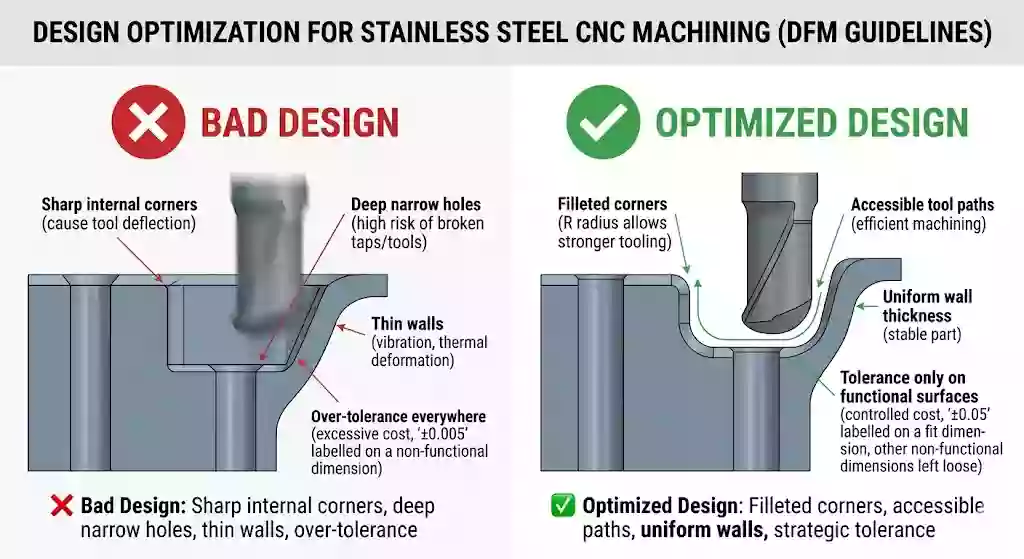
Because stainless steel is sensitive to heat generation and work hardening, maintaining tolerances tighter than ±0.005 mm requires slower finishing passes, tool compensation, and more frequent inspection.
During long machining cycles, both the workpiece and machine components undergo thermal expansion. This “heat drift” must be compensated through controlled machining strategies, which increases production time.
A practical engineering approach is to apply tight tolerances only to functional interfaces such as sealing surfaces, bearing seats, or alignment features, while relaxing non-critical dimensions to improve machining efficiency.
DFM (Design for Manufacturing) Guidelines
Design optimization is one of the most effective ways to control cost in stainless steel machining.
- Increase Internal Radii
Larger internal radii allow the use of stronger cutting tools with higher rigidity, reducing tool deflection and breakage risk. Small radii significantly increase machining difficulty and cost. - Control Thread Depth
Thread depth greater than 2× the nominal diameter increases tap load and risk of tool failure. In stainless steel, thread milling is often preferred over tapping for deeper or high-precision threads. - Avoid Thin-Wall Structures
Thin walls are prone to vibration and thermal deformation during machining. This can lead to poor surface finish and dimensional instability.
Geometry Optimization for Reduced Machining Time
In stainless steel machining, material removal time is often a major cost driver.
Designs that closely match the raw stock shape reduce cutting time and tool wear. Excessive material removal significantly increases cycle time, especially in harder grades like 316 or duplex stainless steels.
Although 5-axis CNC machining allows complex geometries, every additional toolpath complexity increases machining time and cost. Where possible, consolidating features into fewer setups or simplifying tool access can significantly improve efficiency.
How to Verify Quality Before Selecting a Stainless Steel Grade
When selecting a stainless steel grade for CNC machining, material performance alone is not enough. Verification of quality and consistency is a key step in ensuring the selected material behaves as expected in production.
Check Material Consistency Before Committing
Even within the same grade (such as 304 or 316), variations in composition between suppliers or batches can affect corrosion resistance and machining behavior.
Before finalizing material selection, it is important to confirm that the material conforms to the required specification.
Confirm Traceability for Critical Applications
For applications in aerospace, medical, or industrial systems, traceability ensures that the selected material matches the certified chemical composition and mechanical properties.
This reduces the risk of unexpected performance variation during machining or in service conditions.
Validate Dimensional Stability Expectations
Stainless steel can respond differently during machining due to internal stress and work hardening behavior.
Understanding how a material behaves during cutting helps prevent issues such as dimensional drift or inconsistent surface quality after production.
Align Material Selection with Industry Requirements
In regulated industries, material selection is often constrained by compliance requirements.
Ensuring the chosen grade meets relevant material and safety standards helps avoid downstream approval or qualification issues.
Common Engineering Mistakes in Stainless Steel Selection
Even experienced engineers can misjudge stainless steel selection, leading to unnecessary cost increases or manufacturing issues. Most problems come not from material limitations, but from design assumptions that do not reflect real machining behavior.
Over-specifying corrosion resistance
One of the most common mistakes is defaulting to Grade 316 for all environments. While it offers improved chloride resistance, it often provides no functional advantage in dry or controlled environments compared to 304, while significantly increasing machining cost.
Ignoring work hardening behavior
Austenitic grades like 304 and 316 harden rapidly under cutting stress. Deep slots, tight internal features, or interrupted cuts can cause localized hardening if tool engagement is not properly considered, increasing tool wear and risk of failure.
Over-tolerancing non-functional features
Applying tight tolerances across all surfaces significantly increases machining time. In stainless steel, maintaining ±0.005 mm requires slower feed rates, additional tool compensation, and more frequent inspection.
Poor heat treatment planning
High-hardness grades such as 17-4 PH and 440C should be machined in their softer condition before heat treatment. Attempting complex machining after hardening greatly increases cost and risk.
Quick Selection Matrix: Grade vs Application
Material selection becomes faster when simplified into functional priorities rather than chemistry alone.
| Project Priority | Recommended Grade | Engineering Reason |
| Lowest machining cost | 303 | Free-machining sulfur improves chip breaking |
| General purpose | 304 / 304L | Balanced corrosion resistance and cost |
| Marine / chloride resistance | 316 / 316L | Molybdenum improves pitting resistance |
| High strength components | 17-4 PH | Precipitation hardening enables high yield strength |
| Wear resistance | 440C | High carbon content enables maximum hardness |
| Welded structures | 304L / 316L | Low carbon reduces intergranular corrosion |
| Magnetic applications | 430 / 410 | Ferritic / martensitic structure provides magnetism |
| Chemical / offshore | Duplex 2205 | High strength + corrosion resistance balance |
Conclusion: From Material Selection to Manufacturing Reality
Stainless steel selection in CNC machining is not determined by material strength alone, but by how the alloy behaves during manufacturing and in its final application environment.
Austenitic grades offer versatility and corrosion resistance but introduce machining challenges such as work hardening. Martensitic and precipitation-hardened steels provide significantly higher strength, but require controlled process sequencing to avoid excessive tool wear or post-processing complexity. Duplex grades provide a balanced alternative where both mechanical and chemical resistance are required.
In practical engineering terms, the optimal choice is the material that satisfies functional requirements while minimizing machining inefficiency and unnecessary process complexity.
When selection is aligned with real manufacturing constraints—such as geometry, tolerance demand, and post-processing requirements—the result is a more stable production process, lower total cost, and more reliable final performance.