
The Complete Guide to 5-Axis CNC Machining
5-axis CNC machining has become one of the most powerful manufacturing technologies for producing complex, high-precision parts. Compared to traditional 3-axis or 4-axis machining, a 5-axis CNC machine can move a cutting tool or workpiece along five different axes at the same time, allowing manufacturers to machine multiple faces, angles, and contours in a single setup.
As part designs become more complex and tolerances tighter, many shops begin to ask the same questions:
What exactly is 5-axis machining? How does it work? What types of 5-axis machines are available? How much does a 5-axis CNC machine cost? And when does it actually make sense to use one?
This guide answers all of those questions—clearly and practically. We’ll explain how 5-axis CNC machining works, break down the main machine types, discuss pricing and setup considerations, and outline the real advantages and limitations. Whether you’re evaluating 5-axis machining for your shop or considering it for a specific part, this article will help you understand when—and why—5-axis machining is the right solution.
What Is 5-Axis CNC Machining?
5-axis CNC machining is an advanced manufacturing process that allows a cutting tool or workpiece to move along five different axes simultaneously. In addition to the three linear axes (X, Y, and Z), a 5-axis CNC machine includes two rotational axes, enabling the tool to approach the part from almost any direction.
Compared to traditional 3-axis machining, 5-axis machining makes it possible to produce complex geometries, angled features, and contoured surfaces in a single setup. This reduces repositioning, improves accuracy, and significantly shortens production time—especially for high-precision parts.
Understanding the Five Axes
In a standard CNC machine, the tool moves along three linear axes:
- X-axis: left and right movement
- Y-axis: front and back movement
- Z-axis: up and down movement
A 5-axis CNC machine adds two rotational axes, commonly referred to as A, B, or C, depending on the machine configuration. These rotary axes tilt or rotate either the cutting tool or the workpiece, allowing the tool to maintain the optimal cutting angle throughout the operation.
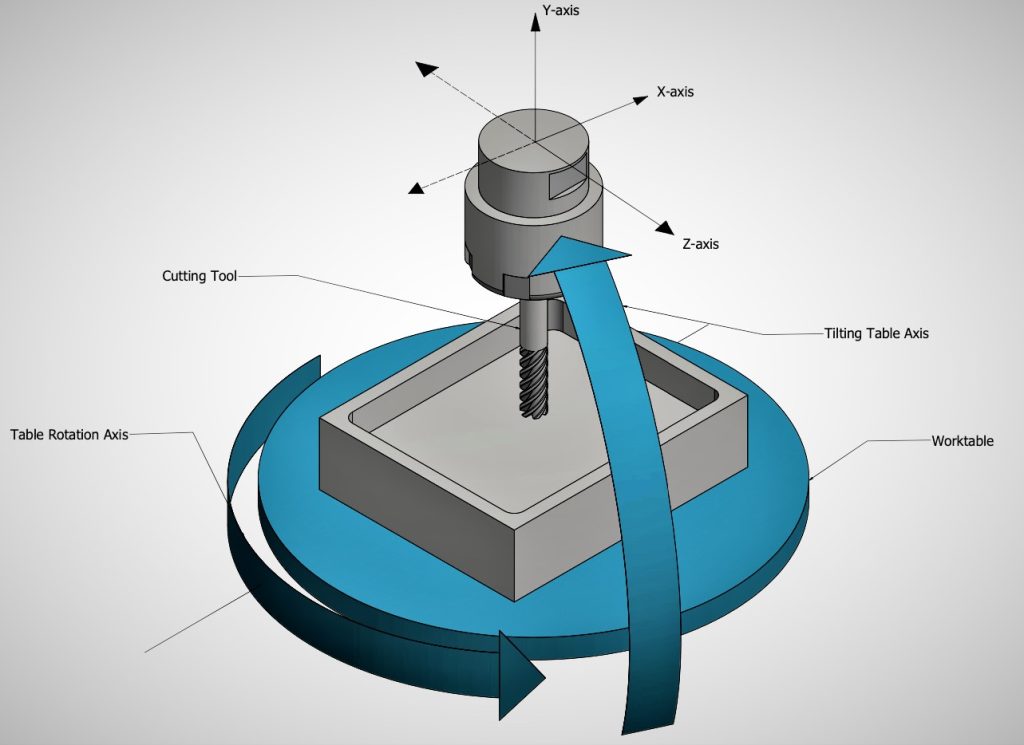
Because of this additional movement, 5-axis machines can reach features that would otherwise require multiple setups or custom fixtures on a 3-axis machine.
Simultaneous 5-Axis vs 3+2 Machining
Not all 5-axis machining is the same. There are two common approaches:
Simultaneous 5-axis machining
All five axes move at the same time during cutting. This method is ideal for complex free-form surfaces, deep cavities, and smooth contours, such as turbine blades or medical implants.
3+2 (positional) machining
The machine positions the part using two rotary axes, then performs cutting using three linear axes. While the axes do not move simultaneously during cutting, this method still reduces setups and improves access to difficult angles.
Many shops use 3+2 machining as a practical entry point into 5-axis CNC machining, while full simultaneous 5-axis machining is typically reserved for highly complex or high-precision components.
Why 5-Axis Machining Is Different from 3-Axis and 4-Axis
The key difference is tool orientation control. With 5-axis machining, the cutting tool can maintain the best possible angle relative to the surface being machined. This leads to:
- Better surface finish
- Shorter cutting tools and reduced vibration
- Higher accuracy across multiple faces
- Fewer setups and less accumulated error
These advantages make 5-axis CNC machining especially valuable for parts that demand tight tolerances, complex geometry, or high-quality surface finishes.
Summary
In simple terms, 5-axis CNC machining expands what is possible with conventional CNC technology. By adding two rotational axes, manufacturers gain greater flexibility, precision, and efficiency—making it a powerful solution for complex, high-value parts.
How Does a 5-Axis CNC Machine Work?
A 5-axis CNC machine works by coordinating linear and rotary movements to control the position and orientation of the cutting tool relative to the workpiece. Unlike 3-axis machining—where the tool approaches the part from a fixed direction—5-axis machining allows the tool to tilt and rotate during cutting, maintaining the optimal angle throughout the operation.
This ability to control tool orientation is what enables 5-axis CNC machines to machine complex shapes, deep cavities, and multi-sided features efficiently and accurately.
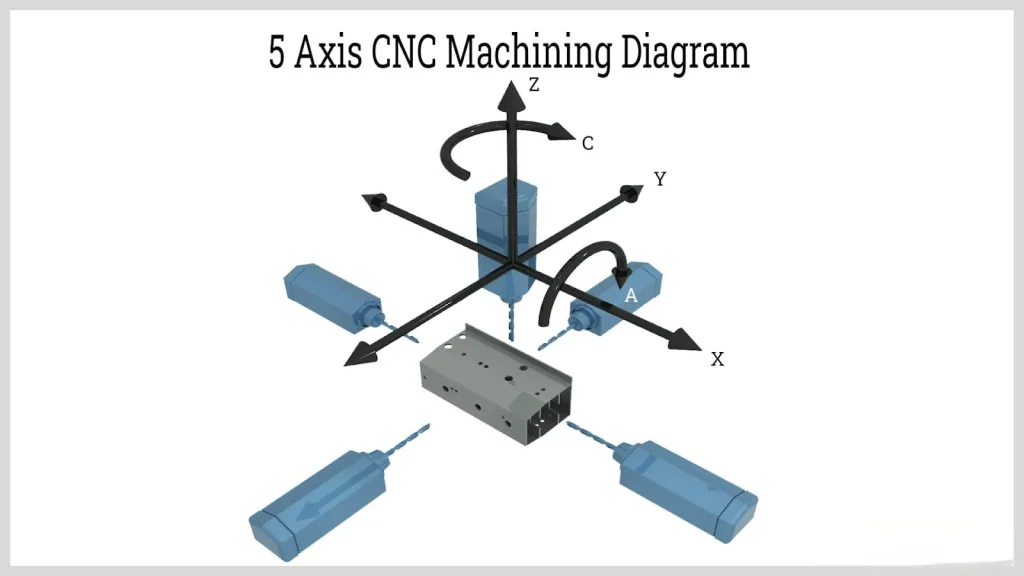
Linear and Rotary Motion Working Together
In a 5-axis CNC system, the three linear axes (X, Y, and Z) handle basic positioning, while two rotary axes tilt or rotate either the tool head or the workpiece. These movements are precisely synchronized by the CNC controller, allowing continuous and smooth toolpaths.
By combining linear and rotary motion, the machine can reach difficult angles without repositioning the part, reducing setup time and minimizing alignment errors.
The Role of the CNC Controller
The CNC controller is responsible for managing all axis movements in real time. It interprets toolpaths generated by CAM software and ensures that:
- All five axes move in coordination
- Feed rates remain consistent across complex geometry
- Tool orientation stays within safe limits
- Axis limits and collisions are avoided
Advanced controllers such as Fanuc, Siemens, and Heidenhain are commonly used in 5-axis CNC machines due to their ability to handle high-speed, multi-axis interpolation.
CAM Software and Toolpath Generation
5-axis machining relies heavily on CAM software to generate accurate and safe toolpaths. The CAM system calculates not only where the tool should cut, but also how the tool should be angled at every point along the path.
Key CAM functions for 5-axis machining include:
- Automatic tool orientation control
- Collision detection and avoidance
- Tool length and holder management
- Simulation and verification before machining
Without proper CAM programming and simulation, 5-axis machining can increase the risk of tool collisions or scrap parts.
Why Simulation Is Critical in 5-Axis Machining
Because multiple axes move at the same time, 5-axis machining introduces more potential for interference between the tool, holder, workpiece, and machine components. For this reason, simulation is considered a standard requirement—not an optional step.
Accurate simulation helps manufacturers verify toolpaths, identify collisions, and optimize cutting strategies before running the program on the machine, reducing downtime and protecting expensive equipment.
Summary
A 5-axis CNC machine works by combining linear motion, rotary motion, advanced control systems, and CAM-generated toolpaths to machine complex parts efficiently in fewer setups. This coordinated approach is what separates 5-axis machining from traditional CNC processes.
Types of 5-Axis CNC Machines
Not all 5-axis CNC machines are built the same. While they all provide five-axis movement, the way those axes are configured can significantly affect machine performance, part size capability, accuracy, and cost. Understanding the main types of 5-axis CNC machines helps manufacturers choose the right solution for their specific applications.
Trunnion Table 5-Axis Machines
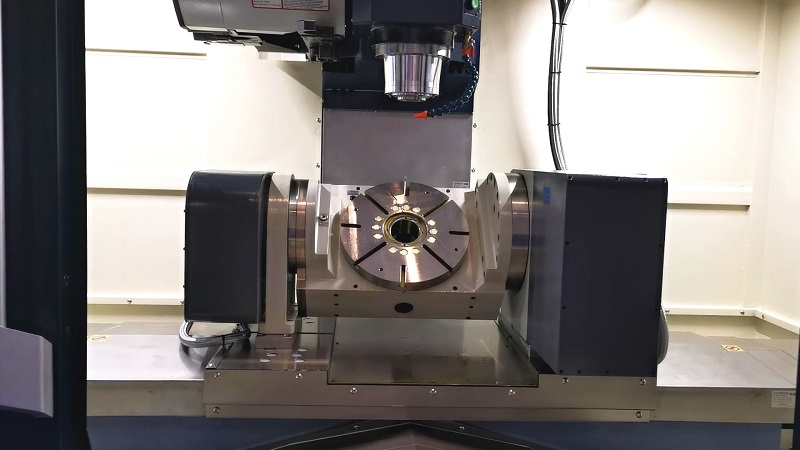
A trunnion-style 5-axis CNC machine uses a tilting rotary table, typically providing rotation around the A and B axes. The workpiece is mounted on the table, while the cutting tool remains fixed in orientation.
Key advantages:
- Excellent rigidity and accuracy
- Stable cutting conditions
- Generally more cost-effective than head-type machines
Limitations:
- Workpiece size is limited by table dimensions
- Rotary axis travel may restrict certain geometries
Trunnion machines are commonly used for aerospace components, medical parts, and precision mechanical components where accuracy is critical.
Rotary Table (C-Axis) 5-Axis Machines
In this configuration, the machine features a rotary table that spins around a single axis—usually the C-axis—combined with a tilting mechanism. The workpiece rotates while the tool approaches from different angles.
Key advantages:
- Good accessibility for multi-sided machining
- Suitable for smaller to medium-sized parts
Limitations:
- Less flexible than full trunnion or head-based designs
- May require more careful fixture planning
This type is often found in compact 5-axis machining centers designed for high-precision, smaller parts.
Swivel Head (Tilting Head) 5-Axis Machines
Swivel head machines tilt and rotate the spindle head instead of the table. The workpiece remains stationary, while the cutting tool moves around it.
Key advantages:
- Ideal for large or heavy workpieces
- Better access to deep cavities and complex angles
- Fewer restrictions on part size
Limitations:
- Higher machine cost
- More complex mechanical design
- Requires advanced programming and collision control
Swivel head 5-axis machines are widely used in aerospace, mold and die manufacturing, and large structural components.
Which 5-Axis Machine Type Is Right for You?
Choosing the right 5-axis CNC machine depends on several practical factors:
- Part size and weight
- Required accuracy and surface finish
- Complexity of part geometry
- Production volume
- Available budget and floor space
For many shops, trunnion-style machines offer the best balance of performance and cost. For larger or more complex parts, swivel head machines may be the better long-term investment.
Summary
While all 5-axis CNC machines provide enhanced flexibility compared to 3-axis systems, their configurations can vary significantly. Understanding these differences is essential when evaluating machine capabilities, cost, and suitability for specific applications.
How Much Does a 5-Axis CNC Machine Cost?
| Machine Type | Typical Use | Advantages | Price Range |
| Trunnion Table | Aerospace, medical, precision parts | High rigidity, accurate, cost-effective | $–$$$ |
| Rotary Table (C-Axis) | Small to medium-sized parts | Multi-sided machining, compact | $–$$ |
| Swivel Head (Tilting Head) | Large or heavy parts, molds, deep cavities | Excellent accessibility, flexible angles | $$$–$$$$ |
Key Factors Affecting Cost:
- Machine type and configuration
- CNC controller (Fanuc, Siemens, Heidenhain)
- Spindle power, accuracy, and travel size
- Optional automation: pallet changers, tool management
Hidden Costs to Consider:
- CAM software and post-processors
- Operator training and programming
- Specialized fixtures and cutting tools
- Regular maintenance and calibration
Summary:
5-axis CNC machines are a significant investment, but for complex parts with tight tolerances, multi-sided features, or high-quality surface requirements, they can save setup time, improve accuracy, and increase production efficiency—often making the investment worthwhile.
How to Set Up a 5-Axis CNC Machine
Proper setup is crucial for 5-axis machining. Because the machine moves along five axes, even small mistakes in workholding, tool setup, or calibration can cause collisions, scrap parts, or poor surface finish.
1. Workholding and Fixturing
Secure your part on the machine table or fixture. Common solutions include tombstones, zero-point systems, or custom clamps. Make sure the part is stable while allowing access for all axes to reach the required features.
2. Tool Setup
Measure and install your cutting tools carefully. Use presetting devices or probes to ensure correct tool length and diameter. Keep a well-organized tool library in your CAM system to maintain consistency and reduce errors.
3. Work Offsets and Machine Calibration
Define the part’s coordinate system accurately. Use probing cycles to set reference points, and make sure the rotary axes are properly calibrated to avoid errors during machining.
4. Simulation and Verification
Always simulate the toolpath before cutting. Check for collisions, over-travel, and tool gouging. Verify that the cutting tool maintains the correct orientation and feed rate throughout the operation.
Quick Tips for Efficient Setup
- Plan your fixtures with all five axes in mind
- Keep tool lengths as short as practical to reduce vibration
- Double-check rotary axis rotation limits and clearance
- Always run a full CAM simulation before machining
Summary
A careful, step-by-step setup ensures part quality, reduces scrap, and maximizes the advantages of 5-axis machining. Skipping or rushing setup can lead to costly mistakes and downtime.
Advantages & Limitations of 5-Axis CNC Machining
5-axis CNC machining offers many benefits over traditional 3-axis systems, but it also has some limitations. Understanding both helps you make informed decisions for your shop or part design.
| Advantages | Limitations |
| Fewer Setups: Machine multiple faces in a single setup, reducing time and errors. | Higher Initial Cost: 5-axis machines require a larger upfront investment compared to 3-axis machines. |
| Improved Accuracy: Less repositioning reduces cumulative errors and maintains tight tolerances. | Programming Complexity: Toolpaths for 5-axis require advanced CAM software and skilled programmers. |
| Better Surface Finish: Optimal tool orientation improves surface quality and reduces tool marks. | Operator Skill Required: Operators must be trained to handle five-axis movements and machine calibration. |
| Shorter Lead Times: Complex parts can be machined more quickly with fewer setups. | Maintenance Needs: Rotary axes and complex kinematics require regular inspection and calibration. |
| Longer Tool Life: Proper cutting angles reduce wear and vibration, extending tool life. | Not Always Necessary: For simple parts, 3-axis or 3+2 setups may be more cost-effective. |
When to Use 5-Axis Machining
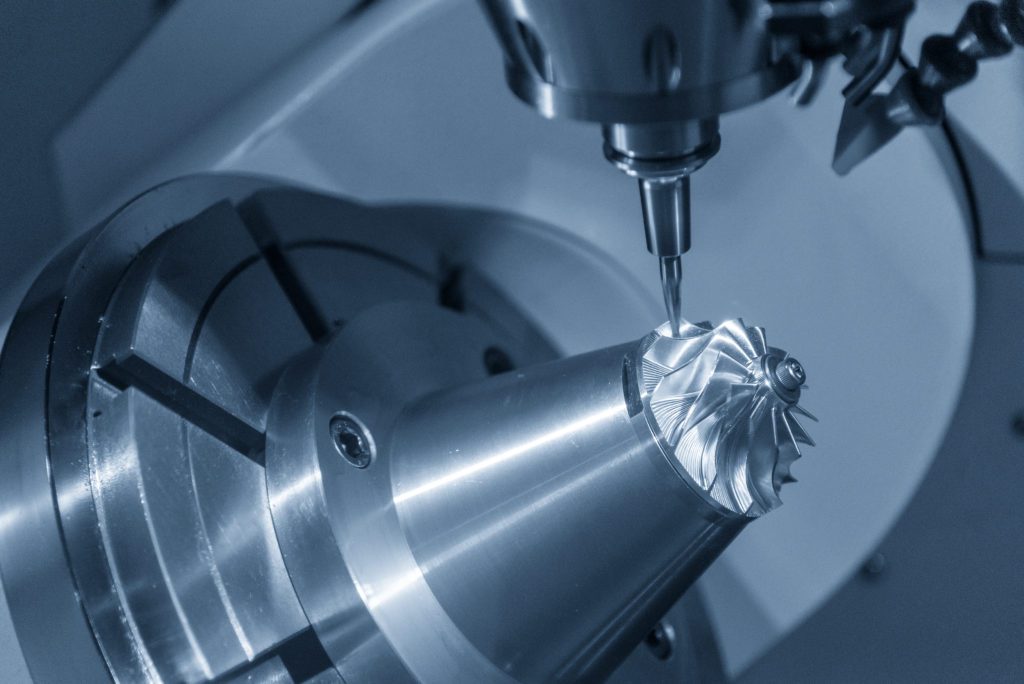
5-axis CNC machining is most beneficial for parts that are complex, multi-faceted, or require tight tolerances. It excels when traditional 3-axis or 4-axis setups would require multiple repositioning steps, which can introduce errors and increase production time.
This technology is particularly useful for components with deep cavities, angled features, or curved surfaces that are difficult to reach with a fixed cutting tool. Industries such as aerospace, medical devices, automotive performance parts, and mold and die manufacturing often rely on 5-axis machining to achieve high precision and superior surface finishes.
Even for smaller shops, 5-axis machining can be the right choice for low- to medium-volume parts that would otherwise require multiple setups on a 3-axis machine. By reducing the number of setups, manufacturers can improve accuracy, shorten lead times, and decrease the risk of part damage or scrap.
However, 5-axis machining is not necessary for every part. Simple prismatic parts, components with only flat surfaces, or high-volume production of repetitive shapes may still be more efficiently produced on 3-axis or 3+2 machines. Evaluating the geometry, tolerance requirements, and production goals of your parts will help determine whether investing in 5-axis machining—or outsourcing to a 5-axis service—is the best approach.
Incorporate 5-Axis Machining in Your Shop
Adding 5-axis CNC machining to your shop can unlock faster production, higher precision, and the ability to handle complex parts. Start by identifying components limited by 3-axis setups, such as parts with multiple faces, angled features, or tight tolerances.
Choose a machine type that fits your needs and budget—trunnion table machines work well for high-accuracy smaller parts, while swivel head machines handle larger or heavier components. Proper training and CAM programming are essential to get the most out of 5-axis machining.
If investing in a machine isn’t feasible, outsourcing complex parts to a 5-axis service provider is a practical way to gain the benefits without the upfront cost. With careful planning, 5-axis machining can enhance your capabilities and streamline production.