
3-Axis CNC Machining: How It Works, Applications & 5-Axis Comparison (2026 Guide)
3-axis CNC machining is a computer-controlled manufacturing process that moves a cutting tool along three linear axes—X, Y, and Z—to remove material and shape a part. It is the most widely used CNC machining method for producing flat, prismatic, and moderately complex components across industries such as automotive, aerospace, electronics, and medical manufacturing.
Although advanced multi-axis systems are becoming more common, 3-axis machining remains the backbone of modern production due to its cost efficiency, programming simplicity, and reliable precision. From rapid prototyping to low- and medium-volume production, it provides an ideal balance between performance and affordability.
In this complete guide, you will learn how the 3-axis machining process works, what types of parts it can produce, its advantages and limitations, and how it compares to 4-axis and 5-axis CNC machining—so you can determine when 3-axis machining is the right solution for your project.
What Is 3-Axis CNC Machining?
3-axis CNC machining is a subtractive manufacturing process in which a rotating cutting tool removes material from a stationary workpiece along three linear directions: X, Y, and Z. These three axes allow the tool to move left-to-right, front-to-back, and up-and-down, enabling the production of flat surfaces, slots, pockets, and drilled holes with high precision.
Unlike manual milling, 3-axis CNC machining relies on computer numerical control (CNC) to execute programmed toolpaths. Engineers first create a digital model using CAD software, then generate machining instructions (G-code) through CAM software. The CNC machine interprets this code and performs automated material removal with consistent accuracy.
Because the cutting tool can only move in three linear directions, 3-axis machining is best suited for parts that can be accessed from a single setup or require machining primarily on one side at a time. While it cannot efficiently produce complex undercuts or multi-angle surfaces like 5-axis systems, it remains the most economical and widely used configuration in machine shops worldwide.
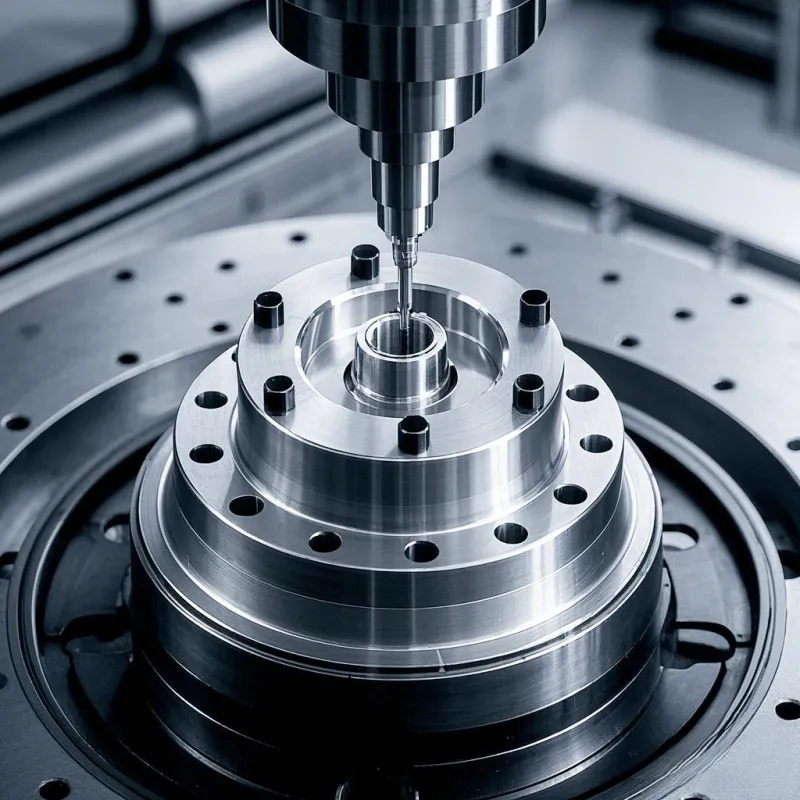
How 3-Axis CNC Machines Work
Understanding how a 3-axis CNC machine operates requires looking at both its motion system and its digital workflow. The machining process combines controlled mechanical movement with precise software-driven toolpaths to remove material efficiently and accurately.
Understanding the X, Y, and Z Axes
A 3-axis CNC machine operates along three linear directions:
X-axis – Moves the cutting tool (or table) left to right
Y-axis – Moves front to back
Z-axis – Moves vertically up and down
These three axes work together to position the cutting tool relative to the workpiece. During machining, the spindle rotates the cutting tool at high speed while coordinated axis movement removes material layer by layer.
Because movement is limited to linear directions, the tool approaches the part from one primary orientation at a time. If multiple faces require machining, the part must be manually repositioned and re-clamped.
Step-by-Step 3-Axis Machining Process
A typical 3-axis CNC machining process follows these stages:
1️⃣ CAD Design
Engineers create a 3D model of the part using CAD software. This model defines dimensions, tolerances, and surface features.
2️⃣ CAM Programming
The CAD file is imported into CAM software, where toolpaths are generated. The programmer selects cutting tools, defines speeds and feeds, and determines machining strategies such as roughing and finishing.
3️⃣ G-Code Generation
The CAM system converts toolpaths into G-code. This code instructs the 3-axis CNC machine how to move along the X, Y, and Z axes.
4️⃣ Machine Setup & Workholding
The workpiece is secured using vises, clamps, or fixtures. Proper setup is critical for maintaining accuracy and minimizing vibration.
5️⃣ Rough Machining
High material removal rates are used to quickly shape the part close to its final geometry.
6️⃣ Finishing Operations
Lower cutting depths and slower feeds refine surface finish and achieve final tolerances.
7️⃣ Inspection & Quality Control
Dimensional verification ensures the part meets design specifications before delivery.
Key Components of a 3-Axis CNC Machine
To fully understand how it works, it’s important to recognize its core components:
Spindle – Rotates the cutting tool
Worktable – Holds and secures the material
Linear guideways – Enable smooth axis movement
Controller (CNC unit) – Executes G-code instructions
Tooling system – Includes end mills, drills, and cutting inserts
Together, these elements allow 3-axis CNC machines to deliver repeatable accuracy typically within ±0.01–0.05 mm, depending on machine quality and setup.
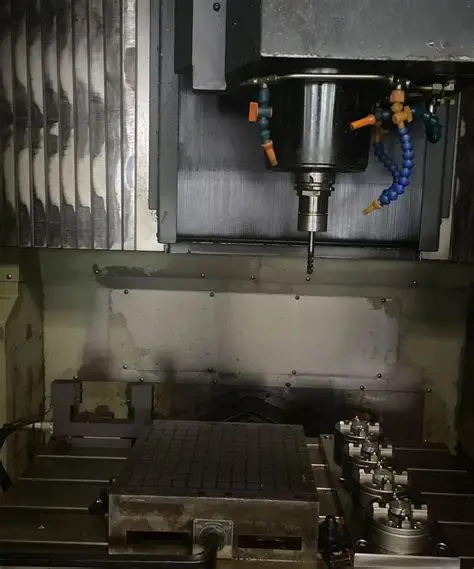
What Can Be Made with 3-Axis CNC Machining?
3-axis CNC machining is ideal for producing flat, prismatic, and moderately complex components that can be accessed from a single direction. While it does not offer the angular flexibility of multi-axis systems, it is exceptionally efficient for a wide range of precision parts used in everyday industrial applications.
Common Features Produced by 3-Axis Machining
A 3-axis CNC machine can accurately create the following part features:
Flat Surfaces
Precision milling of planar faces is one of the most common operations. This includes base plates, covers, mounting surfaces, and structural frames.
Pockets and Cavities
Shallow or moderately deep pockets can be machined efficiently using end mills. These are commonly found in housings, enclosures, and mold bases.
Slots and Channels
Linear slots and grooves are widely used for mechanical assemblies, sliding components, and fastening systems.
Drilled and Tapped Holes
Vertical drilling operations are highly accurate in 3-axis machining, making it suitable for threaded holes and alignment features.
2.5D Geometries
Parts that combine flat surfaces with varying depths (but no complex angular features) are ideal candidates. Many brackets, adapters, and structural components fall into this category.
Industries That Rely on 3-Axis CNC Machining
Because of its balance between cost and precision, 3-axis machining remains a foundational manufacturing method across multiple industries:
Automotive
Engine brackets, transmission housings, mounting plates, and sensor mounts.
Aerospace
Non-structural brackets, tooling fixtures, and support components that do not require complex multi-angle machining.
Electronics
Aluminum enclosures, heat sinks, panels, and mounting frames for PCBs.
Medical
Surgical instrument components, device housings, and custom fixtures.
Industrial Equipment
Machine bases, jigs, fixtures, and custom mechanical assemblies.
Typical Production Scenarios
3-axis CNC machining is commonly used for:
Rapid prototyping
Low to medium-volume production
Replacement parts
Custom one-off components
Cost-sensitive engineering projects
For many businesses, especially startups or small manufacturers, 3-axis machining provides a highly practical solution without the higher investment required for 4-axis or 5-axis systems.
Materials Suitable for 3-Axis CNC Machining
One of the major advantages of 3-axis CNC machining is its compatibility with a wide range of engineering materials. From soft plastics to high-strength metals, 3-axis CNC machines can deliver consistent results when proper tooling and cutting parameters are applied.
Material selection directly impacts machining speed, surface finish, tool wear, and overall production cost. Below are the most commonly used materials in 3-axis machining.
Metals Commonly Machined on 3-Axis CNC Machines
Aluminum

Aluminum is the most frequently machined material in 3-axis CNC operations. It offers:
Excellent machinability
Lightweight strengt
Corrosion resistance
Good thermal conductivity
Grades such as 6061 and 7075 are widely used in aerospace, automotive, and electronics applications.
Carbon Steel
Carbon steel provides strong mechanical properties and durability. It is commonly used for:
Structural components
Machine parts
Industrial hardware
However, it requires proper cutting speeds and coolant to control heat buildup.
Stainless steel offers corrosion resistance and strength but is more challenging to machine due to work hardening. It is frequently used in:
Stainless Steel
Medical devices
Food processing equipment
Chemical industry components
Brass and Copper
These materials are known for:
Excellent electrical conductivity
Easy machinability
They are often used in electrical connectors, fittings, and decorative components.
Titanium
Although machinable on 3-axis systems, titanium requires slower cutting speeds and specialized tooling due to its strength and low thermal conductivity. It is common in aerospace and medical industries.
Plastics Suitable for 3-Axis Machining
Plastics are widely used when weight reduction, electrical insulation, or chemical resistance is required.
ABS
Cost-effective and impact resistant.
Nylon
Strong, wear-resistant, and suitable for mechanical parts.
POM (Delrin)
Low friction and high dimensional stability.
Acrylic
Transparent and ideal for display components.
Polycarbonate
High impact resistance and toughness.
Material Considerations for Optimal Results
When selecting materials for 3-axis CNC machining, consider:
Machinability rating
Required tolerances
Surface finish requirements
Thermal expansion properties
Production volume
Softer materials generally allow faster machining speeds, while harder materials may require slower feeds, coated tooling, and enhanced cooling strategies.
Advantages of 3-Axis CNC Machining
Despite the growing popularity of multi-axis systems, 3-axis CNC machining remains the most widely used configuration in manufacturing facilities worldwide. Its continued dominance is driven by cost efficiency, simplicity, reliability, and versatility.
Below are the key advantages that make 3-axis machining a practical and strategic choice for many projects.
Lower Equipment and Operating Costs
Compared to 4-axis and 5-axis machines, 3-axis CNC machines:
Require lower initial capital investment
Have simpler mechanical structures
Demand less maintenance
Consume less programming time
For small to medium-sized shops, this translates directly into reduced overhead and faster return on investment.
In cost-sensitive production environments, 3-axis machining often provides the most economical solution for standard components.
Simpler Programming and Setup
The 3-axis machining process is easier to program because:
Toolpaths are primarily linear
Fewer collision risks exist
CAM strategies are more straightforward
This reduces:
Programming time
Simulation complexity
Risk of operator error
Additionally, operators typically require less specialized training compared to multi-axis machining environments.
High Repeatability and Reliable Accuracy
Modern 3-axis CNC machines can achieve tolerances in the range of ±0.01 mm to ±0.05 mm, depending on machine quality and setup conditions.
Because the motion system is mechanically simpler than multi-axis machines:
Fewer variables affect positioning accuracy
Calibration is easier
Long-term stability is often better
This makes 3-axis machining highly reliable for batch production.
Ideal for Flat and Prismatic Parts
Most mechanical components in industrial applications are prismatic rather than freeform.
3-axis machining excels at producing:
Base plates
Brackets
Housings
Mounting blocks
Tooling fixtures
For these part types, adding rotational axes often provides no measurable productivity benefit.
Faster Setup for Simple Jobs
When machining parts that only require access from one direction, 3-axis machines can often complete jobs with:
Minimal fixturing
Standard vises or clamps
Quick tool changes
For prototype development and short-run production, this efficiency significantly reduces lead times.
Broad Availability and Industry Standardization
Because 3-axis machines are the most common configuration globally:
Replacement parts are easy to source
Skilled operators are widely available
Tooling solutions are standardized
This reduces operational risk and increases manufacturing flexibility.
Summary of Key Advantages
| Advantage | Impact on Production |
| Lower cost | Better ROI |
| Easier programming | Faster setup |
| Reliable accuracy | Consistent quality |
| Strong repeatability | Suitable for batch runs |
| Broad material compatibility | High versatility |
Limitations of 3-Axis CNC Machining
While 3-axis CNC machining is versatile and cost-effective, it is not suitable for every application. Understanding its limitations is essential when selecting the right manufacturing approach.
Below are the primary constraints that engineers and manufacturers must consider.
Limited Access to Complex Geometries
A 3-axis CNC machine can only move in linear directions (X, Y, and Z). It cannot tilt the tool or rotate the workpiece automatically.
As a result, it struggles with:
Undercuts
Multi-angle surfaces
Deep cavities with angled walls
Complex curved geometries
Producing such features often requires repositioning the part manually or switching to 4-axis or 5-axis machining systems.
Multiple Setups for Multi-Face Parts
When a component requires machining on multiple sides, the operator must:
Remove the part
Reposition it
Re-clamp it
Re-align coordinate systems
Each additional setup increases:
Production time
Risk of dimensional variation
Accumulated tolerance stack-up
For high-precision multi-face parts, this can become inefficient compared to multi-axis machining.
Reduced Efficiency for Deep Cavities
Deep pockets or narrow internal features may require:
Long cutting tools
Reduced cutting speeds
Multiple step-down passes
Longer tools are more prone to vibration (tool deflection), which can affect surface finish and dimensional accuracy.
In contrast, 5-axis systems can approach the feature from optimized angles, reducing tool length requirements.
Longer Cycle Time for Complex Parts
Although 3-axis machines are fast for simple geometries, complex parts may require:
Repeated repositioning
Additional finishing passes
Secondary operations
This increases total machining time compared to a single-setup multi-axis solution.
Tool Access Constraints
Because the spindle remains vertically oriented, tool access is limited to top-down machining in most standard configurations.
Features located at awkward angles may require:
Custom fixtures
Secondary machining operations
Alternative manufacturing strategies
When These Limitations Matter Most
The limitations of 3-axis machining become critical in industries such as:
Aerospace structural components
Turbine blades
Medical implants with organic geometries
Mold and die manufacturing
In these cases, multi-axis machining often provides superior efficiency and accuracy.
Why These Limitations Don’t Reduce Its Value
It’s important to recognize that the majority of industrial components are still prismatic rather than freeform. For such parts, 3-axis machining remains the most practical and cost-effective solution.
Understanding the boundary between “ideal use case” and “performance limitation” allows engineers to make informed manufacturing decisions.
3-Axis vs 4-Axis vs 5-Axis CNC Machining
Choosing between 3-axis, 4-axis, and 5-axis CNC machining depends on part complexity, production volume, budget, and precision requirements. While all configurations use computer numerical control, the number of movement axes significantly affects machining flexibility and efficiency.
Understanding the differences helps manufacturers select the most cost-effective solution for their application.
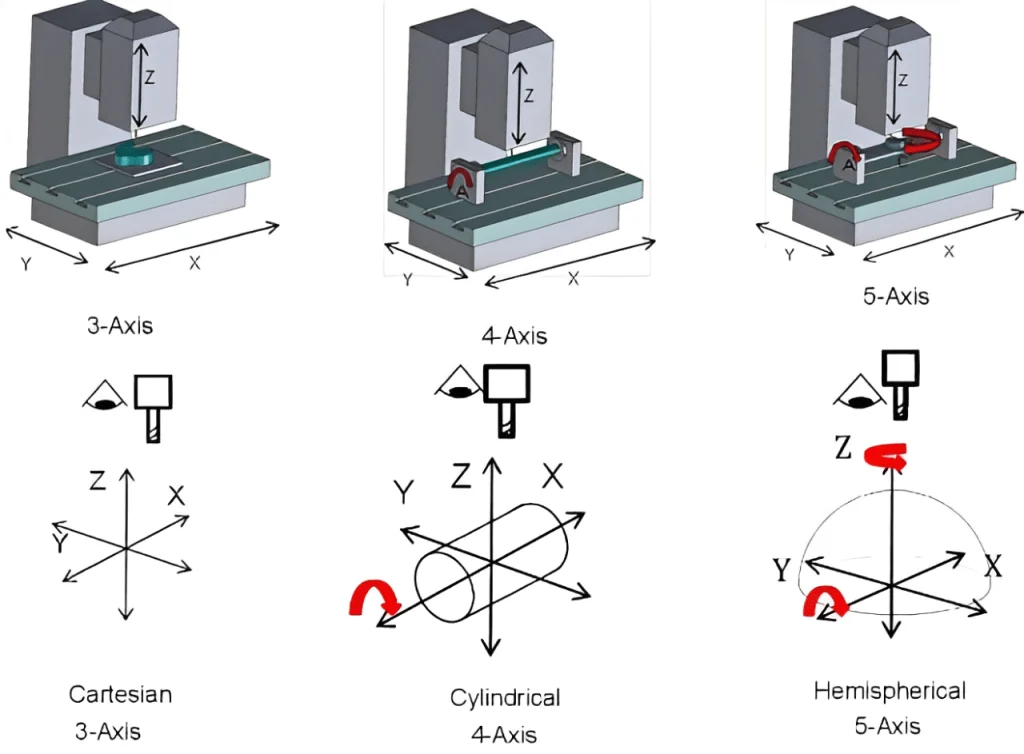
Key Structural Difference
The primary distinction lies in the number of motion axes:
3-axis machining uses three linear movements (X, Y, Z).
4-axis machining adds one rotational axis (typically A-axis).
5-axis machining adds two rotational axes, enabling full angular tool positioning.
Rotational axes allow the workpiece or spindle to tilt, reducing the need for manual repositioning.
Feature Comparison
| Feature | 3-Axis | 4-Axis | 5-Axis |
| Linear movement | X, Y, Z | X, Y, Z | X, Y, Z |
| Rotational movement | None | 1 axis | 2 axes |
| Setup frequency | Higher | Moderate | Minimal |
| Complex surface capability | Limited | Moderate | Excellent |
| Machine cost | Lowest | Medium | Highest |
| Programming difficulty | Low | Medium | High |
Production Efficiency Comparison
3-Axis
Best for:
Flat and prismatic parts
Single-face machining
Cost-sensitive production
Multiple setups may be required for multi-face parts.
4-Axis
Best for:
Cylindrical parts
Indexed multi-side machining
Moderate geometric complexity
Reduces manual repositioning compared to 3-axis.
5-Axis
Best for:
Complex aerospace components
Organic surfaces
Deep cavities
High-precision multi-angle machining
Often completes parts in a single setup, improving geometric accuracy and reducing tolerance stack-up.
Cost vs Capability Trade-Off
While 5-axis machining offers unmatched flexibility, it comes with:
Higher machine investment
More complex programming
Increased maintenance costs
For many industrial applications, 3-axis machining delivers sufficient capability without unnecessary expense.
The decision should be based on part geometry rather than technology preference.
When to Upgrade Beyond 3-Axis
Consider 4-axis or 5-axis machining if your part:
Requires simultaneous multi-angle cutting
Contains complex curved surfaces
Needs ultra-tight tolerances across multiple faces
Must be completed in one setup for efficiency
Otherwise, 3-axis machining remains the most practical and economical option.
When Should You Choose 3-Axis CNC Machining?
Selecting the right CNC machining strategy depends on part geometry, production volume, budget, and required tolerances. While multi-axis machines offer greater flexibility, 3-axis CNC machining remains the optimal choice in many situations.
Ideal Scenarios for 3-Axis Machining
Flat or Prismatic Parts
Parts with predominantly planar surfaces, straight edges, and uniform depths are perfectly suited for 3-axis machining.
Low to Medium Production Volume
Small-batch runs, prototypes, or replacement parts are efficiently produced on 3-axis machines without the need for expensive multi-axis setups.
Cost-Sensitive Projects
When budget constraints are important, 3-axis machining delivers high-quality results at a fraction of the cost of 5-axis systems.
Parts with Limited Geometric Complexity
Components that do not require undercuts, deep angled cavities, or multi-face simultaneous machining are ideal.
Rapid Prototyping and Iteration
The simpler setup and programming of 3-axis machines make them perfect for fast prototyping cycles and design validation.
Situations When You Might Consider 4- or 5-Axis Machining
Complex geometries with multi-angle surfaces
Deep cavities or tight undercuts
Single-setup requirements for multi-face components
Ultra-high precision demands across multiple planes
In these cases, upgrading to a 4-axis or 5-axis CNC machine can improve efficiency, accuracy, and reduce total production time.
Practical Tip for Engineers
If your part mostly consists of flat surfaces with occasional pockets or slots, stick with 3-axis machining. Use CAM software to optimize toolpaths and minimize the number of setups. Reserve multi-axis machining for parts where geometry or tolerance cannot be achieved otherwise.
Design Tips for 3-Axis CNC Parts
Optimizing your part design for 3-axis CNC machining not only improves manufacturing efficiency but also reduces costs and ensures higher quality. Here are key considerations for engineers and designers.
1️⃣ Minimize Multi-Face Machining
Avoid designs that require frequent repositioning of the workpiece.
Plan part orientation to allow machining from a single setup whenever possible.
Use simple fixturing to reduce setup time and improve accuracy.
Benefit: Fewer setups → lower risk of tolerance stack-up and faster production.
2️⃣ Avoid Deep Undercuts and Narrow Cavities
Deep pockets or angled undercuts require long tools, which are prone to deflection and vibration.
If deep features are necessary, consider designing them with stepped depths or multiple roughing passes.
Benefit: Maintains dimensional accuracy and improves surface finish.
3️⃣ Standardize Hole Sizes and Patterns
Use common drill and tap sizes wherever possible.
Align holes along accessible planes to avoid additional setups.
Benefit: Simplifies tooling and reduces machining time.
4️⃣ Optimize Wall Thickness
Ensure walls are thick enough to prevent vibration but not overly heavy.
Maintain a minimum thickness of 1–2× tool diameter to avoid tool chatter.
Benefit: Improves structural integrity and surface finish.
5️⃣ Plan for Tool Access
Check that the cutting tool can reach all surfaces without collision.
Avoid sharp internal corners unless using specialized end mills.
Use fillets in corners to facilitate smoother toolpaths.
Benefit: Reduces risk of tool breakage and ensures uniform material removal.
6️⃣ Leverage 2.5D Features
Flat-bottomed pockets, simple slots, and uniform planar surfaces are ideal for 3-axis machining.
Limit freeform curves and complex angular surfaces unless absolutely necessary.
Benefit: Maximizes machining efficiency and minimizes setup complexity.
7️⃣ Consider Material Machinability
Softer materials (aluminum, plastics) allow faster machining and finer finishes.
Harder metals may require slower feeds, coated tooling, and coolant optimization.
Benefit: Extends tool life and improves overall process reliability.
Summary Table of Key 3-Axis CNC Design Tips
| Tip | Impact |
| Minimize multi-face machining | Faster production, lower tolerance errors |
| Avoid deep undercuts | Maintain dimensional accuracy |
| Standardize holes | Simplifies tooling, reduces cycle time |
| Optimize wall thickness | Improves stability and surface finish |
| Plan for tool access | Reduces collisions and tool wear |
| Leverage 2.5D features | Efficient material removal |
| Consider material machinability | Extends tool life, improves finish |
FAQs
Q1: What is the difference between 3-axis CNC machining and 3-axis milling?
A: 3-axis CNC machining is a broad term for any subtractive manufacturing process that moves a cutting tool along the X, Y, and Z axes to remove material from a workpiece. 3-axis milling specifically refers to milling operations performed on a 3-axis machine using rotating end mills to shape flat or prismatic surfaces. In other words, all 3-axis milling is a form of 3-axis CNC machining, but not all 3-axis machining is milling.
Q2: How accurate is 3-axis CNC machining?
A: Modern 3-axis CNC machines are capable of achieving tolerances typically ranging from ±0.01 mm to ±0.05 mm depending on machine quality, tooling, material, and setup conditions. For most industrial parts such as brackets, housings, and plates, this level of accuracy ensures reliable dimensional consistency and excellent surface finish.
Q3: Can 3-axis CNC machines produce complex parts?
A: 3-axis CNC machines are best suited for flat, prismatic, and 2.5D geometries. While they can handle shallow pockets, slots, and drilled holes with high precision, parts with undercuts, deep cavities, or multi-angle surfaces often require multiple setups or upgrading to 4-axis or 5-axis CNC machines to achieve the desired geometry efficiently.
Q4: What materials can be machined with 3-axis CNC?
A: 3-axis CNC machines can work with a wide range of materials, including metals such as aluminum, steel, stainless steel, brass, and titanium, as well as plastics like ABS, nylon, POM (Delrin), acrylic, and polycarbonate. The choice of material affects cutting speed, surface finish, tool wear, and overall production efficiency, so it is important to select materials that match both design requirements and machining capabilities.
Q5: When should I choose 3-axis over 5-axis CNC machining?
A: 3-axis CNC machining is ideal for parts that are flat or prismatic, have limited geometric complexity, require low to medium production volumes, and need to balance cost with precision. In contrast, 5-axis machining is more suitable for components with multi-angle surfaces, deep cavities, or features that must be machined in a single setup. Selecting 3-axis for the appropriate parts ensures cost efficiency while maintaining quality.
Q6: How does 3-axis CNC machining compare in cost and efficiency?
A: 3-axis CNC machines generally cost less to purchase, operate, and maintain than multi-axis systems. They provide fast and reliable machining for parts with simple to moderately complex geometries, making them highly efficient for prototyping, small-batch production, and standard industrial components. While 5-axis machines offer greater flexibility, 3-axis machines often deliver the best balance of speed, cost, and precision for most applications.
Q7: Can 3-axis CNC machines be used for prototypes?
A: Yes, 3-axis CNC machining is widely used for rapid prototyping because it allows for quick setup, straightforward programming, and the flexibility to work with a variety of materials. This enables engineers to test designs, make iterative changes, and validate functionality before moving to full-scale production, all while keeping costs under control.