
The Technical Guide to Ultem (PEI) CNC Machining: Properties, Grades, and Process Control
Ultem is the brand name for polyetherimide (PEI), a semi-transparent amber-colored thermoplastic developed by SABIC. It belongs to the class of high-performance amorphous engineering polymers. Unlike standard industrial plastics, Ultem combines an ether linkage in its molecular chain for flexibility and processability with an imide group for exceptional thermal and mechanical resistance.
The Engineering Problem: Why Choose Ultem?
When designing parts for extreme environments—such as aerospace interiors, medical devices, or high-frequency electronics—engineers often face a material selection bottleneck. Conventional engineering plastics like nylon, acetal, or polycarbonate fail when continuous operating temperatures exceed 100°C, losing their structural rigidity or outgassing under vacuum.
While metals like aluminum or stainless steel offer the required strength and heat resistance, they add significant weight and conduct electricity, which rules them out for electrical insulation or weight-critical applications.
Ultem fills this critical gap. It is selected because it delivers a unique combination of performance characteristics:
- Continuous use temperatures up to 170°C–180°C.
- High tensile strength and stiffness that rivals some cast metals.
- Outstanding dielectric strength for reliable electrical insulation.
Scope of This Guide
While Ultem offers superior performance, its high rigidity and low thermal conductivity present specific challenges during manufacturing. This technical guide provides an objective analysis of Ultem’s material behavior during CNC machining. We will examine the physical profile of the polymer, contrast the machining differences between standard unfilled Ultem 1000 and 30% glass-filled Ultem 2300, and define the specific process controls—such as tooling geometry, cooling, and annealing protocols—required to prevent stress cracking and part warping.
Core Material Properties of Ultem (PEI)
Ultem (polyetherimide) is an amorphous high-performance thermoplastic known for its balanced combination of thermal, mechanical, and electrical properties. Understanding these baseline material characteristics is essential for predicting how the polymer will behave under the mechanical forces and thermal loads of CNC machining.
Thermal Performance
Ultem exhibits exceptional thermal stability, defined by a high glass transition temperature ($T_g$) of 217°C and a continuous service temperature rating of 170°C to 180°C. It maintains high rigidity and mechanical strength at elevated temperatures close to its softening point. Additionally, the material is inherently flame-retardant, achieving a UL94-V-0 rating without the use of chemical additives.
Mechanical Strength and Creep Resistance
The polymer features high tensile strength and flexural modulus, making it a viable alternative to metals in weight-critical applications. Unlike standard engineering plastics that deform under prolonged mechanical loads, Ultem demonstrates excellent long-term creep resistance. This dimensional stability allows machined components to maintain tight tolerances under continuous stress and structural loading over extended periods.
Electrical and Dielectric Properties
Ultem is an exceptional electrical insulator, characterized by high dielectric strength and a low, stable dielectric loss factor across a broad range of frequencies and temperatures. It is virtually transparent to microwave radiation, making it a standard material choice for high-frequency electronic enclosures, connectors, and radome assemblies.
Chemical and Hydrolytic Stability
The chemical structure of PEI provides resistance to automotive fluids, fully halogenated hydrocarbons, alcohols, and aqueous acid solutions. It also possesses outstanding hydrolytic stability, allowing components to withstand repeated exposure to high-pressure steam sterilization cycles (autoclaving) without molecular degradation.
- Important Note for Machining: Ultem is susceptible to environmental stress cracking (ESC) when exposed to specific polar organic solvents, including certain ketones, esters, and chlorinated hydrocarbons. This chemical sensitivity requires careful selection of chemically compatible, non-aggressive cutting fluids during the CNC machining process.
PEEK vs. Ultem (PEI): Which High-Performance Polymer Fits Your Application?
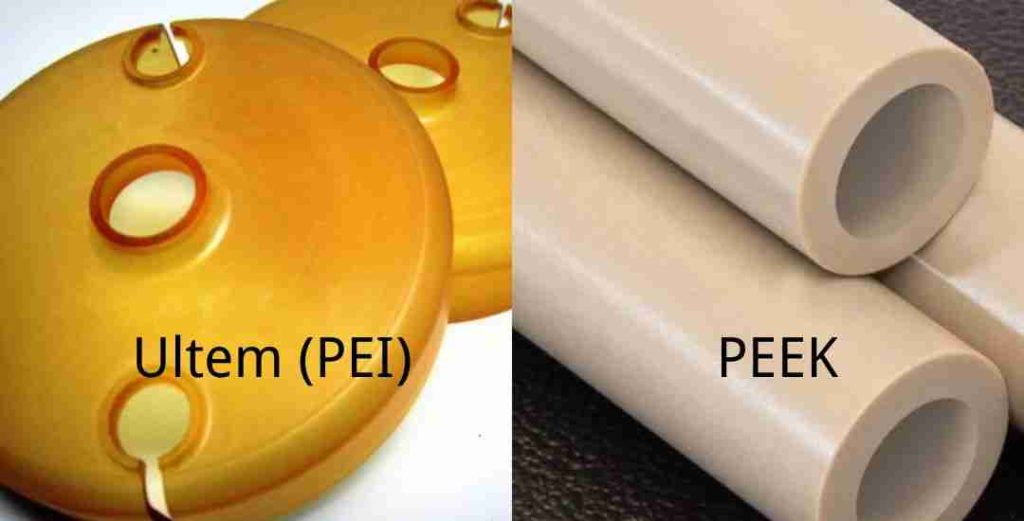
Although both PEEK and Ultem (PEI) are high-performance engineering thermoplastics, their different molecular structures result in distinct thermal, mechanical, and machining characteristics.
Molecular Structure
- PEEK: Semi-crystalline structure offering excellent wear resistance, fatigue performance, and chemical resistance.
- Ultem (PEI): Amorphous structure providing superior dimensional stability and more uniform shrinkage during processing.
Performance Comparison
- Temperature Resistance: PEEK supports continuous service temperatures up to 250°C, while Ultem is typically limited to 170–180°C.
- Dimensional Stability: Ultem exhibits more uniform thermal expansion and tighter dimensional control.
- Cost Efficiency: Ultem is generally 30–50% less expensive than PEEK, making it a cost-effective choice for applications below 170°C.
CNC Machining Characteristics
- PEEK: Produces continuous chips, tends to form burrs, and thin-wall features may deflect during machining.
- Ultem: Produces shorter chips with cleaner edges, but is more susceptible to chipping and stress-induced cracking if machining parameters are not optimized.
Overall, PEEK is preferred for extreme thermal and wear-intensive environments, while Ultem offers excellent dimensional stability and lower material cost for high-performance applications that do not require PEEK’s maximum temperature capability.
Grade Comparison: Ultem 1000 vs. Ultem 2300
Among the various PEI formulations available, Ultem 1000 and Ultem 2300 are the grades most frequently used for CNC-machined components. Although both are based on the same polyetherimide resin, the addition of glass-fiber reinforcement dramatically changes their mechanical properties and machining behavior.
Ultem 1000 (Unfilled Grade)
Ultem 1000 is an unreinforced polyetherimide material characterized by its translucent amber appearance.
Mechanical Characteristics
This grade offers the highest toughness and impact resistance within the standard Ultem family. Its excellent dielectric properties and ability to achieve smooth surface finishes make it suitable for electrical insulation, medical components, and fluid-handling applications.
Machining Behavior: Heat Accumulation
Because Ultem 1000 contains no reinforcing fillers, tool wear is relatively low and surface quality is typically excellent. However, the material’s low thermal conductivity limits its ability to dissipate cutting heat.
During milling or turning operations, frictional heat remains concentrated near the cutting edge rather than being transferred through the workpiece. If spindle speeds are excessive or feed rates are too low, the temperature in the cutting zone can rise rapidly, causing localized softening, material smearing, and heavy burr formation.
Ultem 2300 (30% Glass-Fiber Reinforced)
Ultem 2300 incorporates 30% glass-fiber reinforcement, producing a significantly stiffer and more dimensionally stable material.
Mechanical Characteristics
The addition of glass fibers substantially increases tensile strength and flexural stiffness while reducing thermal expansion. As a result, Ultem 2300 maintains tighter dimensional control under varying thermal and mechanical loads than unfilled grades.
Machining Behavior: Abrasive Tool Wear
While dimensional stability is improved, glass-fiber reinforcement introduces substantial machining challenges. The cutting tool must continuously fracture rigid glass fibers embedded within the polymer matrix.
This creates two primary concerns:
- Accelerated Tool Wear
Glass fibers act as abrasive particles that gradually erode the cutting edge. As the tool loses sharpness, cutting forces increase and surface quality deteriorates. - Edge Chipping and Fiber Pull-Out
During tool exit or breakthrough operations, unsupported fibers may separate from the surrounding resin rather than being cleanly sheared. This can result in edge chipping, rough hole exits, and localized surface defects.
For this reason, reinforced PEI grades typically require more wear-resistant tooling and tighter process control than standard Ultem 1000.
Key Technical Challenges in Ultem CNC Machining
Successfully machining Ultem (PEI) requires careful control of cutting parameters and material handling procedures. Unlike metals or semi-crystalline engineering plastics, Ultem’s amorphous structure introduces several unique manufacturing challenges that directly affect dimensional stability, surface quality, and long-term component reliability.
1. Internal Stress and Part Warpage
Ultem stock shapes, including sheets, plates, and rods, inherently contain residual stresses generated during extrusion or molding. As the material cools, the outer layers solidify before the core, creating an uneven stress distribution throughout the polymer structure.
Stress Redistribution During Machining
Material removal disturbs this internal equilibrium. When machining operations remove stock unevenly from one side of the workpiece, the remaining residual stresses become unbalanced and redistribute throughout the part.
Resulting Deformation
Once the component is unclamped from the fixture, these internal forces can cause the part to bow, twist, or distort. This effect becomes particularly problematic for large flat surfaces and precision components requiring tight positional tolerances.
2. Environmental Stress Cracking (ESC)
Environmental Stress Cracking is one of the most difficult failure mechanisms to diagnose because cracking often occurs long after machining has been completed.
Material Mechanism
As an amorphous polymer, Ultem relies on intermolecular bonding rather than crystalline reinforcement for structural integrity. Under machining loads, clamping pressure, or residual tensile stress, the spacing between polymer chains increases locally.
When incompatible chemicals penetrate these stressed regions, they weaken the intermolecular bonds holding the polymer network together. Micro-cracks can then initiate and propagate through the material even when no external load is present.
Common Cause in CNC Machining
The most common source of ESC is improper coolant selection. Cutting fluids containing petroleum oils, chlorinated additives, sulfur compounds, or aggressive solvents can chemically attack stressed PEI, leading to delayed cracking, crazing, or premature part failure.
3. Heat Buildup and Material Gumming
One of the most significant machining challenges associated with Ultem is its inability to efficiently dissipate heat.
Thermal Accumulation at the Cutting Zone
Unlike metals, which transfer cutting heat through the workpiece and machine structure, Ultem acts as a thermal insulator. The heat generated by tool friction remains concentrated directly at the cutting interface.
If spindle speeds are excessive or feed rates are too low, the temperature at the cutting edge can rapidly approach the material’s glass transition temperature of 217°C.
Softening and Tool Gumming
Once this temperature threshold is exceeded, the material begins transitioning from a rigid glassy state to a softened, rubber-like condition. Instead of shearing cleanly, the plastic starts smearing and adhering to the cutting edge.
This phenomenon, commonly known as tool gumming, leads to poor surface finish, excessive burr formation, chip evacuation problems, and accelerated tool failure. In severe cases, chip packing can overload the cutter and cause immediate tool breakage.
Manufacturing Process Control
Successfully machining Ultem (PEI) requires more than selecting the correct cutting parameters. Because the material is highly sensitive to residual stress and localized heat accumulation, effective process control must focus on thermal stabilization, tooling selection, and coolant management throughout the entire machining cycle.
1. Annealing and Stress Relief
Annealing is one of the most important process controls when machining Ultem. The objective is to reduce residual stresses accumulated during extrusion or molding before they are released during material removal.
A typical annealing cycle consists of three stages:
- Controlled Heating: The material is heated gradually to prevent temperature differentials between the surface and the core.
- Soak Period: The workpiece is maintained at approximately 200°C–205°C, just below Ultem’s glass transition temperature of 217°C, allowing internal molecular stresses to relax.
- Controlled Cooling: The material is cooled at a very slow rate to avoid reintroducing thermal stresses into the polymer structure.
The cooling phase is particularly critical. Excessively rapid cooling can negate the benefits of annealing and create new internal stresses that later contribute to warpage.
For tight-tolerance components, manufacturers often implement a multi-stage approach. Raw stock is first annealed prior to machining, rough-machined close to final dimensions, subjected to a second stress-relief cycle, and then finish-machined to specification.
2. Tooling Geometry and Tool Selection
Tool geometry plays a significant role in controlling heat generation and maintaining edge quality.
Ultem 1000 (Unfilled Grade)
Because the material is relatively soft and non-abrasive, extremely sharp cutting edges are preferred. Fine-grain carbide tools with polished flutes and positive rake geometry promote clean shearing action while minimizing frictional heat.
Ultem 2300 (30% Glass-Filled Grade)
Glass-fiber reinforcement dramatically increases abrasiveness. During machining, the cutting edge continuously encounters hard glass particles embedded within the polymer matrix.
As a result, conventional carbide tooling experiences accelerated wear. Diamond-coated carbide or Polycrystalline Diamond (PCD) tooling is often required for production environments where dimensional consistency and tool life are critical.
3. Coolant and Heat Management
Heat control remains one of the primary challenges in Ultem machining. Unlike metals, PEI cannot efficiently conduct thermal energy away from the cutting zone, allowing temperatures to build rapidly around the tool edge.
At the same time, coolant selection must be carefully controlled to avoid environmental stress cracking.
Fluids to Avoid
Cutting oils containing sulfur additives, chlorinated compounds, or aromatic hydrocarbons should not be used when machining Ultem, as these chemicals can attack stressed polymer regions and promote cracking.
Recommended Cooling Methods
Water-soluble coolants, synthetic coolant systems, and chilled compressed-air solutions are commonly used. In addition to reducing cutting temperatures, coolant delivery should continuously evacuate chips from the cutting zone to prevent chip recutting, which can significantly increase frictional heat and surface damage.
DFM (Design for Manufacturing) Rules for Engineers
Proper DFM practices can significantly improve machinability, dimensional accuracy, and part reliability when designing Ultem components.
1. Radius Design
Ultem is relatively notch-sensitive, meaning sharp internal corners can create localized stress concentrations and increase the risk of cracking.
Design Recommendation:
- Avoid sharp internal corners whenever possible.
- Use internal radii of at least 0.5–1.0 mm.
- Larger radii improve both structural performance and machining efficiency.
2. Wall Thickness
Although stiffer than most engineering plastics, Ultem can still deflect under machining forces when wall sections become too thin.
Design Recommendation:
- Maintain uniform wall thickness throughout the part.
- Avoid walls thinner than 1.0 mm.
- Keep deep-wall aspect ratios below 4:1 whenever possible.
3. Thread Design
Threaded features require careful consideration, particularly in glass-filled grades.
Design Recommendation:
- Use coarse threads instead of fine threads.
- Avoid very small thread sizes where possible.
- For high-load or frequently assembled components, use metal threaded inserts rather than directly tapping the plastic.
By incorporating these design principles early in development, engineers can improve manufacturability, reduce machining risks, and achieve more consistent part quality.
Conclusion
Ultem (PEI) is undoubtedly one of the most capable engineering thermoplastics available for harsh, high-temperature environments. However, unlocking its full potential under CNC machining requires strict adherence to its unique material physics.
Whether navigating the thermal management challenges of unfilled Ultem 1000 or mitigating the severe tool wear and edge-chipping risks associated with 30% glass-filled Ultem 2300, success ultimately relies on precision control. By applying polymer-specific DFM principles—such as avoiding sharp internal corners and maintaining uniform wall thicknesses—engineers can drastically reduce manufacturing defects. Concurrently, machine shops must enforce meticulous process controls, particularly multi-stage industrial annealing cycles and stress-free coolant strategies, to prevent latent warping and environmental stress cracking.
Ultimately, bridging the gap between a complex CAD model and a flawless, stress-relieved Ultem component requires a manufacturing partner who treats plastic machining as a science. At XTPROTO, we integrate these rigorous thermal protocols and specialized tooling setups directly into our professional PEI CNC machining service. By combining deep high-performance polymer expertise with efficient production management, we help engineering teams worldwide bring their critical Ultem applications to life with uncompromised precision and reliable lead times.