
Alloy Steel vs. Stainless Steel in CNC Machining: A Material Selection Guide for High-Stressor Parts
In the realm of custom CNC machining, selecting the appropriate metal for a project is rarely a straightforward decision. While “steel” is often requested as a baseline requirement for high-strength components, the distinction between alloy steel and stainless steel introduces a critical fork in the road for product designers and mechanical engineers. Choosing between them is not a simple matter of choosing a “better” material; rather, it is a complex balancing act involving mechanical loads, environmental exposure, cutting mechanics, and overall manufacturing budgets.
A common misconception in early-stage product development is to view stainless steel as an upgraded, premium version of alloy steel simply due to its corrosion resistance. Conversely, alloy steel is sometimes mischaracterized as merely a budget-friendly alternative that requires extra surface coating. In reality, these two material families operate on fundamentally different metallurgical principles, resulting in starkly different behaviors when subjected to the cutting forces of a CNC lathe or milling center.
Selecting the wrong grade at the drawing board can lead to two equally problematic outcomes. Over-specifying a part by choosing an exotic stainless steel grade when a low-alloy steel would suffice unnecessarily inflates material costs and prolongs cycle times due to lower machinability. On the other hand, under-specifying a component to save upfront costs can result in premature fatigue failure or catastrophic corrosion when the part is deployed in the field.
To bridge the gap between theoretical design and machine shop reality, this guide provides a comprehensive, data-driven analysis of alloy steel versus stainless steel. By examining their internal microstructure, behavior under cutting tools, heat treatment responsiveness, and total cost of ownership, we aim to provide the objective engineering insights needed to optimize your next manufacturing run.
Deep Dive into Metallurgy & Microstructure
To understand how these metals perform under a cutting tool or a heavy structural load, one must look beyond their surface appearance and examine their chemical compositions and internal crystal structures. At their core, both alloy steel and stainless steel are iron-based materials, but their alloying philosophies are fundamentally different.
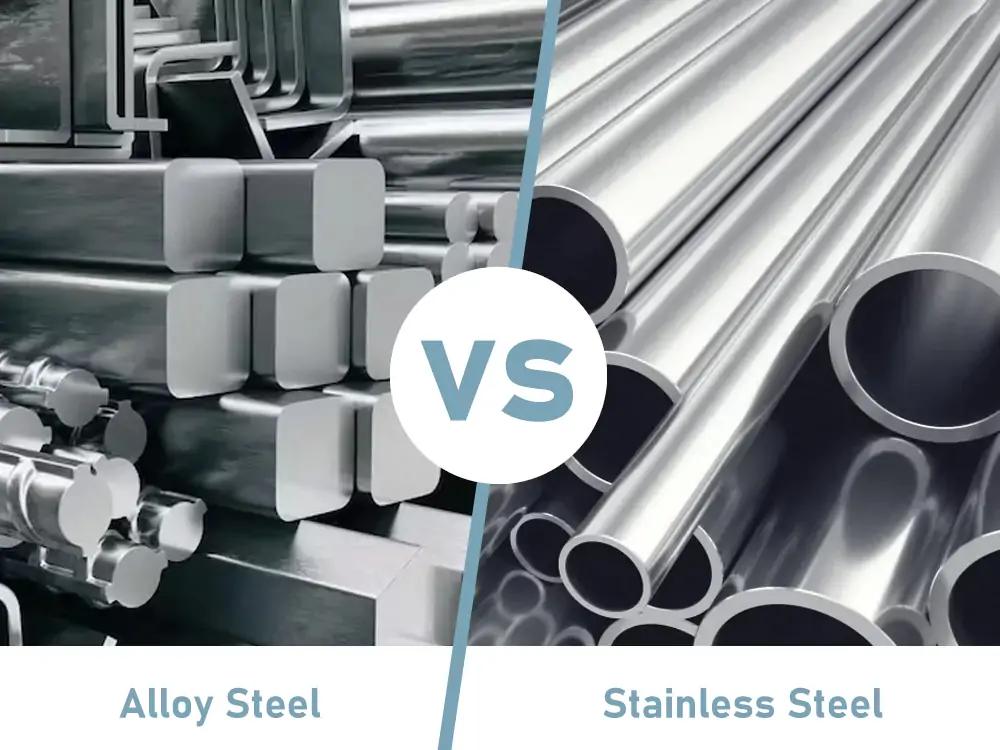
The Mechanism of Alloy Steel (Low-Alloy, High-Strength)
Standard carbon steel is essentially iron combined with small amounts of carbon. While functional, it has distinct limitations in terms of hardenability and toughness. Alloy steel solves this by introducing specific alloying elements—such as chromium (Cr), molybdenum (Mo), nickel (Ni), manganese (Mn), and vanadium (V)—typically keeping the total alloy content below 10% by weight.These elements are not added for corrosion resistance, but to alter the steel’s response to thermal processing. For instance, the combination of chromium and molybdenum in the popular 4140 grade promotes solid solution strengthening. During the manufacturing process, these larger alloy atoms fit into the iron crystal lattice, creating internal stresses that prevent the atomic planes from slipping under load.Furthermore, elements like vanadium form extremely hard micro-carbides within the iron matrix. This refined grain structure directly translates to excellent wear resistance and the ability to maintain structural integrity under severe, cyclic mechanical stresses.
The Science Behind Stainless Steel’s Passivation
Stainless steel operates on a completely different metallurgical priority: environmental survival. For a steel to be classified as stainless, it must contain a minimum of 10.5% chromium by weight.
When exposed to oxygen, the chromium in the steel reacts instantly to form an ultra-thin, invisible layer of chromium oxide (Cr₂O₃) across the surface of the component. This is known as the passivation layer.Unlike iron oxide (rust), which is porous and flakes away to expose more metal to degradation, the chromium oxide layer is completely non-porous and tightly adherent to the base metal. If the surface is scratched or machined away, the exposed chromium instantly reacts with ambient oxygen to rebuild the protective barrier.Beyond chromium, the addition of nickel splits stainless steel into distinct sub-families based on crystalline structures:
Austenitic (e.g., 304, 316)
- Contains high levels of nickel.
- Alters the crystal lattice from a Body-Centered Cubic (BCC) structure to a Face-Centered Cubic (FCC) structure at room temperature.
- Non-magnetic, highly ductile, and exceptionally corrosion resistant.
- Significantly more difficult to machine cleanly than many alloy steels.
Martensitic (e.g., 410, 420)
- Contains lower chromium and minimal nickel.
- Retains a crystal structure that can be hardened through heat treatment.
- Provides a balance between moderate corrosion resistance and high mechanical hardness.
Precipitation-Hardening (e.g., 17-4 PH)
- Uses additions of copper or niobium to form strengthening precipitates within the martensitic matrix.
- Delivers an advanced combination of high tensile strength and stainless corrosion resistance.
Understanding these microstructural baselines is essential, as they dictate exactly how a CNC cutting tool will interact with the raw stock during manufacturing.
CNC Machining Physics & Tool Mechanics
Translating a digital CAD file into a tangible metal component requires a clear understanding of the physical phenomena occurring at the cutting edge. When a CNC tool engages with a workpiece, the material undergoes extreme plastic deformation until it shears away as a chip. The efficiency of this process depends heavily on whether you are cutting alloy steel or stainless steel.
Alloy Steel: Predictable Cutting Forces and Controlled Heat
In its annealed or normalized state, alloy steel is generally considered a highly machinable material. The physics of cutting alloy steel favor predictable chip formation and stable tool life.
When the cutting edge shears the material, the shear angle remains relatively consistent, resulting in a smooth, continuous chip that is easy to manage with standard chipbreakers. Because alloy steels possess relatively high thermal conductivity compared to stainless varieties, a significant portion of the heat generated by friction at the tool-chip interface is absorbed by the chip itself and carried away from the cutting zone.
However, alloy steel is not without its machining challenges. The presence of carbide-forming elements like chromium and vanadium introduces hard microscopic particles into the ferrite matrix. As the tool moves through the material, these micro-carbides act as an abrasive, leading to steady abrasive wear along the tool’s flank face.
Machining alloy steels that have been pre-hardened or tempered (such as 4140 Condition H) increases cutting forces exponentially, generating higher localized heat that demands rigid workholding and precise tool geometries to avoid micro-chipping of the cutting edge.
Stainless Steel: The Challenges of Work Hardening and Thermal Concentration
For a CNC machinist, transitioning from alloy steel to an austenitic stainless steel (such as 304 or 316) requires a complete recalibration of cutting parameters. The physical properties that make stainless steel resilient in harsh environments also make it notoriously difficult to machine efficiently.
Work Hardening (Strain Hardening)
Austenitic stainless steels possess high ductility and a tendency to harden rapidly when deformed. As the cutting tool passes through the metal, the mechanical force alters the grain structure of the uncut material directly ahead of and below the tool edge.If the tool rubs instead of cuts—due to a dull edge, low feed rate, or insufficient depth of cut—the surface hardness of the workpiece increases immediately. The next tooth of the milling cutter or the next revolution of the lathe must then engage a layer of steel that is significantly harder than the base material, accelerating tool wear and increasing the likelihood of premature tool failure.
The Thermal Conductivity Barrier
While alloy steel allows heat to dissipate through the chips, stainless steel acts as a thermal insulator. Its thermal conductivity is roughly one-third that of low-alloy steel.As a result, the heat generated by plastic deformation cannot escape efficiently. Instead, it remains concentrated at the cutting edge and along the tool flank. This localized thermal stress can easily exceed 1000°C, causing rapid breakdown of tool coatings, plastic deformation of the tool tip, and thermal cracking caused by repeated heating and cooling cycles when coolant is applied.
Adhesion and Built-Up Edge (BUE)
Stainless steel exhibits high cohesion and a strong affinity for the materials used in carbide cutting tools. At elevated temperatures, the material becomes “gummy” and tends to adhere to the rake face of the tool.This accumulation of material, known as a built-up edge (BUE), alters the effective geometry of the cutting edge, increases cutting forces, and eventually breaks away. When it does, it can tear microscopic fragments from the carbide tool tip, significantly reducing tool life and degrading the surface finish of the machined component.
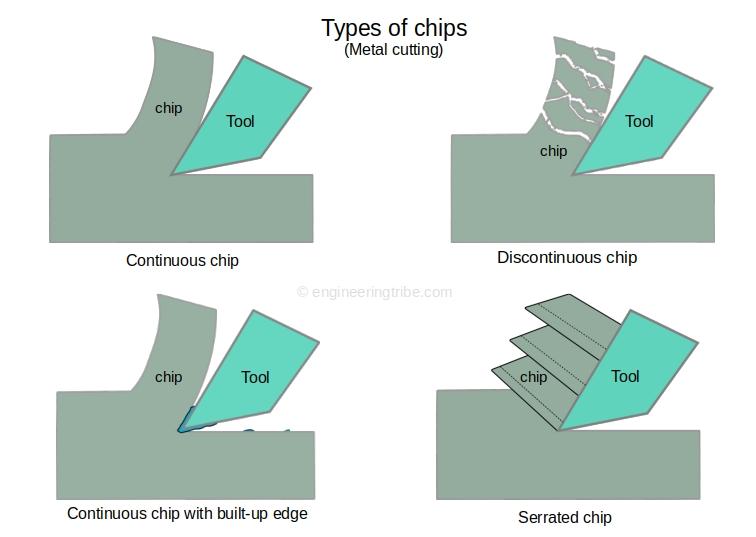
Tooling Tactics and Parameter Adjustments
To counteract these distinct machining behaviors, CNC programmers and machinists typically apply different tooling strategies for each material family.
| Machining Parameter | Strategy for Alloy Steel | Strategy for Stainless Steel |
| Tool Material / Coating | Carbide tools with AlTiN (Aluminum Titanium Nitride) coatings for general wear resistance. | Carbide tools with thick TiAlN or advanced multilayer PVD coatings to resist extreme heat and chemical adhesion. |
| Tool Geometry | Moderate rake angles and robust cutting edges optimized for chip control and high material removal rates. | Positive rake geometries, highly polished rake faces, and razor-sharp cutting edges to reduce cutting forces and minimize work hardening. |
| Cutting Speed (Vc) | Relatively high cutting speeds are possible due to efficient heat dissipation. | Typically 30%–50% lower than alloy steel to control thermal buildup at the cutting edge. |
| Feed Rate (f) & Depth of Cut | Flexible and easily optimized for either productivity or surface finish requirements. | Higher, deliberate feed rates and sufficient depth of cut to ensure the tool cuts beneath the work-hardened layer created by the previous pass. |
Understanding these machining dynamics is critical when selecting materials for CNC manufacturing. While alloy steel generally offers greater machining efficiency and longer tool life, stainless steel often requires specialized tooling, more conservative cutting parameters, and careful process control to achieve consistent dimensional accuracy and surface quality.
Post-Machining Treatment & Heat Responsiveness
Rarely is a high-stress component ready for deployment immediately after the final CNC milling or turning pass. To achieve their intended mechanical properties, many structural components must undergo post-machining heat treatment. Alloy steel and stainless steel exhibit completely different reactions to thermal processing, affecting both the sequence of manufacturing steps and the final dimensions of the part.
Alloy Steel: The King of Heat Treatment and Microstructural Transformation
Alloy steels are explicitly engineered to be highly responsive to heat treatment. By manipulating the temperature and cooling rate of a low-alloy steel like 4140 or 4340, a heat treater can transform the soft, machinable pearlite/ferrite microstructure into an incredibly hard, uniform martensite structure.The typical manufacturing workflow for high-strength alloy steel parts involves rough machining the component while the material is in its annealed (soft) state. This maximizes material removal rates and extends tool life. Once the rough geometry is established, the part undergoes a Quench and Temper (Q&T) process:
- Austenitizing: The steel is heated to a high temperature (typically between 815°C and 870°C) until its crystal structure shifts to austenite.
- Quenching: The part is rapidly cooled in oil or water, trapping the carbon atoms within the collapsing lattice to form hard, brittle martensite.
- Tempering: The steel is reheated to a lower temperature (e.g., 400°C to 650°C) to restore toughness and ductility while retaining a massive amount of yield strength.
Beyond through-hardening, alloy steels are uniquely suited for surface modification techniques like gas carburizing, nitriding, or induction hardening. For example, a CNC machined gear made from AISI 8620 alloy steel can be case-hardened so that the outer gear teeth achieve a file-hard, wear-resistant shell, while the internal core of the gear remains ductile and resilient against shock loads.The primary drawback of heat-treating alloy steel after CNC machining is thermal distortion. The rapid cooling of quenching induces volumetric changes and residual stresses, which can cause thin walls to warp or tight holes to shrink, requiring a final post-heat-treat grinding or finish-machining step.
Stainless Steel: Structural Limitations and Specialized Hardening
When it comes to altering mechanical properties via heat, stainless steel is far more restrictive, governed heavily by the specific crystalline family to which the grade belongs.
- Austenitic Grades (300 Series): The high nickel content in 304 and 316 stainless steel locks the material into a Face-Centered Cubic (FCC) austenite structure that remains stable from cryogenic temperatures up to its melting point. Because it does not undergo a phase change upon heating and cooling, 300-series stainless steel cannot be hardened by heat treatment. Any increase in strength must come from cold working (mechanical deformation), which increases residual stresses and compromises dimensional stability.
- Martensitic Grades (400 Series): Grades like 410 and 440C behave similarly to alloy steels; they can be heated, quenched, and tempered to achieve high hardness. However, their high chromium content requires precise atmosphere control during heating to prevent decarburization.
- Precipitation-Hardening (PH Grades): Advanced grades like 17-4 PH offer a highly predictable alternative. These metals are machined in a solution-treated condition. After machining, they undergo an aging (precipitation hardening) process at relatively low temperatures (around 480°C to 620°C). Copper or niobium precipitates form within the matrix, locking dislocations and dramatically increasing strength. Because the aging temperatures are low and do not require a rapid liquid quench, 17-4 PH components experience virtually zero thermal distortion, making it ideal for high-precision, intricate CNC components.
The Problem of Sensitization
A critical risk when heating stainless steel is a phenomenon known as sensitization.When stainless steel is held within a temperature window of 425°C to 870°C (often during slow cooling, welding, or improper stress relieving), the chromium atoms combine with carbon atoms to form chromium carbides along the grain boundaries. This depletes the surrounding matrix of the chromium needed to maintain the passivation layer, leaving the grain boundaries vulnerable to rapid, localized corrosion.To combat this, low-carbon variants (like 316L) must be specified if the component will experience elevated temperatures during post-processing or service.
Fatigue Life, Wear, and Environmental Survival
When analyzing the long-term operational durability of a component, the debate of alloy steel vs stainless steel shifts from how the material behaves in the machine shop to how it survives real-world degradation. Engineering components face cyclic mechanical loading, surface-on-surface friction, and chemical attacks from their surrounding environments—forces that test the limits of both material families in entirely different ways.
Fatigue Limits Under Dynamic Loading
Fatigue failure is the primary cause of mechanical breakdown in moving machinery, occurring when a part is subjected to repeated, alternating stresses that are well below its ultimate tensile strength. In high-cyclic structural applications, the comparison of alloy steel vs stainless steel leans heavily in favor of high-grade alloy steels.
Alloy steels like AISI 4340 or 4140 possess a distinct, well-defined fatigue limit (or endurance limit). If the alternating operational stresses remain below this threshold, the component can theoretically endure an infinite number of cycles without failing. This predictable fatigue behavior is why critical, high-stress moving components—such as automotive crankshafts, connecting rods, and industrial drive shafts—are almost exclusively manufactured from heat-treated alloy steel.
Conversely, most austenitic stainless steels do not have a true endurance limit; their fatigue strength continuously decreases as the number of load cycles increases. Over millions of stress cycles, even low-amplitude vibrations can eventually initiate microscopic fatigue cracks in a 304 or 316 stainless component, making them less suitable for purely high-fatigue, high-torque dynamic power transmission.
Wear Resistance Under High Friction
In applications involving metal-to-metal contact, such as gears, bearing journals, and heavy-duty sliding guides, surface wear can quickly alter critical dimensional tolerances. When evaluating alloy steel vs stainless steel for high-friction environments, surface hardness dictates the winner.
As discussed in previous sections, alloy steels can be through-hardened or case-hardened via carburizing or nitriding to achieve extreme surface hardness (often exceeding 60 HRC). This hard outer shell provides exceptional resistance to adhesive and abrasive wear.
Austenitic stainless steel, on the other hand, is prone to a catastrophic wear phenomenon known as galling. Because of its high ductility and low thermal conductivity, when two stainless steel surfaces slide against one another under a load, the microscopic high points on the surfaces can instantaneously friction-weld together. As the movement continues, these welds tear apart, ripping large chunks of metal out of the surfaces, clogging the assembly, and rendering the part unusable. While martensitic stainless steel grades (like 440C) can be hardened to resist wear, they represent a small subset of the broader stainless family.
Environmental Degradation and Corrosion Ecosystems
The single area where the alloy steel vs stainless steel dynamic completely reverses is in atmospheric and chemical corrosion resistance. This is the exact operational trade-off that justifies the higher cost and machining difficulty of stainless grades.
Alloy steel relies entirely on secondary, external barriers for corrosion protection. Without a post-machining surface treatment—such as black oxide, zinc plating, chrome plating, or painting—an alloy steel component exposed to ambient moisture will rapidly undergo oxidation. If these surface coatings are scratched, chipped, or worn away during operation, the underlying base metal is immediately exposed, leading to progressive rusting that can compromise the structural integrity of the part.
Stainless steel provides intrinsic, uniform protection throughout its entire cross-section via its passive chromium oxide layer. However, engineers must recognize that stainless steel is not entirely rust-proof. It is susceptible to localized attacks in specific environments:
- Pitting Corrosion: In environments high in chlorides (such as seawater or de-icing salts), chloride ions can penetrate weak points in the passive film of 304 stainless steel, creating deep, microscopic pits that can cause sudden structural failure. This is why 316 stainless steel, which contains 2% to 3% molybdenum, is specified for marine applications to enhance pitting resistance.
- Crevice Corrosion:Occurs in stagnant, shielded areas—such as under washers, gaskets, or tight threads—where oxygen cannot circulate to regenerate the passive chromium oxide film once it breaks down.
Ultimately, balancing the mechanical fatigue superiority of alloy steel against the absolute environmental resilience of stainless steel is the core decision matrix for any high-stress engineering project.
The Total Cost of Ownership (TCO) Financial Model
For procurement managers and project leads, the ultimate decision in the alloy steel vs stainless steel debate often comes down to economics. However, evaluating the cost of a machined component solely by looking at the raw material line item on a vendor’s quote is a fundamental mistake. A true financial evaluation requires a Total Cost of Ownership (TCO) approach, which factors in initial material premiums, CNC machining cycle times, tooling consumption, post-processing requirements, and the eventual operational lifespan of the component.
To visualize the economic trade-offs of alloy steel vs stainless steel, it is necessary to consider the full set of manufacturing cost drivers rather than any single cost element in isolation.
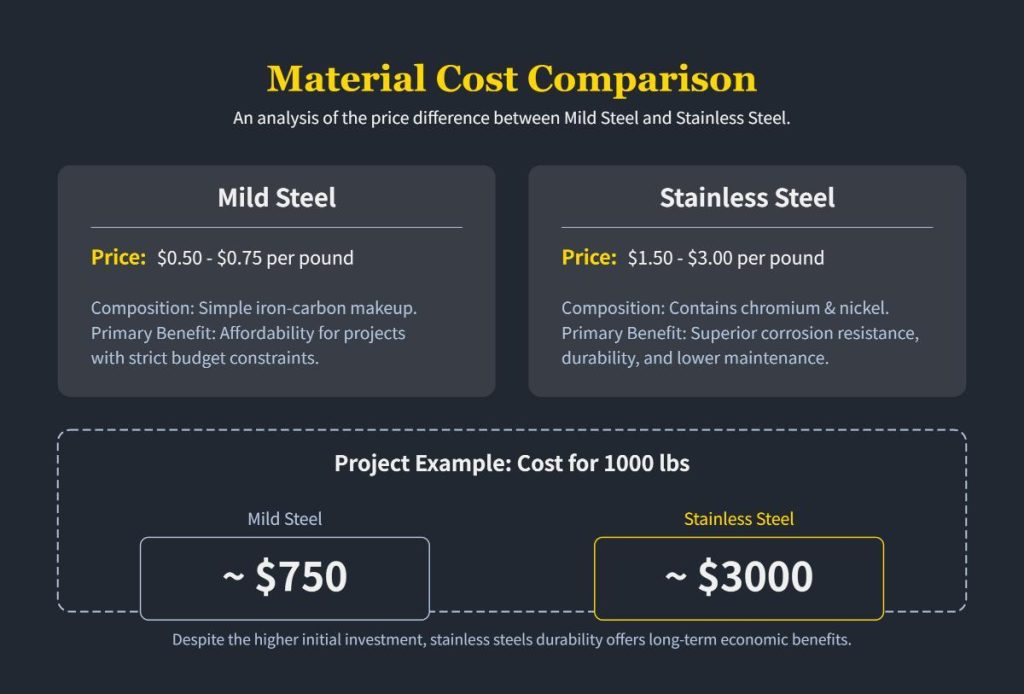
Raw Material Price Premiums
The baseline cost of raw metal stock fluctuates based on global commodity markets, particularly the London Metal Exchange (LME). When comparing raw alloy steel vs stainless steel, stainless steel invariably commands a premium.Alloy steels are primarily composed of iron and carbon, with small additions of relatively inexpensive elements like manganese or silicon, and modest amounts of chromium or molybdenum. Austenitic stainless steels (like 304 and 316), however, require massive concentrations of chromium (≥ 10.5%) and substantial amounts of highly expensive nickel (often 8% to 12%). The raw material cost for 316 stainless steel can easily be two to three times higher per pound than that of a high-strength 4140 alloy steel, creating a significant upfront financial hurdle for high-volume production runs.
CNC Machining and Tooling Overhead
As detailed in the cutting physics section, the machinability gap between these two material classes directly dictates the shop floor production costs. Because alloy steel is more forgiving to cut, CNC machines can run at higher spindle speeds and faster feed rates. This reduces overall cycle time, which lowers the machine cost per part.From a tooling perspective, stainless steel projects incur much higher overhead. The aggressive work-hardening behavior and poor thermal conductivity of stainless grades accelerate tool wear, meaning carbide inserts, end mills, and taps must be replaced or indexed far more frequently. The cost of specialized, multi-layer coated cutting tools and the machine downtime required to swap out worn tooling must be incorporated into part pricing.
Post-Processing and Surface Treatments
This is the one phase of production where the cost dynamic of alloy steel vs stainless steel flips.
An alloy steel component is rarely complete after it leaves the CNC machine; it almost always requires secondary operations. Whether it is through-hardening to achieve structural strength, or applying a surface plating (like zinc, nickel, or black oxide) to prevent rust, these secondary processes add logistics, lead time, and multi-stage vendor costs.Conversely, a stainless steel part generally requires no secondary coating. Once machined, it can simply be deburred and passivated (a chemical process using nitric or citric acid to clean the surface and enhance the protective oxide layer). Eliminating heat treatment and plating steps can significantly reduce post-processing cost and shorten production lead time for stainless components.
The Long-Term Lifecycle Calculation
The final step in the TCO evaluation is considering how the part performs over its entire operational lifespan.
The Case for Alloy Steel:
If a part operates in a protected environment—such as a sealed, oil-lubricated gearbox—specifying alloy steel delivers maximum strength and fatigue life at the lowest possible manufacturing cost. In this scenario, using stainless steel provides no additional functional benefit.
The Case for Stainless Steel:
If a component is deployed in corrosive or high-moisture environments such as offshore equipment or food processing systems, alloy steel will inevitably degrade due to corrosion and coating failure. This leads to maintenance interruptions and part replacement costs. In these conditions, stainless steel’s higher upfront cost is offset by reduced downtime and longer service life, making it the more economical choice over time.
Conclusion & Strategic Selection Framework
Navigating the trade-offs of alloy steel vs stainless steel comes down to balancing your operational environment against mechanical loads and budget. Neither metal is a one-size-fits-all solution; each serves a different engineering purpose.
- Choose Alloy Steel if: Your part faces heavy structural loads, high torque, or constant cyclic stress where fatigue resistance is a must. It is ideal for internal parts like gears, shafts, and linkages that operate in protected, oiled environments, or where secondary surface coatings can handle minor corrosion economically.
- Choose Stainless Steel if: Your main enemy is rust, chemical exposure, or strict sanitary rules. It is the go-to for medical, food-grade, marine, or outdoor applications where protective coatings might scratch or fail, and where saving long-term maintenance costs justifies the higher upfront material and machining price.
Turn Your Designs into Reality with XTPROTO
Transforming these metals into precision parts requires more than standard machining—it takes a deep understanding of metallurgy. At XTPROTO, we specialize in bridging the gap between complex CAD drawings and flawless physical components.Whether your project requires managing the high cutting forces of pre-hardened alloy steel or overcoming the severe work-hardening tendencies of 316 stainless steel, XTPROTO has the advanced CNC equipment, rigid setups, and tooling expertise to get the job done right.Don’t guess on material constraints or manufacturing steps alone. Head over to our dedicated Alloy Steel CNC Machining Services page to upload your drawings. The XTPROTO team will provide a fast, clear Design for Manufacturability (DFM) analysis and a competitive quote within 24 hours.