
Robotic CNC Machining: Automation for Precision & Efficiency
In today’s fast-paced manufacturing environment, robotic CNC machining is transforming how factories operate. By combining computer numerical control (CNC) machines with robotic arms, manufacturers can automate repetitive and complex machining tasks, achieving levels of precision and efficiency that are difficult to reach with human labor alone.
This technology is particularly valuable in industries where high accuracy, consistent quality, and fast turnaround times are critical—such as aerospace, automotive, medical devices, and electronics. Robotic CNC machining not only boosts productivity but also reduces human error, improves workplace safety, and helps companies stay competitive in an increasingly automated world.
With automation playing a central role in Industry 4.0, understanding the capabilities and benefits of robotic CNC systems is essential for manufacturers looking to scale operations, reduce costs, and maintain consistent product quality.
What Is Robotic CNC Machining?
To understand robotic CNC machining, one must first distinguish it from traditional CNC operations. In a standard setup, a CNC machine is a subtractive manufacturing tool that follows pre-programmed code to cut material. However, it often requires a human operator to load raw stock, flip parts, and clear finished goods.
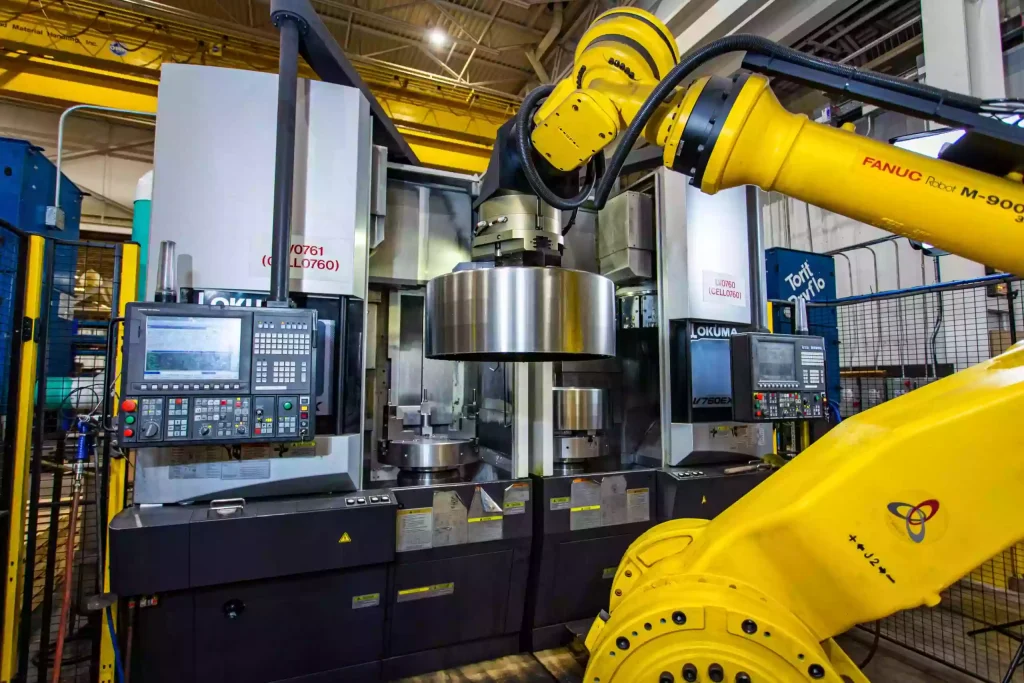
Robotic CNC machining evolves this process by integrating programmable robotic arms directly into the manufacturing workflow. This fusion creates a “machining cell” where the robot and the CNC machine communicate in real-time to execute tasks with minimal human intervention.
Core Technologies Involved
The magic of this integration lies in three primary components:
CNC Machines + Robotic Arms: While the CNC machine handles the high-torque, high-precision cutting, the robotic arm (typically a 6-axis articulated arm) handles the “geometry of movement.” This can mean moving parts in and out of the machine or, in some cases, holding the cutting tool itself to carve large-scale foam or composite molds.
End Effectors and Tool Changers: The “hand” of the robot, known as the End Effector, is what makes it versatile. Depending on the job, a robot can be equipped with vacuum grippers, pneumatic clamps, or even a motorized spindle. Automatic tool changers allow the robot to switch between “handling mode” and “processing mode” without stopping the line.
Control Systems and Software Coordination: This is the “nervous system” of the setup. Advanced PLC (Programmable Logic Controller) systems and specialized CAM software ensure that the robot’s path and the CNC’s spindle are perfectly synchronized. If the CNC door is closed, the robot knows to wait; if the part is finished, the CNC signals the robot to retrieve it.
The Key Difference: Flexibility
Traditional automation (like a dedicated bar feeder) is “hard” automation—it does one thing very well. Robotic CNC machining is “soft” automation. Because robots are multi-axis and easily reprogrammable, they can be pivoted from machining automotive gears to tending medical implants with just a software update.
How It Works
Robotic CNC machining works by seamlessly combining robotic automation with precision CNC machining to create a highly efficient production system. The process typically involves several coordinated steps that allow machines to operate continuously and accurately:
- Part Loading and Unloading
Robots are programmed to pick up raw materials or workpieces and load them into the CNC machine. After machining, the robot removes finished parts and places them in designated bins or conveyors. This eliminates the need for manual handling and speeds up production cycles. - Tool Handling and Changes
Many robotic CNC systems are equipped with automatic tool changers, allowing the robot to switch cutting tools without human intervention. This enables machining of complex parts with multiple operations in a single setup. - Secondary Operations
In advanced setups, robots can perform finishing operations such as polishing, deburring, or quality inspection. Some systems use vision sensors to ensure parts meet precise dimensional tolerances before they leave the machine. - Integrated Control Systems
The CNC machine and robot are synchronized through integrated software, often combining CNC programming with robotic path planning. This ensures that the robot moves in perfect coordination with the machining process, maintaining efficiency and safety. - Continuous Monitoring and Feedback
Modern robotic CNC systems include monitoring software that tracks machine performance, tool wear, and part quality in real time. This allows for predictive maintenance, reducing downtime and improving overall efficiency.
By automating repetitive and time-consuming tasks, robotic CNC machining increases productivity, reduces errors, and frees operators to focus on higher-value activities. Whether in aerospace, automotive, medical, or electronics manufacturing, this combination of robotics and CNC machining is redefining modern production workflows.
Key Benefits of Robotic CNC Machining
Integrating robotics with CNC machining offers manufacturers numerous advantages, making robotic CNC machining a valuable solution for modern production. Here are the key benefits:
1. Increased Productivity
Robots can operate 24/7 without fatigue, significantly boosting machine utilization and throughput.
Automation reduces idle time between operations, allowing for faster turnaround on high-volume or complex parts.
2. Enhanced Precision and Consistency
Robotic CNC systems maintain exact tolerances across every part, reducing human error.
Consistent machining quality improves overall product reliability, which is critical in industries like aerospace and medical devices.
3. Cost Savings
While initial investment may be higher, long-term savings come from reduced labor costs and minimized scrap due to errors.
Robots help optimize tool usage and reduce material waste, increasing operational efficiency.
4. Flexibility and Scalability
Robotic CNC systems can handle multiple part types without extensive reprogramming.
Ideal for both low-volume prototyping and high-volume production, enabling manufacturers to scale quickly.
5. Improved Safety
Robots take over repetitive, heavy, or hazardous tasks, protecting human operators from workplace injuries.
Automation reduces operator exposure to sharp tools, hot surfaces, or toxic materials.
6. Seamless Integration with Industry 4.0
Many robotic CNC setups can connect to factory networks, enabling real-time monitoring and smart analytics.
Integration allows predictive maintenance, automated quality control, and data-driven process improvements.
By combining the precision of CNC machines with the flexibility and reliability of robots, robotic CNC machining empowers manufacturers to optimize production, reduce costs, and stay competitive in today’s rapidly evolving industrial landscape.
Real World Applications of Robotic CNC Machining
Robotic CNC machining is not just a concept—it’s actively transforming production across multiple industries. Here are some of the most impactful applications:
1. Aerospace
Robots assist in machining turbine blades, structural components, and precision airframe parts.
Automation ensures extremely tight tolerances and consistent quality, which are critical for safety and performance.
2. Automotive
Engine components, gearboxes, and chassis parts are increasingly produced using robotic CNC systems.
Continuous operation allows manufacturers to meet high-volume production demands without compromising precision.
3. Medical Devices
Surgical instruments, implants, and prosthetics require exacting accuracy.
Robotic CNC machining enables manufacturers to produce complex geometries reliably and with minimal human handling, reducing contamination risks.
4. Electronics and Semiconductors
Precision housings, connectors, and specialized components benefit from robot-assisted CNC machining.
Small tolerances and delicate parts are handled efficiently, improving throughput while maintaining quality.
5. General Industry and Custom Manufacturing
Molds, dies, consumer products, and specialized components can all be efficiently machined.
Robotic CNC systems provide the flexibility to switch between different production runs quickly, making them ideal for low- to medium-volume manufacturing.
By applying robotic CNC machining across these sectors, manufacturers gain a competitive edge through increased productivity, improved quality, and reduced operational risks.
Integration Challenges: Navigating the Implementation
While the benefits are clear, transitioning to a robotic CNC setup comes with a unique set of technical and operational hurdles. Understanding these early can save a manufacturer months of downtime and significant capital.
Synchronization and Communication
The robot and the CNC machine must speak the same language.
The “Handshake” Protocol: Establishing a reliable communication link (via Profinet, Ethernet/IP, or DeviceNet) is critical. If the robot attempts to load a part before the CNC chuck has fully opened, the result is an expensive mechanical collision.
Latency Issues: Even a millisecond of delay in signal transmission can disrupt the harmony of a high-speed cell. (rotec-ltd.com)
Software Compatibility (CAD/CAM Sync)
One of the biggest bottlenecks is the digital workflow.
Unified Programming: Traditionally, CNCs use G-code, while robots use proprietary languages (like ABB’s RAPID or Fanuc’s KAREL).
The Solution: Modern integration requires sophisticated CAD/CAM software that can simulate both the toolpath and the robot’s arm movement simultaneously to detect potential collisions in a virtual environment before they happen on the shop floor.
Maintenance and Predictive Upkeep
A robotic cell is a complex system with many moving parts.
Wear and Tear: Robotic joints and end effectors require regular calibration to maintain precision over years of 24/7 operation.
The “Single Point of Failure”: If the robot goes down, the entire CNC cell stops. This necessitates a shift toward predictive maintenance, using sensors to detect vibration or heat signatures before a component fails. (rotec-ltd.com)
Safety Protocols and Standards
Integrating a fast-moving robotic arm into a space where humans might enter requires strict adherence to safety standards (such as ISO 10218).
Physical vs. Virtual Barriers: While traditional fences are common, many modern shops are moving toward light curtains and area scanners that slow down or stop the robot when a person approaches.
Risk Assessment: Every new part or tool change requires a fresh safety evaluation to ensure the robot’s movements don’t create new “pinch points.”
Industry 4.0 & Future Trends: The Next Frontier
The integration of robotics and CNC machining is a centerpiece of the Fourth Industrial Revolution (Industry 4.0). We are moving beyond simple repetitive tasks toward autonomous systems that can think, adapt, and communicate.
IoT Connectivity & Smart Monitoring
Modern robotic cells are no longer isolated islands of automation.
Real-Time Data: Through IoT (Internet of Things), sensors on both the robot and the CNC machine feed data to a central dashboard.
Remote Management: Managers can monitor spindle speeds, cycle times, and error logs from a smartphone anywhere in the world. (Source: Yijin Solution)
AI and Machine Learning Optimization
Artificial Intelligence is changing how we program these machines.
Path Optimization: AI algorithms can analyze thousands of machining cycles to find the most efficient movement path for a robot arm, shaving seconds off every cycle.
Self-Correction: Future systems will use Machine Learning to detect tool wear or thermal expansion. If a part starts to drift out of tolerance, the AI can automatically adjust the robot’s positioning or the CNC’s offsets in real-time. (Source: Yijin Solution)
Collaborative Robots (Cobots)
The rise of Cobots is lowering the barrier to entry for smaller machine shops.
Human-Robot Synergy: Unlike traditional industrial robots that must be caged for safety, cobots are designed with force-limiting sensors to work alongside human operators.
Ease of Programming: Most cobots feature “lead-through” programming, where an operator can physically move the arm to teach it a path, making them ideal for high-mix, low-volume production. (rotec-ltd.com)
Fully Autonomous Machining Cells
The ultimate goal of Industry 4.0 is the “Dark Factory”—a facility that requires zero human presence on the floor.
Integrated Logistics: Future trends show robots not just tending a single machine, but navigating the floor on AMRs (Autonomous Mobile Robots) to move parts between different CNC stations, cleaning stations, and quality control docks.
Economic & Sustainability Impacts of Robotic CNC Machining
Implementing robotic CNC machining offers both financial and environmental benefits, making it an attractive investment for modern manufacturers.
Cost Efficiency and ROI
Although the initial investment in robots and CNC integration can be significant, long-term savings are substantial.
Reduced labor costs, lower scrap rates, and higher throughput contribute to faster return on investment (ROI).
Automation minimizes errors, which reduces waste and rework costs, directly improving the bottom line.
Energy and Resource Savings
Robotic CNC systems optimize machine usage and material handling, leading to less energy consumption per part.
Precision machining reduces excess material removal, lowering raw material costs and waste.
Sustainable Manufacturing
By cutting down on scrap, energy use, and manual intervention, robotic CNC machining supports environmentally responsible production.
Companies can align with green manufacturing initiatives and meet sustainability targets without sacrificing productivity.
Scalability for Growth
Robotic CNC systems allow manufacturers to scale production efficiently while maintaining consistent quality.
Flexible automation supports both small-batch custom orders and large-volume industrial production, maximizing economic advantage.
In summary, robotic CNC machining not only improves operational efficiency but also delivers measurable economic and environmental benefits, making it a smart choice for companies aiming for sustainable, high-performance manufacturing.
Choosing the Right Robotic CNC Solution
Selecting the right robotic CNC machining system is crucial to maximize efficiency, reduce costs, and ensure consistent product quality. Here are key considerations for manufacturers:
1. Match Robot Type to Task
Articulated robots offer high flexibility for complex part handling and multi-axis operations.
SCARA robots are ideal for fast, repetitive pick-and-place tasks.
Gantry robots excel in handling large or heavy workpieces with precision.
2. Assess Production Volume and Part Complexity
For high-volume production, fully integrated robotic CNC cells provide continuous operation and minimal downtime.
For low- to medium-volume or custom parts, flexible robotic setups allow quick reprogramming and adaptation.
3. Consider Integration Capabilities
Ensure the robotic system is compatible with existing CNC machines, software, and factory automation protocols.
Look for solutions that support vision systems, automated tool changers, and real-time monitoring for seamless operation.
4. Evaluate Total Cost of Ownership (TCO)
Factor in not just upfront purchase costs, but also maintenance, software updates, energy use, and operator training.
A higher initial investment may be justified by long-term savings, improved throughput, and reduced errors.
5. Prioritize Safety and Compliance
Confirm that the system meets safety standards for human-robot interaction.
Consider enclosures, sensors, and emergency protocols to protect operators and maintain compliance with industry regulations.
By carefully evaluating these factors, manufacturers can select a robotic CNC machining solution that delivers maximum efficiency, flexibility, and return on investment, while supporting safe and sustainable production.
Conclusion
Robotic CNC machining is revolutionizing modern manufacturing by combining the precision of CNC machines with the efficiency and flexibility of industrial robots. From aerospace and automotive to medical devices and electronics, this technology allows manufacturers to achieve higher productivity, consistent quality, and improved safety, all while reducing labor costs and material waste.
As industries move toward Industry 4.0, the integration of robotics with CNC machining is becoming increasingly intelligent, with IoT connectivity, AI-driven optimization, and collaborative robots shaping the future of production. Choosing the right system, considering factors like robot type, part complexity, and integration capabilities, ensures maximum efficiency and a strong return on investment.
By adopting robotic CNC machining, manufacturers can stay competitive, scale their operations efficiently, and embrace sustainable production practices—making it a critical technology for the factories of today and tomorrow.
FAQ
What is robotic CNC machining and how does it differ from a standard CNC machine?
Robotic CNC machining utilizes a high-precision CNC robotic arm equipped with a spindle to perform cutting, milling, or drilling tasks. Unlike a traditional 3-axis or 5-axis CNC machine which is limited by its “box” work envelope, a CNC robot offers a much larger reach and greater degrees of freedom, making it ideal for processing oversized or complex-shaped workpieces.
Is robotic CNC machining suitable for all materials?
It is exceptionally effective for materials like plastics, foams, wood, and composites. For metal CNC machining, a specialized, high-stiffness robot arm is required to handle the cutting forces. Many manufacturers use robotic CNC machining for trimming carbon fiber parts or creating large-scale aluminum molds where reach is more critical than extreme sub-micron tolerances.
How difficult is it to program a CNC robotic arm?
Modern software has bridged the gap between traditional CNC programming and robotics. Today, you can use specialized CAM software to generate toolpaths for a CNC robot just as you would for a 5-axis mill. This “offline programming” allows the robot arm to simulate the entire process before the first cut, ensuring safety and accuracy.