
The Ultimate Guide to Tool Steel CNC Machining:Engineering Principles, Metallurgy, and Cutting Physics Explained
Tool steels like D2, H13, S7, and M2 don’t behave like typical engineering metals.
Anyone who has tried machining them with “normal steel parameters” usually learns this the hard way—tool wear spikes immediately, cutting edges chip without warning, and parts that look acceptable in the annealed state often shift after heat treatment.
The reason is not just hardness. It’s how the material is built.
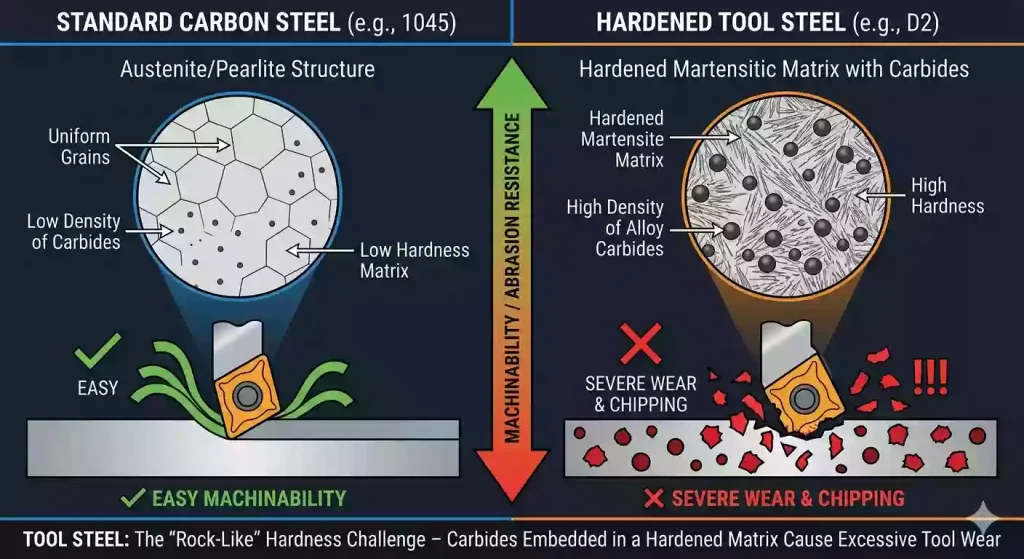
Tool steel is essentially a hardened martensitic matrix reinforced with a dense distribution of alloy carbides. These carbides are not evenly distributed at a machining scale—they act like embedded hard particles throughout the cutting path.
So instead of a clean, continuous cutting action, the tool is constantly hitting a mixed structure: relatively tough matrix material interrupted by extremely hard carbide phases. Some of these carbides are harder than the cutting edge itself, which is why flank wear and micro-chipping show up so quickly in real production.
Thermally, the situation is just as challenging.
Tool steels don’t conduct heat efficiently. During cutting, most of the generated heat stays concentrated right at the tool–chip interface instead of being carried away by the material or chip flow. That’s why you see rapid edge softening, coating breakdown, and thermal fatigue even when feeds and speeds don’t look extreme on paper.
In practice, this combination of abrasive microstructure and localized heat makes tool steel machining less about “removal rate” and more about controlling instability. You’re not simply cutting harder material—you’re managing a process where mechanical load, heat buildup, and tool degradation are all happening at the same time, and they escalate quickly once the balance is lost.
Tool Steel Metallurgy & Machinability Science
To understand why tool steel behaves the way it does during machining, you have to look at what’s actually inside the material—not just the grade name on the drawing.
Tool steels are not uniform alloys. They are composite microstructures made up of a hardened martensitic matrix with alloy carbides distributed throughout. This internal structure is what gives them wear resistance, but it’s also the main reason they are difficult to cut.
During heat treatment, carbon combines with alloying elements such as chromium, vanadium, and molybdenum to form extremely hard carbide phases. These particles are locked into the steel matrix after quenching, and they don’t disappear during machining. Instead, they become fixed abrasive points that the cutting edge has to repeatedly shear through.
Vanadium carbides are the most aggressive in this system. They are extremely hard and behave almost like internal abrasives embedded in the material. Chromium carbides contribute more to overall wear resistance, but they still increase cutting resistance significantly. Molybdenum and tungsten carbides add thermal stability, which is why grades like M2 and M42 remain hard even under high cutting temperatures—but that also means the cutting tool is exposed to sustained high stress for longer periods.
This is where machinability starts to diverge sharply between different tool steel families.
Cold work steels like D2 contain a high volume of hard carbides, which makes them highly wear resistant but very abrasive during cutting. Hot work steels like H13 have a more balanced carbide structure, so they are slightly easier to machine, especially in the annealed state. High-speed steels such as M2 and M42 sit at the extreme end—they are designed to retain hardness at elevated temperatures, which directly translates into high cutting resistance during CNC operations.
What’s important here is that hardness alone does not define machinability. Two materials can show similar Rockwell hardness in the annealed state, but behave completely differently once cutting starts. The difference comes from carbide density, size, and distribution—not just bulk hardness values.
In practice, this is why tool steel machining is always grade-dependent. The cutting strategy that works for H13 will fail quickly on D2, even if their hardness readings look close on paper. The material response is governed more by microstructure than by nominal hardness.
The Physics of Tool Steel Cutting: Heat, Force, and Instability
Once cutting starts, tool steel stops behaving like a solid block of metal and starts behaving more like a system under extreme stress.
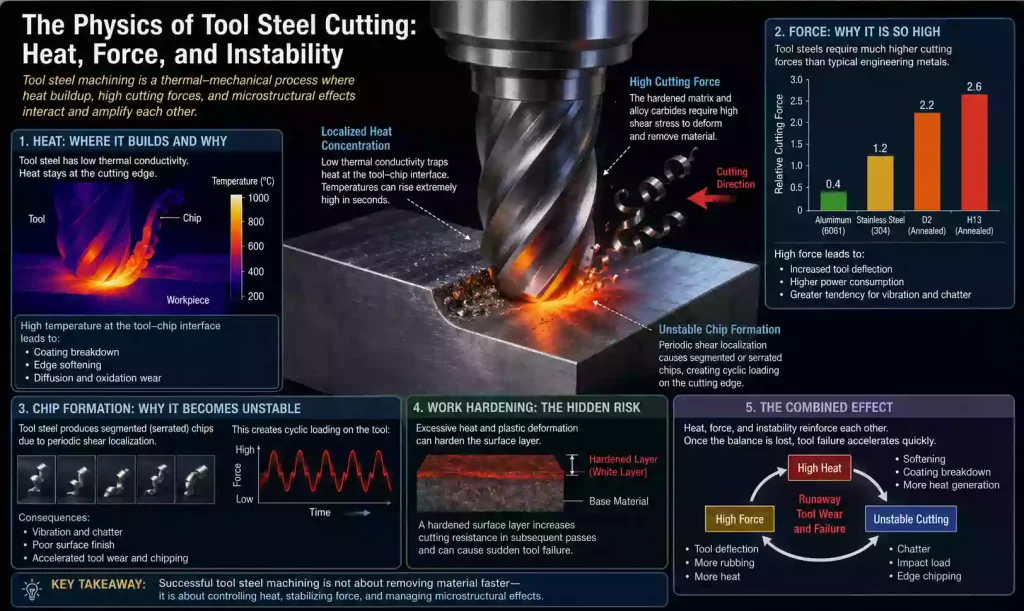
The first thing that becomes obvious in production is cutting force. Tool steels require significantly higher shear stress to remove material compared to aluminum or even stainless steel. This is not just because they are harder, but because the microstructure actively resists deformation. The martensitic matrix is already highly strained, and the embedded carbides interrupt shear continuity, forcing the cutting edge to work in a highly discontinuous load environment.
But the more critical issue is not force—it’s heat.
Tool steel has relatively low thermal conductivity, which means heat generated during cutting does not flow into the bulk material efficiently. Instead, it accumulates directly at the tool–chip interface. In real machining conditions, this localized zone can reach extreme temperatures within seconds, even when the spindle speed does not appear excessive on the surface.
This creates a situation where mechanical stress and thermal stress are acting on the cutting edge at the same time. The tool is not just cutting—it is also operating under continuous thermal loading, which accelerates coating breakdown, edge softening, and diffusion wear.
Chip formation also becomes unstable.
Instead of smooth, continuous chips, tool steel tends to generate segmented or serrated chip patterns. This is a direct result of periodic shear localization inside the material. Each segment forms under high stress, then fractures away suddenly, creating a cyclic load on the cutting tool. That cyclic loading is one of the main reasons tool steel machining often produces chatter even on rigid machines.
There is also a less obvious but very important effect: localized work hardening.
Under incorrect cutting parameters, the surface layer of tool steel can harden during machining due to rapid plastic deformation and heat concentration. This creates a thin hardened layer that is significantly more resistant than the base material. Once this layer forms, subsequent tool passes encounter a much harder surface than expected, which often leads to sudden tool failure if the condition is not controlled.
In practice, this is why stable tool steel machining is not achieved by simply selecting a “stronger tool.” It depends on controlling how energy is introduced into the cut—how heat is distributed, how force fluctuates, and how chip formation is stabilized over time.
CNC Strategies for Tool Steel Machining: Controlling Engagement, Not Forcing Removal
Once you understand how tool steel reacts under heat and stress, the next realization is simple: most conventional milling strategies are not stable in this material.
The biggest issue with traditional toolpaths is how they manage tool engagement. In standard slotting or full-width pocketing, the cutter is constantly exposed to high radial engagement. This means a large portion of the tool is in contact with the material at all times, which immediately increases heat generation and cutting force in a nonlinear way.
In tool steel, this quickly becomes unstable.
High engagement does not just increase load—it traps heat. Because the material does not dissipate thermal energy efficiently, the tool ends up cutting in a self-heating environment where every pass slightly worsens the conditions for the next one. This is why tool life in tool steel often drops suddenly rather than degrading gradually.
To avoid this, modern tool steel machining shifts away from full engagement cutting and moves toward controlled engagement strategies.
Instead of maximizing material removal per pass, the focus becomes maintaining a stable cutting load. This is typically achieved by reducing radial engagement significantly while increasing axial depth. The goal is not to reduce cutting effort, but to distribute it in a way that avoids sudden thermal spikes and mechanical shock.
When this approach is implemented correctly, the cutter remains in a more consistent load state. Heat is carried away more effectively through chip evacuation rather than being absorbed into the tool or workpiece. This alone can dramatically improve stability, especially in high-carbide grades like D2 or M2.
Another critical factor is toolpath continuity.
Tool steel does not respond well to abrupt directional changes. Sharp cornering or sudden engagement shifts cause instantaneous spikes in cutting force, which often exceed the mechanical limit of the cutting edge. This is why smoother, continuous toolpaths are preferred—they reduce load fluctuation and prevent localized stress concentration.
In real production environments, this is where CAM strategy becomes more important than spindle power or machine size. A poorly designed toolpath on a high-end machine will still fail, while a well-optimized path on a mid-range machine can produce stable results.
Ultimately, machining tool steel is not about cutting harder. It is about preventing instability from forming in the first place—by controlling how the tool enters, stays in, and exits the material.
Machine & Tooling Limits (Rigidity Matters)
Even with optimized cutting strategies, tool steel machining is still heavily constrained by the physical limits of the machine system itself.
Unlike aluminum or mild steel, tool steel does not tolerate structural flexibility. Any small deflection in the machine frame, spindle, or tool holder is immediately reflected at the cutting edge as vibration, chatter, or edge instability.
In high-hardness cutting, the process is no longer defined only by toolpath or cutting parameters. It becomes a coupled system between machine rigidity, spindle accuracy, tool holding stiffness, and vibration damping capacity.
Even microscopic spindle runout can significantly amplify cutting edge stress under high radial load conditions. This is why machine rigidity is not a supporting factor—it is part of the cutting stability itself.
Tool holding systems also play a critical role. Under high cutting forces, insufficient clamping rigidity leads to micro-movement between tool and spindle interface. This introduces dynamic imbalance, which accelerates tool wear and often results in sudden edge failure rather than gradual degradation.
At the same time, vibration behavior becomes more pronounced in tool steel due to its high cutting resistance and discontinuous chip formation. Once chatter begins, it quickly escalates because each vibration cycle increases variation in chip load, creating a self-reinforcing instability loop.
In practice, this means that no cutting strategy can compensate for insufficient machine rigidity. Tool steel machining is fundamentally limited by system stiffness before it is limited by programming or tool selection.
Heat Treatment & Why It Breaks Geometry
Tool steel components are rarely finished in the state they are machined. Most parts undergo heat treatment to achieve final hardness, which introduces a separate set of physical transformations that directly affect dimensional accuracy.
During austenitizing and quenching, the steel undergoes a phase transformation from austenite to martensite. This transformation is accompanied by volumetric expansion, typically in the range of 0.5% to 1.5%, depending on alloy composition and section thickness.
This expansion is not uniform. Complex geometries, varying wall thicknesses, and asymmetric material distribution cause uneven thermal response during quenching. As a result, internal stress gradients develop across the part, leading to distortion such as warping, twisting, or localized dimensional drift.
In addition to phase transformation, residual stresses from prior machining operations are also released during heat treatment. If rough machining was not properly balanced, these stresses can significantly amplify post-heat-treatment deformation.
Another critical factor is decarburization. When heat treatment is performed in a non-protective atmosphere, carbon loss at the surface can create a soft outer layer that does not respond uniformly to hardening. This leads to inconsistent surface properties and requires additional post-process correction.
Because of these effects, tool steel machining must always account for post-heat-treatment behavior. Final dimensions are not achieved during rough machining—they are achieved through a controlled sequence of machining, heat treatment, and precision finishing.
Hard Finishing After Heat Treatment
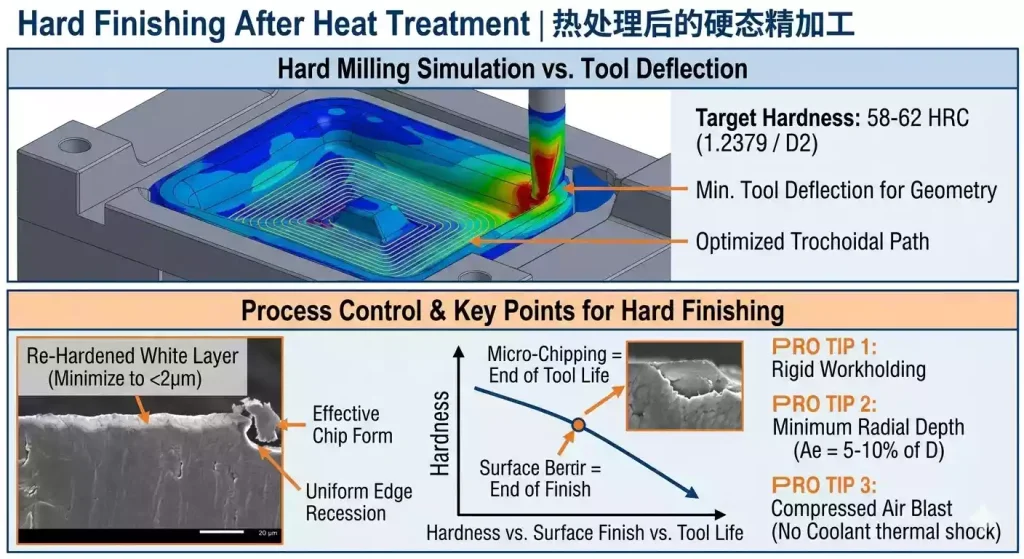
Once tool steel has been heat treated to its final hardness—typically in the range of 48–62 HRC—the material enters a completely different machining regime. At this stage, conventional milling is no longer the primary shaping method. Instead, finishing becomes a controlled removal of distortion rather than bulk material cutting.
The key issue after heat treatment is dimensional instability. Even when parts are machined accurately in the annealed state, quenching and tempering introduce volumetric changes and residual stress redistribution. As a result, surfaces that were previously within tolerance often shift out of specification.
This is why hard finishing is not an extension of rough machining—it is a correction process.
For open geometries and functional surfaces, hard milling can still be applied, but only under highly controlled conditions. The cutting tool is now operating directly on hardened martensitic structure, which significantly increases edge stress and reduces tool life. Tool engagement must therefore remain shallow and stable to avoid micro-chipping and thermal overload.
For tighter tolerances, grinding becomes the dominant process. Unlike cutting, grinding removes material through controlled abrasive interaction at a microscopic scale. This allows dimensional correction down to micron-level precision while minimizing mechanical deformation of the workpiece. However, thermal burn risk must be strictly controlled, as excessive localized heat can alter surface integrity.
For internal features and complex geometries, EDM becomes the only viable solution. Since electrical discharge machining does not rely on mechanical force, it can process hardened tool steel regardless of hardness level. This makes it essential for sharp internal corners, deep cavities, and fine detail features that cannot be reached by mechanical tools.
In practice, hard finishing is less about shaping and more about restoring geometry after transformation. It is the stage where final accuracy is recovered from the distortion introduced by heat treatment.
Surface Engineering (Optional Performance Layer)
Once the geometry of a tool steel component is finalized through hard milling, grinding, or EDM, the next question is no longer dimensional accuracy, but surface behavior under real working conditions. In many applications, especially molds, dies, and wear components, the bulk hardness of tool steel is not sufficient on its own. The surface must be engineered to resist friction, adhesion, corrosion, and thermal fatigue.
Surface engineering in tool steel is therefore not cosmetic—it is functional.
The most common approach is physical vapor deposition (PVD) coating. Unlike bulk heat treatment, PVD does not change the internal structure of the steel. Instead, it deposits a thin, high-hardness film onto the surface under vacuum conditions. This coating typically operates in the micrometer range, but its impact on wear resistance is significant because it directly modifies the tool–workpiece interface.
Among PVD coatings, TiN is often used as a baseline option. It provides a stable, low-friction surface and improves resistance to adhesive wear. However, for high-temperature or high-load applications, advanced coatings such as AlTiN are more relevant. These coatings maintain stability at elevated cutting temperatures and form a protective oxide layer during operation, which slows down oxidation and surface degradation.
For components exposed to sliding contact or cyclic loading, nitriding is often more appropriate than coating. In this process, nitrogen is diffused into the surface layer of the steel, forming hard nitrides within the diffusion zone. The result is a surface with significantly higher hardness and compressive residual stress, while the core remains tough and ductile. This combination is particularly useful in applications where impact resistance and fatigue life are critical.
Unlike coatings, nitriding becomes part of the material itself rather than a separate layer. This makes it more resistant to peeling or delamination under mechanical stress.
In practice, surface engineering is selected based on failure mode rather than material preference. If the dominant issue is abrasion, coatings are preferred. If the failure mechanism involves fatigue or impact loading, diffusion-based treatments like nitriding are more suitable.
At this stage, the tool steel component transitions from being simply a machined part into a functionally engineered surface system designed for a specific working environment.
Design Rules for Manufacturability (DFM)
Tool steel performance is not determined only on the shop floor. In most real cases, the biggest cost, risk, and failure mode are actually locked in during the design stage. Once a geometry is released that ignores machining physics and heat treatment behavior, no amount of process control can fully recover it.
This is why DFM for tool steel is not about convenience—it is about preventing irreversible manufacturing risk.
One of the most critical rules is internal corner design. Sharp internal corners should always be avoided in tool steel components. From a machining perspective, a cutter cannot physically achieve a true zero-radius internal corner, which means it must either overcut or dwell at the edge. Both conditions create localized stress concentration, increased tool engagement, and sudden load spikes that significantly reduce tool life. In hardened tool steel, this also increases the risk of micro-cracking at the cutting interface.
A practical design approach is to always introduce a fillet radius that is compatible with standard tooling geometry, rather than forcing idealized CAD geometry. The transition between surfaces should be smooth and continuous, not abrupt.
Wall thickness is another critical factor. Tool steel components that undergo heat treatment must maintain sufficient structural mass to resist thermal gradient distortion. Thin walls cool faster than thick sections during quenching, which creates uneven martensitic transformation. This mismatch generates internal stress that often results in warping or permanent deformation after hardening. In practice, extremely thin sections also become unstable during machining due to vibration and deflection.
Threading strategy is also highly dependent on process sequence. Whenever possible, threads should be completed in the annealed state before heat treatment. Attempting to machine threads in hardened tool steel significantly increases tool wear and breakage risk. In cases where post-hardening adjustment is required, thread milling is generally preferred over tapping due to its controlled cutting engagement and lower failure sensitivity.
Another key consideration is stock allowance strategy. Tool steel components are rarely finished to final dimension before heat treatment. Instead, controlled stock is intentionally left on functional surfaces to compensate for volumetric changes and distortion during hardening. This stock is then removed during final grinding or EDM finishing to recover dimensional accuracy.
From a design perspective, this means that final geometry is not a single-stage output. It is the result of a planned deformation and correction cycle.
In summary, DFM for tool steel is not about optimizing machining alone. It is about designing a part that can survive machining, survive heat treatment, and still be corrected back into tolerance after all transformations have occurred.
Cost Structure & Procurement Reality
Tool steel machining cost is often misunderstood because it is usually evaluated using the same logic as standard aluminum or stainless steel parts. In reality, the cost structure is fundamentally different because the dominant cost drivers are not cutting time, but instability, tool wear, and post-process correction.
At the simplest level, machining time is only one part of the equation. In tool steel, tool consumption often becomes a larger cost factor than spindle time. High carbide content materials such as D2 or M2 accelerate flank wear and micro-chipping, which shortens tool life dramatically. In production environments, this does not translate into predictable wear—it often shows up as sudden failure, which interrupts machining cycles and increases scrap risk.
Another major cost component is heat treatment. Unlike standard machining processes, tool steel components almost always require controlled thermal processing to achieve final hardness. This introduces additional costs in energy, cycle time, and more importantly, dimensional risk. Every heat treatment cycle carries a probability of distortion, which directly affects downstream grinding or EDM correction work.
Scrap risk is one of the least visible but most critical cost factors. A part may go through rough machining, stress relief, and heat treatment successfully, but still fail during final finishing due to unexpected deformation or micro-cracking. At this stage, the cumulative cost is already high, which makes any failure disproportionately expensive compared to early-stage scrap.
From a procurement perspective, selecting the lowest machining quote is often misleading. Lower-cost suppliers typically reduce process control, simplify heat treatment management, or minimize finishing allowance strategies. While this may reduce upfront pricing, it increases the probability of dimensional instability and inconsistent part life in real applications.
A more accurate way to evaluate cost is through lifecycle thinking. Instead of focusing on per-part machining price, the real metric is total usable output—how many functional, in-tolerance parts are actually delivered after all process losses are accounted for.
In many cases, a higher initial cost process with controlled machining, vacuum heat treatment, and precision finishing results in lower total cost because it reduces scrap rate and stabilizes final yield.
Tool steel procurement is therefore not a price competition. It is a risk management decision that balances material cost, process stability, and final performance reliability.
Engineering Summary: Why Tool Steel Requires System Thinking
Tool steel machining cannot be accurately described as a single manufacturing process. It is better understood as a tightly coupled system where material behavior, cutting physics, heat treatment response, and finishing strategy all interact and continuously influence each other.
If any one stage is optimized in isolation, the overall system tends to fail. A perfectly executed CNC roughing strategy can still produce a rejected part if heat treatment distortion is not accounted for. A well-controlled hard milling process can still fail if the initial stress distribution was not properly managed. Even precise grinding cannot fully recover a geometry that was not designed with thermal transformation in mind.
This is why tool steel production is fundamentally different from conventional machining workflows. It is not linear. It is interdependent.
At the material level, tool steel is defined by its microstructure—martensitic matrices reinforced with alloy carbides. This structure is what gives it strength in service, but also what makes it resistant to machining. At the process level, cutting is governed by localized heat concentration, intermittent chip formation, and unstable load conditions. At the system level, machine rigidity, tooling selection, and toolpath strategy determine whether cutting remains stable or collapses into vibration and failure.
After machining, heat treatment introduces another transformation layer. Phase changes and stress redistribution alter geometry in ways that cannot be fully predicted without understanding both design intent and material response. Final accuracy is only achieved through controlled correction methods such as grinding or EDM, which act as stabilization steps rather than primary shaping operations.
Because of this layered complexity, successful tool steel manufacturing depends on integration rather than segmentation. CNC machining programming, metallurgy, heat treatment, and finishing cannot be treated as separate disciplines. They must operate as a single coordinated process with shared assumptions about material behavior and dimensional evolution.
In practice, this means that tool steel is not “machined” in the traditional sense. It is engineered through a sequence of controlled transformations, each one compensating for the effects of the previous stage.
The real engineering challenge is not cutting harder materials. It is controlling how those materials change across the entire production lifecycle—and ensuring that every transformation still converges back to a functional, dimensionally stable final part.