
PPS CNC Machining Guide: The Engineering Guide to Precision Machining PPS Plastic
PPS, short for Polyphenylene Sulfide, is a high-performance engineering plastic positioned between standard industrial plastics and advanced materials like PEEK.
It is widely used in applications that require heat resistance, chemical stability, and long-term dimensional consistency, especially where materials like Nylon or Acetal would gradually deform or absorb moisture over time.
From a CNC machining perspective, PPS behaves differently from most general-purpose engineering plastics. It is more rigid and dimensionally stable during cutting, but also less forgiving. Sharp edges can chip, thin sections may crack under excessive cutting force, and reinforced grades such as glass-filled PPS can significantly increase tool wear.
While datasheets typically focus on mechanical strength, thermal resistance, and chemical compatibility, they do not fully describe how PPS behaves during machining. In practice, performance is also influenced by cutting heat, brittleness at thin features, fiber reinforcement effects, and stability during longer machining cycles.
This guide focuses specifically on PPS from a CNC machining perspective — how it behaves during cutting, what common issues occur, and what design and process decisions help improve machining stability and part quality.
Understanding PPS Material Properties
Before looking at how PPS behaves during CNC machining, it helps to first understand what kind of material it actually is. Many of the machining characteristics of PPS — including its dimensional stability, brittleness, thermal behavior, and tool wear tendencies — are directly connected to its underlying material properties.
What Is PPS Plastic?
PPS (Polyphenylene Sulfide) is a high-performance semi-crystalline thermoplastic used in applications that require heat resistance, chemical resistance, and long-term dimensional stability.
It is commonly used in industrial components such as electrical housings, pump parts, and precision mechanical structures where standard plastics are not sufficient.
Unlike general-purpose plastics, PPS is designed for stability under harsh operating conditions, making it suitable for precision engineering applications.
Key Mechanical and Thermal Properties of PPS
Once you understand what PPS is, the next step is to look at the properties that actually influence how it behaves during CNC machining. On paper, PPS looks like a stable high-performance plastic, but in practice, a few key properties are what really define how it cuts, holds tolerance, and reacts under tool pressure.
High Temperature Resistance
PPS maintains its mechanical strength at temperatures where many engineering plastics begin to soften or deform. This is one reason it’s used in environments close to motors, heaters, chemical systems, and electrical assemblies.
From a machining point of view, this high temperature resistance is a double-edged sword. The material itself does not easily melt or smear like lower-grade plastics, which helps surface finish stay cleaner during cutting. But at the same time, any heat generated during machining tends to stay localized at the cutting zone instead of being absorbed and dissipated quickly. This is why overheating can still cause issues like edge chipping or slight surface whitening, especially on fine features.
Chemical Resistance
PPS is resistant to a wide range of chemicals, including acids, alkalis, and many industrial solvents. This is why it often appears in chemical processing equipment, pump components, and valve systems.
While this property doesn’t directly affect machining behavior, it does explain why PPS parts are often used in applications where long-term exposure is harsh. In other words, the parts you machine from PPS are usually expected to survive environments where other plastics would degrade over time. That expectation often pushes tighter tolerances and more demanding design requirements.
Low Moisture Absorption
One of the practical advantages of PPS is its very low moisture absorption compared to materials like Nylon. It does not swell or shrink significantly with humidity changes.
In machining, this makes PPS more predictable. A part that is machined to size is likely to stay close to that size after machining and during storage. There is less need to compensate for post-machining dimensional drift caused by environmental moisture.
However, this stability also means PPS does not “self-relieve” internal stresses as easily as some softer plastics. Any stress introduced during machining tends to stay in the part, which can show up later as slight warping or distortion if the part is not machined properly.
Dimensional Stability
Dimensional stability is one of the main reasons PPS is selected for precision components.
It has relatively low creep compared to many thermoplastics, meaning it resists slow deformation under load. It also maintains shape well over time, even in changing thermal environments.
For CNC machining, this is important because it allows tighter and more reliable tolerances. Features like sealing surfaces, alignment holes, and mating interfaces can remain consistent over time.
But again, this stability only holds if machining is done correctly. Excessive heat, uneven clamping force, or aggressive material removal can still introduce internal stress that affects final part accuracy.
Why PPS Performs Well in Precision Machining
PPS is often selected for precision CNC parts not because it is “easy to machine,” but because it behaves in a controlled and predictable way once you understand its limitations.
Compared with softer plastics, PPS doesn’t deform as much during cutting. It holds its shape better when machining pockets, flat surfaces, and functional features like sealing faces or alignment holes. This makes it suitable for parts that require consistent geometry across batches, not just one-off prototypes.
Another practical advantage is repeatability. Once you dial in a stable machining setup, PPS tends to behave consistently from part to part. You don’t usually see large dimensional shifts between batches caused by moisture or environmental changes, which is common with materials like Nylon.
That said, PPS is not forgiving.
It doesn’t absorb mistakes the way softer plastics do. If cutting parameters are too aggressive, the result is usually not gradual deformation — it’s more likely to be visible defects like edge chipping, micro-cracks, or rough transitions on features.
This is especially noticeable in two situations:
- thin-wall sections, where the material has little support during cutting
- sharp internal corners or small features, where stress concentrates easily
Reinforced PPS grades make this even more obvious. The added fibers improve stiffness and strength, but also make the material more sensitive to tool condition and cutting direction. If tooling is not sharp or stable enough, surface quality can drop quickly.
So in practice, PPS performs well in precision machining, but only within a “controlled window.” Outside that window, problems tend to appear quickly and are usually related to stress, heat, or tool interaction rather than the material failing in a traditional sense.
Common PPS Grades and Reinforced Materials
PPS is rarely used in a single “standard” form in real machining work. Most of the time, what you actually see in production is a specific grade that has been modified to improve stiffness, wear resistance, conductivity, or dimensional stability.
These modifications matter a lot because they don’t just change the material performance in service — they also change how the material behaves during CNC machining.
Unfilled PPS
This is the base form of PPS without reinforcement.
From a machining standpoint, unfilled PPS is usually the most predictable version. It cuts relatively cleanly, produces less tool wear, and gives a more consistent surface finish compared to filled grades.
However, it is also the most brittle in thin sections. If feeds are too aggressive or if the part has sharp internal features, edge chipping can still appear. It’s stable, but not forgiving.
Glass-Filled PPS
Glass-filled PPS is one of the most common reinforced versions.
The glass fibers improve stiffness, strength, and dimensional stability, especially in structural or load-bearing applications. This is why it is widely used in electrical housings, automotive components, and precision industrial parts.
But from a machining perspective, this is where things change noticeably.
The glass fibers are abrasive, so tool wear increases significantly. Cutting edges dull faster, and once the tool loses sharpness, surface finish drops quickly. You may also see more edge chipping around drilled holes or milled corners if the tool condition is not maintained properly.
In short: better part performance, but harder machining.
Carbon-Filled PPS
Carbon-filled PPS is often used when electrical conductivity, static dissipation, or higher stiffness is required.
It behaves differently during machining compared to glass-filled grades. The material tends to be slightly more brittle and can produce sharper chips. Tool wear is still a concern, but more on edge degradation rather than pure abrasion.
One thing machinists often notice is that surface finish can become less uniform if cutting conditions are not stable. Small variations in feed or tool sharpness can show up more clearly on the final surface.
Mineral-Filled PPS
Mineral-filled PPS is used to improve dimensional stability and reduce cost in some applications.
From a machining standpoint, it sits somewhere between unfilled and glass-filled PPS. It is less abrasive than glass-filled grades but still harder on tools than unfilled material.
The main challenge is consistency. Depending on filler distribution, you may see slight variations in cutting resistance, especially in complex geometries.
PTFE-Filled PPS
PTFE-filled PPS is used where low friction or improved wear resistance is required.
In machining, this grade usually feels softer and easier to cut compared to reinforced PPS types. Tool wear is lower, and surface finish can be relatively smooth if parameters are well controlled.
However, because the material is more “slippery,” chip control and dimensional accuracy on fine features may require more attention, especially in thin-wall or high-precision parts.
How PPS Behaves During CNC Machining
If you only look at PPS from a datasheet point of view, it looks like a very stable engineering plastic. But once it goes onto a CNC machine, the behavior is not just about strength or temperature resistance — it becomes a mix of brittleness, heat response, and how the material breaks under cutting force.
This is the part where most machining issues actually come from.
Chip Formation and Brittleness
PPS does not behave like ductile plastics such as Nylon or PP. It does not “flow” during cutting. Instead, it tends to fracture in a more controlled but brittle way.
In practice, this means chip formation is usually short and broken rather than long and continuous. That sounds good, but it also means the material is more likely to chip at edges if the tool engagement is not stable.
You often see this around:
- sharp internal corners
- exit points of drilled holes
- thin-wall transitions
If cutting conditions are too aggressive, the material doesn’t deform — it cracks slightly.
Heat Generation and Thermal Stability
PPS itself can handle high temperatures, but that doesn’t mean it ignores machining heat.
During cutting, heat is generated at the tool–chip interface. PPS doesn’t melt easily like softer plastics, so instead of smearing, the heat tends to stay concentrated near the cutting zone.
This creates a few typical effects:
- slight whitening on machined edges
- localized stress marks on fine features
- increased risk of micro-cracking if heat builds up repeatedly
This is why tool sharpness and feed balance matter more than spindle speed alone.
Surface Finish Characteristics
When machining conditions are stable, PPS can produce a relatively clean and matte surface finish.
However, surface quality is sensitive to small changes in tooling and vibration. A slightly dull tool or unstable fixture can quickly introduce:
- micro-chipping along edges
- roughness variation between passes
- visible fiber exposure in reinforced grades
Glass-filled PPS is especially sensitive here. The fibers tend to “show” on the surface if the cut is not clean.
Internal Stress and Dimensional Movement
PPS is dimensionally stable in use, but machining can still introduce internal stress.
This usually comes from:
- uneven material removal
- excessive clamping force
- localized heat during cutting
Once stress is introduced, the part may not show immediate deformation, but it can relax slightly after machining, leading to small dimensional shifts.
This is more noticeable in thin or asymmetric parts.
Machining Challenges in Reinforced PPS
Reinforced PPS grades behave differently again during cutting.
The most noticeable changes are:
- Fiber abrasion: especially in glass-filled grades, which accelerates tool wear
- Edge chipping: fibers interrupt clean cutting at boundaries
- Tool sensitivity: once the tool loses sharpness slightly, surface quality drops quickly
- Non-uniform cutting resistance: especially in mineral-filled or mixed formulations
Because of this, reinforced PPS is less about “cutting the shape” and more about maintaining stable cutting conditions throughout the entire operation.
In real machining practice, this is usually where PPS stops behaving like a normal plastic and starts behaving more like a composite material.
CNC Machining Processes and Tooling for PPS
Once you understand how PPS behaves during cutting, the next step is how it actually gets processed on a CNC machine. In practice, PPS is not difficult to machine in terms of machine capability — most standard CNC mills and lathes can handle it — but the results depend heavily on tooling condition, cutting stability, and how the process is controlled.
Milling and Turning PPS
Most PPS parts are produced through CNC milling, especially for housings, blocks, and precision functional components.
During milling, PPS generally cuts cleanly if the tool is sharp and engagement is stable. The material doesn’t smear like softer plastics, so feature definition is usually good. However, sharp internal corners and thin walls still require careful control because PPS tends to chip rather than deform.
Turning is less common but used for cylindrical parts. PPS behaves relatively well on a lathe, but vibration control is important. If the setup is not rigid, you can start to see slight edge breakout or inconsistent surface finish.
Drilling and Threading Considerations
Drilling PPS is one of the more sensitive operations.
The material does not “self-heal” during cutting, so once a drill pushes too hard or exits too aggressively, edge chipping can happen immediately. This is especially true for glass-filled PPS.
Common issues during drilling include:
- exit chipping at hole breakout
- ovality if tool deflects
- fiber pull-out in reinforced grades
Threading also requires caution. PPS can hold threads well, but only if the thread is cut cleanly without excessive heat or pressure. In reinforced grades, thread quality depends heavily on tool sharpness.
Tool Materials and Geometry
Tool selection has a direct impact on PPS machining quality.
In most cases:
- Carbide tools are the standard choice
- Sharp cutting edges are more important than heavy-duty coatings
- Polished flutes help reduce chip adhesion and improve surface finish
Unlike metals, PPS does not require high-force cutting tools. Instead, it benefits from sharp, clean cutting edges that minimize tearing or micro-fracture.
In reinforced PPS, tool geometry becomes even more important. A slightly dull edge can immediately lead to fiber pull-out and rough surfaces.
Tool Wear Mechanisms
Tool wear in PPS machining depends heavily on the grade.
For unfilled PPS, tool wear is relatively mild and mostly related to normal edge rounding over time.
For glass-filled PPS, wear is more aggressive and typically shows up as:
- flank wear from abrasive glass fibers
- edge micro-chipping
- loss of sharpness leading to surface degradation
Carbon-filled and mineral-filled grades fall somewhere in between, but still require more frequent tool inspection than unfilled material.
Cooling and Cutting Strategies
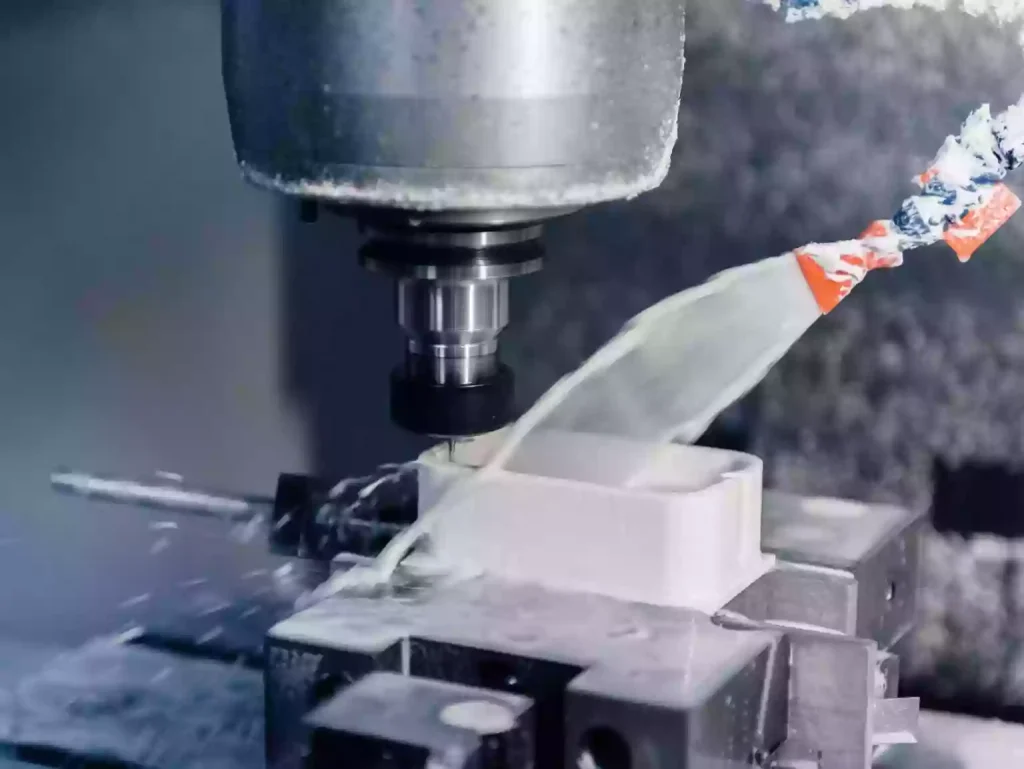
PPS does not always require aggressive coolant usage, but thermal control still matters.
In many cases, light air cooling or minimal lubrication is enough, as long as chip evacuation is good. The goal is not just cooling, but preventing heat buildup at localized cutting zones.
Key points in practice:
- avoid excessive heat accumulation during long cuts
- maintain stable chip removal to reduce re-cutting
- prevent thermal stress in thin-wall sections
- balance feed rate to avoid rubbing instead of cutting
In real machining environments, PPS performs best when cutting is kept sharp, controlled, and consistent — not necessarily fast or aggressive.
Common PPS Machining Problems and How to Avoid Them
Even though PPS is considered a stable engineering plastic, machining problems still show up in real production. Most of the time, these issues are not caused by the material itself “failing,” but by how cutting forces, heat, and tool condition interact with a relatively brittle material.
Below are the most common problems you’ll see when machining PPS, and what usually causes them in practice.
Edge Chipping
This is probably the most common issue.
PPS doesn’t deform much before breaking, so if the cutting force is too high or not well supported, the edge will chip instead of bending.
You usually see this:
- around sharp corners
- at hole exits
- on thin-wall edges
Typical causes:
- too aggressive feed rate
- dull cutting tools
- poor tool engagement (too much radial load)
In practice, sharper tools and lighter finishing passes usually fix most of it.
Cracking and Stress Damage
PPS can hold stress internally after machining, especially if the part is clamped too tightly or material is removed unevenly.
Cracks don’t always appear immediately. Sometimes they show up after the part is released from the fixture or after a short period of relaxation.
Common causes:
- excessive clamping force
- uneven material removal
- heat buildup during cutting
This is more noticeable in thin or asymmetric parts where stress has fewer paths to distribute.
Burr Formation and Poor Surface Finish
Compared with softer plastics, PPS usually produces cleaner cuts, but burrs still appear when conditions are not stable.
Typical reasons:
- tool is slightly dull
- cutting speed too low (rubbing instead of cutting)
- vibration during machining
Surface finish issues often come from the same root causes. PPS doesn’t “flow” to hide tool marks, so any instability tends to show directly on the surface.
Warping and Dimensional Instability
Although PPS is dimensionally stable in use, machining can still introduce distortion.
This usually happens when internal stress is built into the part during processing.
Main reasons:
- uneven stock removal
- heat concentration in one area
- poor machining sequence (no rough-to-finish balance)
In real shop situations, parts that look fine immediately after machining may shift slightly after a few hours once internal stress relaxes.
Fiber Pull-Out in Reinforced PPS
This issue only appears in filled grades like glass-filled or mineral-filled PPS.
Instead of cutting cleanly, fibers can get dragged or pulled out from the surface.
You will see:
- rough texture on machined faces
- small voids or “fuzzy” surfaces
- inconsistent finish between passes
Main causes:
- worn or blunt cutting edges
- incorrect cutting direction
- unstable chip formation
Reinforced PPS behaves more like a composite material in this case, so tool sharpness becomes critical.
Thread Damage and Thin-Wall Failure
Threads in PPS can be very reliable, but only if machining is controlled.
Problems usually include:
- stripped threads
- cracking at thread roots
- deformation in thin-wall threaded areas
Typical causes:
- tapping too aggressively
- poor chip evacuation in blind holes
- insufficient support in surrounding material
Thin-wall failures are similar — once the wall loses stiffness during cutting, it tends to flex and then crack instead of deforming gradually.
Design Guidelines for CNC Machined PPS Parts
Design is where most PPS machining problems are either created or avoided. In practice, a lot of “machining issues” are actually design issues — features that look fine on CAD but behave poorly once cutting starts.
PPS is not a forgiving material when it comes to stress concentration or thin features, so design choices directly affect surface quality, dimensional stability, and even tool life.
Recommended Wall Thickness
PPS can support relatively thin walls compared to some plastics, but only within a controlled range.
In real machining work:
- Thin walls tend to vibrate during cutting
- Vibration leads to chipping and rough surfaces
- Reinforced grades are stiffer but also more brittle
As a result, walls that look fine structurally in CAD may still fail during machining if they are too thin for the cutting forces involved.
A practical approach is to avoid designing walls that are unnecessarily thin unless there is a functional requirement. Stability during machining matters more than theoretical strength.
Corner Radius and Slot Design
Sharp internal corners are one of the biggest risk areas in PPS machining.
Because PPS is relatively brittle, stress tends to concentrate at sharp transitions. During cutting, this often shows up as micro-chipping or edge breakout.
In practice:
- Internal corners should always have a radius
- Slots with sharp ends are more likely to crack
- Larger radii improve both tool life and surface quality
This is especially important in glass-filled PPS, where fibers amplify stress concentration effects.
Hole and Thread Design Considerations
Holes in PPS generally machine well, but exit behavior is critical.
Common issues appear at:
- drill breakthrough points
- deep blind holes
- threaded regions in thin sections
To improve reliability:
- avoid placing holes too close to edges
- ensure enough material support around threads
- reduce aggressive entry/exit conditions
Threads can perform well in PPS, but only when cutting is clean and stress-free. Poor hole design is one of the main reasons threads fail later in use.
Tolerance Capability of PPS
PPS is often selected for precision parts because it maintains dimensional stability well after machining.
However, achievable tolerance is not only a material property — it depends heavily on part geometry and machining strategy.
In general:
- simple, rigid parts hold tighter tolerances more easily
- thin-wall or asymmetric parts are more sensitive to stress
- reinforced grades may introduce variability due to fiber structure
One important point is that PPS does not “self-correct” after machining. Any error introduced during cutting usually stays in the final part.
Fixturing and Clamping Considerations
Clamping plays a bigger role in PPS machining than many people expect.
Because the material is relatively stiff but brittle, excessive clamping force can introduce stress that later shows up as distortion or cracking.
Common issues include:
- deformation under clamp pressure
- stress marks on finished surfaces
- slight warping after release
A more controlled clamping strategy usually works better than high-force rigid holding. The goal is to support the part without introducing new stress into the material.
Designing Thin-Wall PPS Components
Thin-wall PPS parts are possible, but they require careful design and machining balance.
The main risks are:
- vibration during cutting
- localized heat buildup
- edge chipping during finishing passes
If thin walls are unavoidable, it’s usually better to design them with support features or machining strategies in mind rather than treating them as isolated structures.
In practice, successful thin-wall PPS parts depend less on material capability and more on how well the design accounts for machining forces and stability during processing.
PPS vs Other Engineering Plastics in CNC Machining
| Material | Machining Behavior | Key Takeaway |
| PPS | Rigid, slightly brittle, stable but edge-chipping risk | Good balance of stability and precision, but not forgiving |
| PEEK | Tough, ductile, more forgiving during cutting | Easier to machine, better stress tolerance |
| Delrin (POM) | Very smooth cutting, easy chip formation | Best for easy machining, lower high-temp performance |
| Nylon | Soft, easy to cut but unstable with moisture | Good machinability, poor long-term stability |
| PTFE | Extremely soft, hard to control dimensions | Easy to machine, weakest precision control |
Applications of Machined PPS Components
PPS machined parts usually don’t show up in simple consumer products. You see them in places where parts are expected to survive heat, chemicals, electrical stress, or long-term dimensional loading without drifting out of spec.
What’s important here is not just where PPS is used, but why it gets selected after machining is considered.
Semiconductor and Electronics Components
This is one of the biggest application areas for PPS CNC parts.
In semiconductor equipment, parts are often exposed to heat cycles, chemical cleaning agents, and strict contamination control requirements.
PPS is used here because:
- it stays dimensionally stable after machining
- it has very low moisture absorption
- it maintains insulation properties under heat
- it doesn’t easily deform during long-term use
Typical machined parts include:
- wafer handling fixtures
- insulating spacers
- precision housings
- alignment components
In these applications, the tolerance stability after machining is usually more important than how easy the material is to cut.
Chemical-Resistant Parts
PPS is commonly used in environments where exposure to aggressive chemicals would degrade standard plastics.
This includes systems involving acids, bases, fuels, and industrial solvents.
Machined PPS components in this category are often used for:
- pump housings
- valve seats
- flow control components
- sealing-related structural parts
The key reason PPS works well here is not just chemical resistance, but the fact that it does not significantly swell or deform after exposure — meaning machined dimensions remain stable even after long service.
High-Temperature Precision Components
PPS performs well in environments where continuous or repeated heat exposure is involved.
Unlike lower-grade plastics that soften or creep under temperature, PPS maintains rigidity and shape stability.
Common machined parts include:
- heat-resistant brackets
- structural supports near thermal sources
- components in motor or heater assemblies
In these cases, PPS is often selected not because it is the strongest material, but because it maintains geometry over time under thermal load.
Electrical Insulation Applications
PPS has strong electrical insulation properties, which makes it useful in precision electronic assemblies.
Machined PPS parts are often used where:
- electrical isolation is required between components
- stable dielectric performance is needed under heat
- long-term insulation reliability is critical
Typical parts include:
- insulating plates
- connector housings
- spacing components in electronic assemblies
The combination of insulation + dimensional stability is what makes PPS suitable for precision electrical systems.
Pump, Valve, and Fluid Handling Components
In fluid systems, PPS is used for parts that need both chemical resistance and structural stability.
Machined components in this category include:
- valve seats
- pump internal components
- wear-resistant guiding parts
- flow control elements
What matters here is not just exposure resistance, but maintaining tight functional fits over time — especially in moving or sealing interfaces.
Cost Factors in PPS CNC Machining
PPS machining cost is not driven by material price alone. In most real production cases, the material itself is only a small part of the total cost. What actually drives cost is how the material behaves during machining and how much control is needed to keep parts consistent.
Material Cost (Raw PPS Price)
From a raw material standpoint, PPS sits in the mid-to-high range among engineering plastics.
Unfilled PPS is relatively manageable in cost, but reinforced grades (glass-filled or carbon-filled) are noticeably more expensive.
However, even for high-grade PPS, material cost is usually not the main cost driver in CNC machining projects. It becomes more significant only in high-volume production.
Tool Wear and Tooling Consumption
Tool wear is one of the biggest hidden cost factors in PPS machining.
In particular:
- Glass-filled PPS acts as an abrasive material
- Cutting edges wear faster than with standard plastics
- Tool sharpness degrades quickly, affecting surface finish
As a result, production often requires:
- more frequent tool inspection
- more tool replacements
- tighter control of cutting edge condition
Over time, tooling cost and downtime can exceed the raw material cost, especially in reinforced PPS parts.
Machining Time and Cycle Efficiency
PPS is not typically a “high-speed machining” material when precision is required.
To avoid defects such as chipping or stress cracking, machining parameters are often conservative:
- controlled feed rates
- lighter finishing passes
- reduced aggressive cutting strategies
This directly increases cycle time per part, which has a major impact on overall cost, especially in medium-to-high complexity geometries.
Reinforced PPS Machining Complexity
When using glass-filled or carbon-filled PPS, machining cost increases further due to reduced process tolerance.
Key cost drivers include:
- higher scrap risk due to edge chipping or cracking
- stricter tool condition requirements
- reduced machining window (less room for parameter optimization)
- more frequent process adjustments
In practice, reinforced PPS parts cost more not because they are harder to cut, but because they are less forgiving during cutting.
Precision Requirements and Inspection Cost
Tight-tolerance PPS parts significantly increase total manufacturing cost.
This is driven by:
- additional finishing passes
- slower machining to maintain stability
- higher inspection frequency (CMM or dimensional checks)
- higher rejection sensitivity for small deviations
The tighter the tolerance, the more cost shifts from machining speed to process control.
Part Geometry and Setup Complexity
Geometry is often one of the largest cost factors in PPS machining.
Features that increase cost include:
- deep pockets
- thin walls
- sharp internal corners
- multiple setups or re-clamping operations
Each additional setup increases:
- alignment time
- risk of tolerance stack-up
- chance of introducing stress or deformation
In many cases, complex geometry has a bigger cost impact than material grade.
Scrap Rate and Process Stability
Unlike softer plastics, PPS does not always “fail gradually.” When machining conditions are not stable, defects can appear suddenly:
- edge chipping
- micro-cracks
- surface defects on reinforced grades
Even a small increase in scrap rate has a direct impact on total cost, especially in precision parts where rework is limited.
In PPS CNC machining, cost is mainly driven by:
- tooling wear (especially in reinforced grades)
- machining time required for stable cutting
- tolerance and inspection requirements
- part geometry complexity
- scrap risk and process stability
Material cost is only one part of the equation. In most real engineering projects, process control and machining strategy have a much larger impact on the final price than the PPS material itself.
Conclusion
PPS is a stable but sensitive material in CNC machining. It holds dimensions well and performs reliably in demanding environments, but it is not forgiving when machining conditions are off.
Good results mainly come from control rather than cutting power — sharp tools, stable fixturing, and proper heat management are what keep PPS parts consistent and clean.
When these factors are handled correctly, PPS becomes a very reliable material for precision components where long-term dimensional stability and performance matter more than machining ease.