
CNC Acrylic Machining Tips & Techniques: The Engineer’s Guide to Optical Clarity
Acrylic resin (PMMA), also known as polished polymethyl methacrylate, offers up to 92% light transmission—surpassing even glass—making it a popular choice in high-end manufacturing. Transparent and durable, it’s ideal for display pieces, lighting panels, and precision components. However, PMMA is highly sensitive to heat; unlike metals, it cannot dissipate heat through chips and acts as an insulator.
During CNC machining, if the heat generated by the cutting tool exceeds the material’s glass transition temperature (Tg), a chain reaction can occur: the material softens, sticks to the tool, and leaves a hazy, molten surface. Excessive cutting speed, deep feed, or inadequate cooling can result in cracking, warping, or surface scratches.
Machining PMMA requires a careful balance of cutting speed, feed rate, tool selection, and cooling to maintain efficiency while preserving surface finish and dimensional accuracy. This “delicate balance” is the key to producing high-quality acrylic parts.
Achieving a “water-clear” finish directly from the machine isn’t luck—it’s science. This guide explores advanced CNC PMMA machining techniques, helping you control heat and internal stress to achieve the optical clarity demanded by modern engineering.
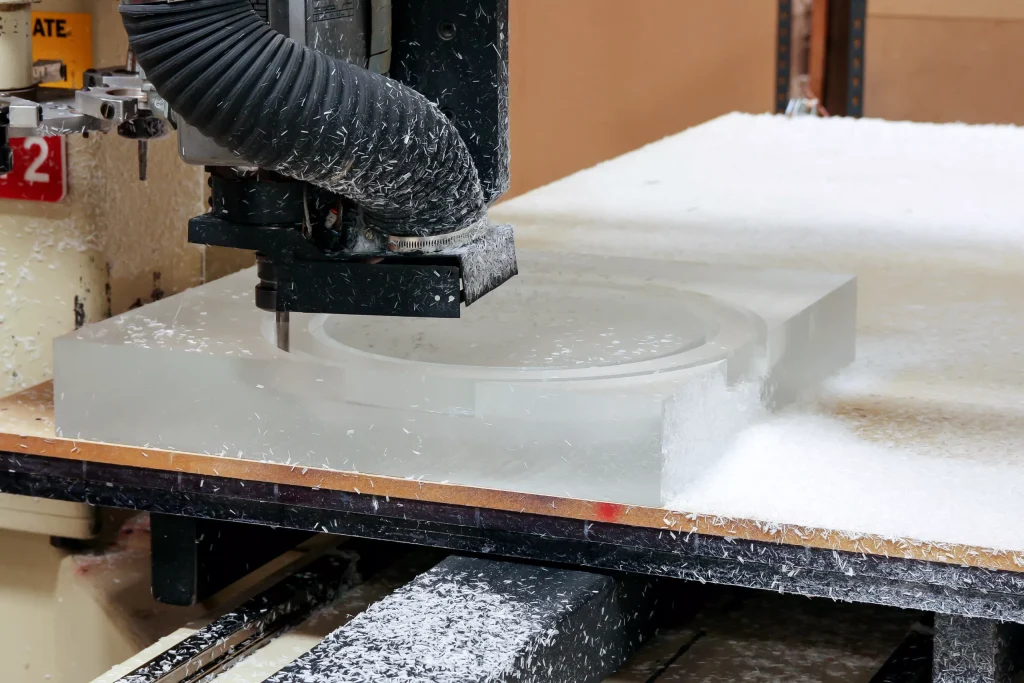
Technique 1: Tool Geometry – Why “Less is More”
In metal machining, adding more flutes usually increases efficiency, but with acrylic (PMMA), the opposite is true: less is more. Single-flute end mills are key to achieving optical-grade surface finishes. PMMA has a very low thermal conductivity, so most of the cutting heat stays in the chips. A single-flute design provides a wide flute space, allowing hot chips to be ejected quickly, preventing secondary cutting and frictional heat buildup, which can otherwise melt the material and cause chip welding.
Precise control of tool angles is equally critical. Keeping the rake angle between 0° and 5° allows the tool tip to cut into the PMMA like a scalpel, significantly reducing cutting resistance. A larger clearance angle minimizes contact between the tool’s flank and the machined surface, effectively preventing hazy heat marks caused by friction.
Material choice and flute polishing are advanced details that make a big difference in acrylic CNC machining. While coated tools are extremely hard, their coatings slightly blunt the cutting edge. Acrylic requires an atomically sharp edge, making uncoated micro-grain carbide the preferred choice. The flutes must also be mirror-polished; even tiny surface roughness can impede chip evacuation and lead to chip welding.
By optimizing the number of flutes, tool angles, material, and flute finish, PMMA machining can be both efficient and capable of producing optical-clear, high-precision surfaces—the hallmark of high-quality acrylic parts.
Technique 2: Finding the “Sweet Spot” Between Feed and Spindle Speed
In acrylic CNC machining, locating the “sweet spot” between feed rate and spindle speed is critical. It doesn’t just affect efficiency—it determines whether the surface remains clear and optical-grade or ends up damaged.
Monitoring Chip Load
The ideal chip should be a thin, consistent shaving. If the chips are powdery, it indicates the spindle is too fast or the feed too slow, causing the tool to dwell too long in one spot and locally melt the material. If the chips are too thick, they can trigger brittle chipping. Our rule of thumb: prioritize optimizing the feed rate rather than blindly increasing spindle speed. Each flute should effectively remove material, carrying away heat and preventing thermal damage
Ramping Strategy & Structural Integrity
Acrylic is extremely sensitive to vertical impact. Helical ramping is far superior to straight plunging, as it distributes cutting forces across horizontal and vertical axes. This approach minimizes “volcano”-shaped chipping at entry points and protects the overall structural integrity of the part.
Cooling Philosophy: High-Pressure Air vs. Chemical Sensitivity
Cooling medium selection is key for optical-grade surfaces. Traditional liquid coolants often contain solvents that can react with PMMA, leading to the infamous stress cracks known as crazing. In contrast, high-pressure air blasts not only cool the material but also immediately clear chips from the cutting zone, preventing secondary cutting or surface scratching and preserving the acrylic’s natural transparency.
Technique 3: Eliminating the “Hidden Enemy” – Internal Stress Management
In acrylic machining, the real challenge often doesn’t occur during cutting, but days or even weeks later, when tiny cracks suddenly appear on the surface. This phenomenon is known in the industry as crazing. Advanced practitioners of CNC acrylic machining must know how to identify and eliminate this “hidden enemy.”
The Science of Crazing: Why “Perfect” Surfaces Crack
Have you ever seen a freshly machined acrylic part, perfectly clear and mirror-like, suddenly develop spiderweb-like micro-cracks after contact with alcohol or cleaning agents? CNC cutting is essentially a mechanical separation of material at the molecular level. Even the sharpest tools leave behind residual stress (RSS) within the PMMA polymer chains. When these stressed regions encounter chemical solvents, the molecular equilibrium is disrupted, and microscopic cracks can rapidly propagate.
The Annealing Cycle: Ensuring Long-Term Durability
To fully release locked-in stresses, annealing is an essential step. This is not simply heating, but a carefully controlled physical recovery process:
- Isothermal Holding: Slowly heat the workpiece to just below its glass transition temperature (typically 70°C–85°C) to allow disordered polymer chains to realign and release internal stress.
- Controlled Cooling: Cool extremely gradually, ideally no more than 5°C per hour. Rapid cooling creates temperature differences between the surface and core, introducing secondary thermal stress.
Expert Recommendation: For precision parts with uneven wall thickness or complex geometries, annealing cycles may last 12–24 hours.
Chemical Sensitivity: Cutting Oils vs. PMMA
Many conventional metalworking cutting oils contain esters, ketones, or aromatics, which can penetrate PMMA polymer chains and, combined with residual stress, trigger cracking. To maintain chemical stability and optical clarity, high-pressure air or specialized plastic coolants are preferred in precision acrylic machining.
Technique 4: Precision Fixturing for Fragile Surfaces
In CNC Acrylic Machining Tips & Techniques, securing the workpiece is often more challenging than the cutting itself. Acrylic has low surface hardness and unique viscoelastic properties, so improper clamping pressure can leave permanent marks or cause dimensional deviations after machining. To maintain optical-grade surfaces and precise geometry, the fixturing strategy must carefully manage pressure, vibration, and elastic deformation.
In acrylic machining, the hard steel jaws commonly used for metals are a surface “nemesis.” To prevent scratches or micro-cracks, flexible interfaces such as aluminum soft jaws or custom non-metallic clamps made from POM or nylon are recommended, with rubber pads or anti-static protective films at contact points. These measures effectively distribute local pressure and protect the workpiece from mechanical stress. For through-hole machining or thin-wall milling, placing high-density MDF or acrylic sacrificial substrates beneath the workpiece is essential. This not only prevents exit chipping but also provides uniform support and reduces vibration in thin areas.
When handling large, ultra-thin, or complex-shaped acrylic sheets, vacuum fixturing is the gold standard. Vacuum tables provide evenly distributed holding force and eliminate small gaps between the workpiece and machine bed, significantly suppressing machining vibrations and preventing chatter marks on sidewalls. Additionally, vacuum fixturing removes the need for external clamps, allowing full 360° profiling without interference. This not only improves efficiency but also ensures consistent part contours.
Acrylic’s elastic modulus is far lower than metals, meaning excessive clamping can induce minor elastic deformation. When the clamps are released, the material rebounds, potentially causing dimensional shifts. During finishing, minimal clamping force should be applied—just enough to counteract cutting forces. This physical balance ensures that the workpiece maintains both geometric accuracy and optical surface integrity after removal from the fixture.
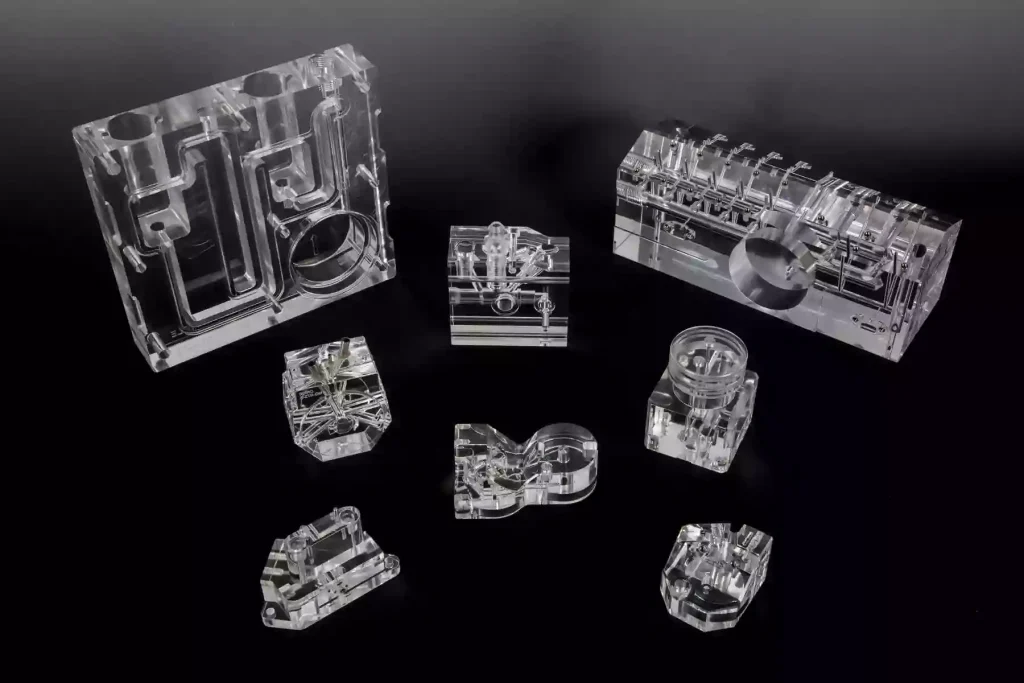
Technique 5: Strategic Post-Processing
Once the CNC cutting is complete, acrylic surfaces often show a semi-matte or frosted appearance. To achieve a crystal-clear, optical-quality finish, the right post-processing strategy must be carefully selected based on both functional and aesthetic requirements. This step is not just about looks—it ensures durability, performance, and transparency across the part.
Strategic Post-Processing Choices
Choosing the correct finishing method is critical for balancing internal geometry, edge brilliance, and overall surface quality. Each technique offers distinct advantages depending on whether the priority is clarity of internal features, edge shine, or mirror-like smoothness.
Vapor Polishing vs. Flame Polishing
For complex internal geometries, vapor polishing is the gold standard. Solvent vapors melt the acrylic at a microscopic level, removing machining marks without altering dimensions, ensuring deep channels and internal cavities remain fully transparent. Flame polishing, by contrast, excels at enhancing external edge brilliance quickly and cost-effectively. However, due to the heat-affected zone, it is less suitable for parts requiring tight tolerances or precise assembly.
Mechanical Buffing
Mechanical buffing is indispensable for achieving lens-like optical clarity. By progressing through increasingly fine grits—from 400 to 2000 or higher—and finishing with wool pads and polishing compounds, surface imperfections are systematically eliminated. Unlike vapor or flame polishing, mechanical buffing provides consistent flatness and avoids localized “orange peel” effects, preserving light transmission and optical integrity throughout the part.
Conclusion
Achieving the ultimate in acrylic machining is far more than optimizing a single variable—it is a deep synergy of tool physics, thermal control, and post-machining care.
From the chip evacuation logic of single-flute end mills to the molecular realignment during the annealing cycle, neglecting any step can compromise optical performance or structural integrity. In precision manufacturing, transparency is not just a visual attribute—it is a rigorous engineering metric. By mastering these CNC Acrylic Machining Tips & Techniques, we are not simply shaping material; we are shaping the potential for optical perfection.
Seeking Expert Support
For PMMA projects with complex geometries, tight tolerances, or specialized optical requirements, even minor process differences can determine success or failure. If you are looking for machining solutions that balance dimensional precision with optical clarity, our engineering team is ready to assist. Leveraging extensive practical experience, we provide one-stop technical support from design optimization (DFM) to final part delivery.
FAQ
As you master CNC Acrylic Machining, practical issues often arise that can impact surface quality, dimensional accuracy, or structural integrity. Here are answers to the most common questions our engineers encounter.
Why does my machined acrylic surface sometimes show a cloudy or milky haze?
This is usually caused by heat accumulation. If the clearance angle is too small or spindle speed too high, the tool generates friction rather than clean cutting, causing micro-melting on the PMMA surface.Solution: Increase the feed rate so each pass effectively removes hot chips, or switch to a single-flute polished end mill for superior chip evacuation and reduced thermal load.
How can I minimize stress cracking (crazing) without performing a full annealing cycle?
While annealing is the most reliable approach, you can mitigate stress by optimizing cutting parameters: use a high-pressure air blast directed at the cutting edge, perform layered fine finishing passes with final depths under 0.1 mm, and avoid any post-processing with alcohol-based cleaners.
Why do my acrylic parts sometimes expand in size after a few days of storage?
Acrylic is slightly hygroscopic. In humid environments, PMMA absorbs moisture and swells.Store raw material in a controlled temperature and humidity environment and complete a proper annealing cycle after machining to stabilize the molecular structure.
Should I use climb milling or conventional milling when machining acrylic?
Climb milling is generally preferred. It cuts from thick to thin, reducing physical push on the material, minimizing exit chipping on thin walls, and producing smoother surface textures.
Will vapor polishing affect my part’s dimensional tolerance?
Vapor polishing reorganizes only the top ~2–5 µm of the surface. With controlled exposure, it has negligible effect on overall geometry. For parts with extremely strict flatness or sealing requirements, mechanical polishing is recommended.