
Titanium CNC Machining: The Expert Guide to Grades, Techniques, and Costs
In the realm of precision manufacturing, Titanium CNC machining represents the pinnacle of a machine shop’s proficiency. Recognized for its remarkable strength-to-weight ratio and exceptional resistance to corrosion, titanium serves as the benchmark for critical components across the most rigorous industries.
Nonetheless, the inherent physical characteristics of this material render it one of the most difficult substances to machine effectively. This guide utilizes our extensive shop-floor experience to elucidate the essential knowledge required to adeptly work with this sophisticated metal.
The Popularity of Titanium in Manufacturing
Engineers who opt for titanium CNC machining typically seek to capitalize on three principal advantages:
- Exceptional Strength-to-Weight Ratio: Titanium possesses a strength comparable to many types of steel while weighing approximately 45% less.
- Superior Corrosion Resistance: Titanium develops a protective passive oxide layer, providing resistance to seawater, chlorine, and aggressive acids.
- Biocompatibility: Titanium is non-toxic and is not rejected by the human body, making it essential for the medical implant sector.
Titanium vs. Other Common Metals
| Property | Titanium (Grade 5) | Stainless Steel (316) | Aluminum (6061) |
| Density (g/cm³) | 4.43 | 8.00 | 2.70 |
| Tensile Strength (MPa) | 950 | 515 | 310 |
| Corrosion Resistance | Excellent | Good | Moderate |
| Machinability | Difficult | Moderate | Easy |
Common Challenges in Titanium Machining
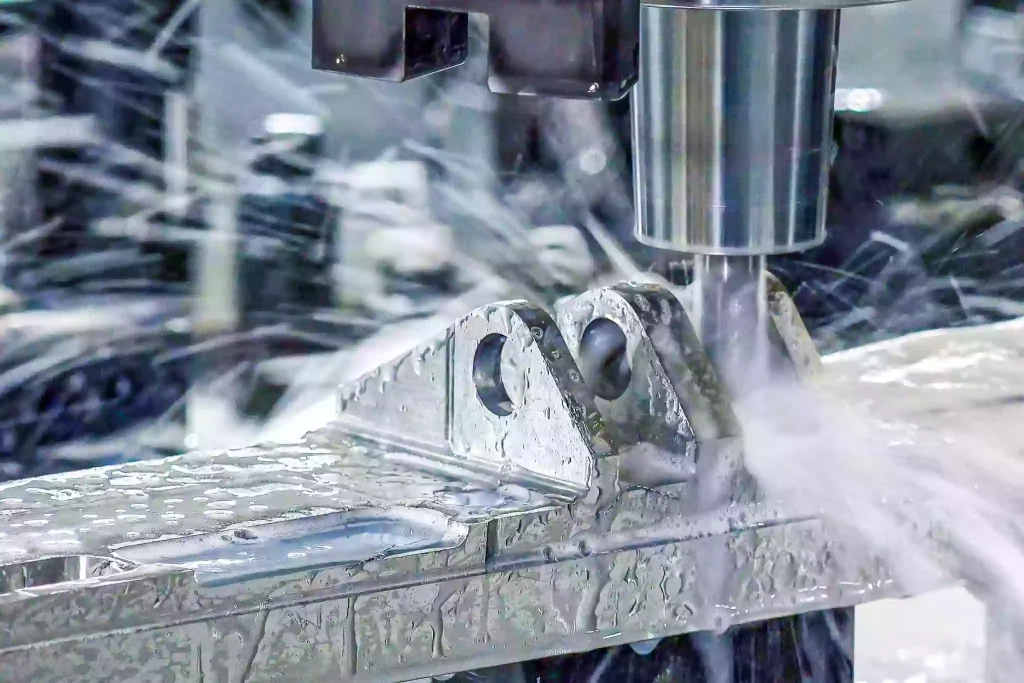
To succeed in machining titanium, one must overcome the “three main challenges”: heat, pressure, and elasticity.
1. The Heat Trap (Low Thermal Conductivity)
Unlike aluminum, which dissipates heat through the material and chips, titanium is a poor thermal conductor. During the cutting process, heat stays concentrated at the cutting edge. When temperatures at the interface spike above 1000°C, standard tool coatings can break down rapidly, leading to instantaneous tool failure.
2. Work Hardening
Titanium is highly sensitive to metallurgical changes. If the feed rate is too low or the tool dwells even for a split second, the material surface will work-harden instantly. This creates a “skin” significantly harder than the base metal, which will likely snap the tool on the next pass.
3. The “Spring-Back” Effect (Elastic Modulus)
Titanium has a lower modulus of elasticity than steel, making it more “flexible.” The workpiece tends to deflect away from the tool under pressure and “spring back” once the tool passes. Without high-rigidity workholding, this makes holding tight tolerances on thin-walled sections extremely difficult.
Technical Essentials: Titanium Machining Speeds and Feeds
In the world of Titanium CNC machining, “guessing” is the fastest way to blow your tool budget. Your parameters must hit the “sweet spot” between material removal rate (MRR) and tool life.
Grade 5 Titanium Cutting Parameter Baseline
| Operation | Tool Material | Surface Speed (SFM) | Feed per Tooth (IPT) |
| Rough Milling | Coated Carbide | 150 – 250 | 0.003 – 0.006 |
| Finish Milling | Coated Carbide | 250 – 400 | 0.001 – 0.003 |
| Drilling | Solid Carbide | 80 – 150 | 0.002 – 0.005 |
| Tapping | HSS-E (Vanadium) | 10 – 25 | N/A |
The Golden Rule: Never Let the Tool Dwell. The moment an end mill stops its forward progress while spinning, it begins to “rub” rather than “cut.” This friction generates instantaneous heat, work-hardening the surface to a diamond-like state. Always lean toward a heavier chip load (IPT) rather than a higher surface speed (SFM).
Best Cutting Tools for Titanium: Choosing Your Arsenal
1. Tool Geometry and Substrate Requirements
| Feature | Specification | Why it matters? |
| Substrate | Sub-micron Grain Carbide | Provides edge toughness to resist chipping under high loads. |
| Helix Angle | 35° to 45° High Helix | Optimizes chip evacuation and reduces “hammering” on the spindle. |
| Pitch | Variable Pitch/Unequal Index | Breaks up harmonics to eliminate chatter and resonance. |
2. Specialized Coatings for Thermal Protection
| Coating Type | Best For | Technical Advantage |
| AlTiN | General Grade 5 | Forms a protective aluminum oxide layer at high temperatures. |
| TiB2 | Preventing BUE | Low chemical affinity for titanium; prevents material welding to the tool. |
Industry Applications: Aerospace vs. Medical
The requirements for titanium parts vary drastically depending on the niche:
| Industry | Primary Grade | Components & Key Requirements |
| Aerospace | Grade 5 (Ti-6Al-4V) | Turbine blades: Focus on fatigue strength and integrity at high temps. |
| Medical | Grade 23 (Ti-6Al-4V ELI) | Implants: Requires high biocompatibility and zero-burr finishes. |
| Chemical | Grade 2 (CP Titanium) | Valves: Prioritizes maximum corrosion resistance in aggressive acids. |
Titanium Machining Cost Optimization: Pro Tips for Designers
| Strategy | Design Action | Why it saves money? |
| Corner Radii | Specify internal radii > 25% of tool dia. | Allows for larger, more rigid tools and faster cycles. |
| Wall Thickness | Maintain walls > 0.5mm (0.020″). | Prevents vibration and chatter, reducing scrap rates. |
| Hole Depths | Limit depth to 5 times diameter. | Reduces risk of tool deflection and catastrophic breakage. |
Partnering with a Specialist Titanium Machining Service
When vetting a partner for Titanium CNC machining, verify these “Expert Markers”:
- Rigidity & Power: Heavy-duty centers (Mazak, Makino) designed for exotic alloys.
- High-Pressure Cooling: 1000+ PSI through-spindle coolant is non-negotiable for deep-hole drilling.
- Certifications: Look for AS9100 (Aerospace) or ISO 13485 (Medical).
Conclusion
Mastering titanium requires a blend of rigid setups, precise speeds and feeds, and specialized tooling. While the challenges—such as heat dissipation and work hardening—are steep, the resulting components offer performance that no other metal can replicate. As a specialized field within CNC machining, working with titanium demands a deep understanding of material science and machine dynamics to ensure every cut is as efficient as it is accurate.
By leveraging advanced CNC machining techniques, manufacturers can overcome the inherent difficulties of this “super metal” to produce parts that are both incredibly strong and exceptionally light. Whether you are developing critical aerospace structures or life-saving medical implants, choosing the right partner for your CNC machining needs is the key to unlocking the full potential of titanium.
Looking for precision? We provide high-end custom titanium CNC machining services tailored to your tightest specs. Our state-of-the-art facility is optimized for the rigors of titanium, ensuring consistent quality and fast turnaround times for your most complex projects. Upload your CAD files today for an instant quote and experience the best in professional CNC machining.
Titanium CNC Machining: Frequently Asked Questions
Why is Titanium CNC machining considered more difficult than aluminum?
Titanium has low thermal conductivity, meaning heat stays at the cutting edge rather than dissipating through the chips. To master titanium CNC, we use rigid setups and specialized titanium milling tools to manage heat and prevent work hardening, ensuring your custom titanium parts meet exact specs.
What specific titanium CNC machining services do you offer?
We provide a full suite of services, including titanium turning for cylindrical components and high-speed titanium milling for complex geometries. Our facility utilizes advanced titanium CNC machines to handle everything from Grade 5 (Ti-6Al-4V) to commercially pure titanium.
Do you provide CNC machining for other materials like aluminum or plastic?
Absolutely. While we are experts in titanium, we also specialize in CNC aluminum machining and CNC machining plastic parts. Whether you need high-strength metal or plastic CNC machining near me, our workshop is equipped to handle diverse material requirements.