
Polycarbonate vs Acrylic: Differences, Pros and Cons, and How to Choose the Right Material
Acrylic and polycarbonate are two of the most widely used transparent plastic materials, often chosen by various industries as lightweight alternatives to glass. Both materials offer excellent transparency, durability, and versatility, but their performance characteristics differ.
Acrylic (PMMA) is known for its superior optical transparency, smooth surface, and scratch resistance, while polycarbonate (PC) is known for its excellent impact strength, toughness, and temperature resistance. These differences make each material suitable for specific applications and manufacturing requirements.
The choice between polycarbonate and acrylic depends on factors such as mechanical strength, optical properties, environmental conditions, and cost. This article compares acrylic and polycarbonate in terms of performance, advantages and disadvantages, key differences, applications, and material selection considerations to help you choose the right transparent plastic material for your project.
What Are Acrylic and Polycarbonate?
Acrylic and polycarbonate are two widely used transparent thermoplastic materials that are often compared as alternatives to glass. Both materials offer excellent transparency, lightweight properties, and good durability, but they have different characteristics in terms of strength, impact resistance, heat performance, and applications.
What Is Acrylic (PMMA)?
Acrylic, also known as polymethyl methacrylate (PMMA), is a transparent thermoplastic material known for its excellent optical clarity and glass-like appearance. It offers high light transmission, good UV resistance, and a smooth surface finish, making it a popular choice for applications where visual quality and aesthetics are important.
Compared with glass, acrylic is lighter, easier to fabricate, and more resistant to shattering. However, it is more brittle than polycarbonate and has lower impact resistance. Acrylic is commonly used for display panels, lighting covers, optical components, signs, and transparent protective covers.
What Is Polycarbonate (PC)?
Polycarbonate is a high-performance engineering thermoplastic valued for its exceptional impact resistance, toughness, and durability. Unlike acrylic, which focuses more on optical performance and appearance, polycarbonate is designed for applications that require higher mechanical strength and resistance to harsh conditions.
Polycarbonate provides excellent dimensional stability, better heat resistance, and greater flexibility, allowing it to withstand impacts without cracking or breaking. It is commonly used for safety shields, machine guards, protective windows, industrial covers, and structural plastic components.
Although both acrylic and polycarbonate provide excellent transparency, their different material properties make them suitable for different applications. Understanding these basic characteristics is the first step in choosing the right transparent plastic material for a specific project.
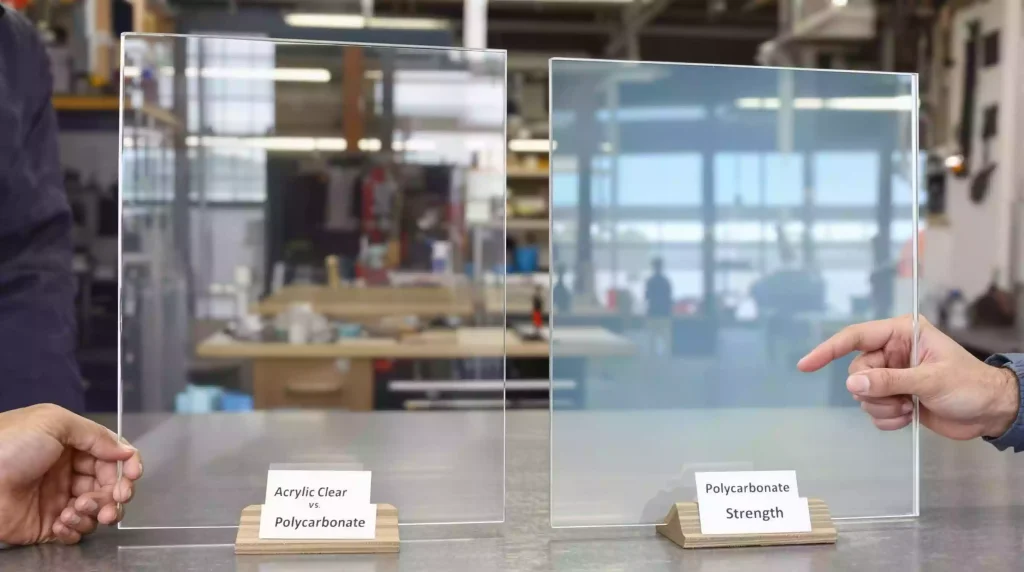
Pros and Cons of Acrylic and Polycarbonate
Acrylic and polycarbonate each offer unique advantages that make them suitable for different applications. Acrylic is typically chosen for its excellent optical performance and surface appearance, while polycarbonate is preferred when higher strength and impact resistance are required. Understanding the advantages and limitations of each material helps determine which option better fits specific performance requirements.
Acrylic Advantages and Disadvantages
Acrylic is widely used in applications where transparency, appearance, and surface quality are important. Its glass-like clarity and smooth finish make it a popular material for decorative and optical applications.
Advantages of Acrylic:
- Excellent optical clarity: Acrylic provides superior transparency and light transmission, making it suitable for applications requiring a clear, glass-like appearance.
- Better scratch resistance: Compared with polycarbonate, acrylic has a harder surface that is more resistant to scratches.
- Good UV resistance: Acrylic maintains its appearance and performance under long-term outdoor exposure.
- Easy to polish and finish: Acrylic can achieve smooth, high-quality surfaces and polished edges after fabrication.
- Lower material cost: Acrylic is generally more cost-effective than polycarbonate.
Disadvantages of Acrylic:
- Lower impact resistance: Acrylic is more brittle and can crack or break when subjected to strong impact.
- Less flexible: Its rigid structure makes it less suitable for applications involving vibration or mechanical stress.
- Lower heat resistance: Acrylic has limited performance in high-temperature environments compared with polycarbonate.
Polycarbonate Advantages and Disadvantages
Polycarbonate is an engineering plastic designed for demanding applications where toughness, durability, and impact resistance are critical.
Advantages of Polycarbonate:
- Outstanding impact resistance: Polycarbonate is significantly stronger than acrylic and can withstand heavy impacts without cracking.
- High toughness and flexibility: It can absorb mechanical stress and resist deformation better than acrylic.
- Better heat resistance: Polycarbonate maintains its mechanical properties at higher temperatures.
- Excellent durability: It performs well in demanding industrial environments requiring long-term reliability.
- Good dimensional stability: Polycarbonate maintains consistent dimensions under changing conditions.
Disadvantages of Polycarbonate:
- Lower scratch resistance: Its softer surface is more vulnerable to scratches compared with acrylic.
- Higher material cost: Polycarbonate is typically more expensive due to its enhanced mechanical properties.
- Lower optical performance than acrylic: Although transparent, it does not provide the same level of clarity and surface appearance as acrylic.
- Requires UV protection for some outdoor applications: Standard polycarbonate may degrade under prolonged UV exposure without proper coatings or stabilization.
Overall, acrylic is better suited for projects prioritizing transparency, appearance, and surface quality, while polycarbonate is the better choice for applications requiring superior strength, impact resistance, and durability.
Acrylic vs Polycarbonate: Key Differences
Although acrylic and polycarbonate are both transparent plastics, their performance varies significantly in terms of optical properties, mechanical strength, durability, and environmental resistance. Comparing these key differences helps identify which material is better suited for a specific application.
Transparency and Optical Clarity
One of the main advantages of acrylic is its superior optical clarity. Acrylic offers excellent light transmission and a glass-like appearance, making it ideal for applications where visual quality and aesthetics are important.
Polycarbonate also provides good transparency, but its primary advantage is not optical performance. Instead, it is designed to deliver higher durability and impact resistance. For applications requiring the clearest appearance, acrylic is usually preferred, while polycarbonate is selected when transparency must be combined with greater strength.
Impact Resistance
Impact resistance is the most significant difference between acrylic and polycarbonate.
Polycarbonate provides much higher impact strength than acrylic and can withstand heavy impacts without cracking or breaking. This makes it suitable for protective applications where safety and durability are critical.
Acrylic is more rigid but more brittle. Under strong impact or sudden stress, it is more likely to crack compared with polycarbonate.
Strength and Flexibility
Acrylic and polycarbonate have different mechanical characteristics.
Acrylic has higher surface hardness and greater rigidity, allowing it to maintain a smooth appearance and resist surface deformation. However, its lower flexibility makes it more susceptible to cracking under mechanical stress.
Polycarbonate has greater toughness and flexibility, allowing it to absorb impact forces and withstand repeated loading. This makes it a better choice for structural and high-stress applications.
Scratch Resistance
Acrylic generally performs better in scratch resistance due to its harder surface. It can maintain a cleaner appearance over long-term use, especially in applications where the surface is frequently visible.
Polycarbonate has a softer surface and is easier to scratch. However, additional hard coatings can be applied to improve its scratch resistance and extend service life.
Heat Resistance
Polycarbonate offers better heat resistance compared with acrylic. It can maintain its mechanical properties in higher-temperature environments, making it suitable for industrial applications exposed to heat.
Acrylic performs well under normal operating temperatures but has lower temperature resistance, which limits its use in high-heat environments.
UV and Weather Resistance
Acrylic has excellent natural resistance to UV exposure and maintains its transparency and appearance over time, making it suitable for outdoor applications.
Polycarbonate can also be used outdoors, but standard grades may require UV stabilization or protective coatings to prevent yellowing and degradation caused by long-term sunlight exposure.
Chemical Resistance
Both materials provide reasonable chemical resistance, but their performance varies depending on the type of chemical exposure.
Acrylic can be affected by certain solvents and chemicals, which may cause cracking or surface damage. Polycarbonate generally provides better resistance to many chemicals, but it can also be affected by strong solvents and aggressive chemicals.
For applications involving chemical exposure, the specific operating environment should be considered before selecting either material.
Cost Comparison
Acrylic is generally more affordable than polycarbonate, making it a cost-effective option for applications where optical clarity and appearance are the primary requirements.
Polycarbonate typically has a higher material cost due to its superior impact resistance, toughness, and heat performance. However, the additional cost can be justified for applications requiring long-term durability and higher mechanical performance.
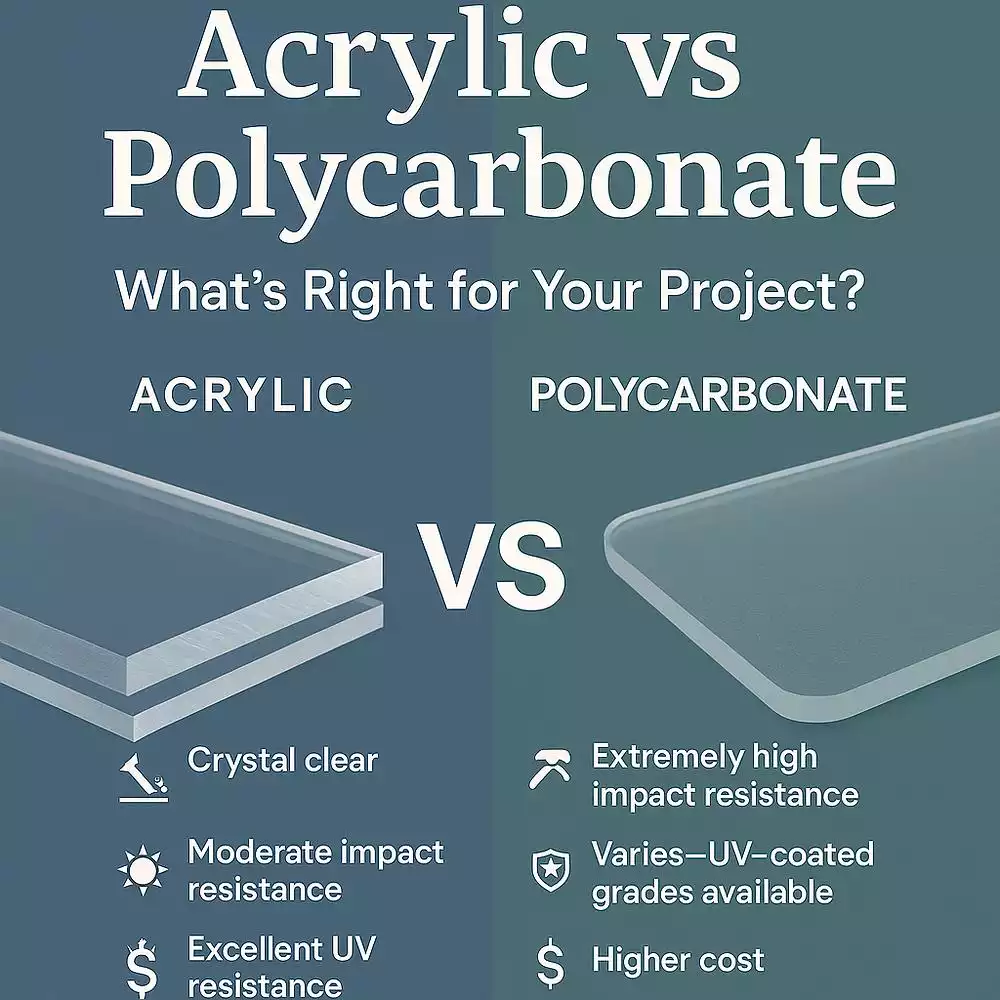
Acrylic vs Polycarbonate: Applications
The different properties of acrylic and polycarbonate make them suitable for different types of applications. Acrylic is typically selected when optical clarity, surface appearance, and cost efficiency are the main considerations, while polycarbonate is preferred for applications requiring high impact resistance, toughness, and durability.
Acrylic Applications
Acrylic is widely used in applications where transparency, aesthetics, and surface quality are important. Its glass-like appearance and excellent light transmission make it ideal for both decorative and functional transparent components.
Common acrylic applications include:
- Display panels and covers – Acrylic provides a clear, attractive surface for electronic displays, product showcases, and protective panels.
- Lighting components – Its excellent transparency and light diffusion properties make it suitable for light covers, lenses, and diffusers.
- Optical components – Acrylic is used for applications requiring good optical performance and visual clarity.
- Signs and decorative panels – Its smooth finish, color options, and weather resistance make it popular for signage and architectural applications.
- Transparent enclosures – Acrylic is commonly used for protective housings where appearance and visibility are important.
Acrylic is the preferred choice when the final part needs a premium appearance, excellent transparency, and a smooth surface finish.
Polycarbonate Applications
Polycarbonate is commonly used in demanding applications where strength, impact resistance, and long-term durability are critical. Its superior toughness allows it to perform reliably in environments where acrylic may be more likely to crack.
Common polycarbonate applications include:
- Safety shields and protective barriers – Polycarbonate provides excellent impact protection in industrial and commercial environments.
- Machine guards – Its toughness makes it suitable for protecting operators while allowing visibility of machinery.
- Industrial windows and covers – Polycarbonate is used where transparent protection and mechanical strength are required.
- Automotive components – Its lightweight structure and durability make it suitable for various vehicle parts.
- Electrical enclosures – Polycarbonate provides reliable protection for components exposed to mechanical stress and environmental conditions.
Polycarbonate is the better choice for applications where safety, durability, and resistance to impact are more important than surface appearance.
When comparing acrylic vs polycarbonate applications, the key factor is the performance requirement of the final part. Acrylic is better suited for appearance-focused applications, while polycarbonate is more suitable for functional components exposed to impact, stress, or harsh operating conditions.
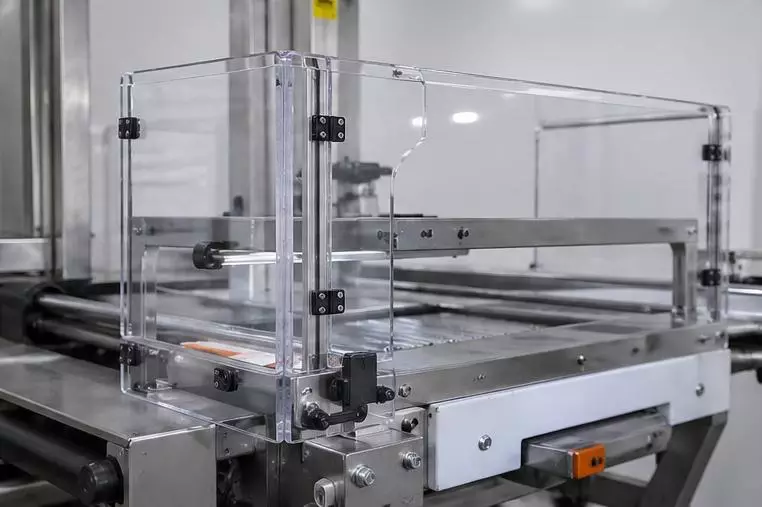
How to Choose Between Acrylic and Polycarbonate?
Choosing between acrylic and polycarbonate depends on the specific requirements of the application. While both materials provide excellent transparency and lightweight properties, their different performance characteristics make them suitable for different working conditions.
Choose Acrylic When You Need:
Acrylic is a better choice when appearance, optical performance, and surface quality are the main priorities.
Select acrylic for applications requiring:
- Excellent optical clarity – Acrylic provides glass-like transparency and superior light transmission.
- Better scratch resistance – Its harder surface helps maintain appearance over time.
- High-quality surface finish – Acrylic is suitable for parts requiring polished edges and an attractive appearance.
- Good UV resistance – It performs well in outdoor applications where long-term appearance is important.
- Cost efficiency – Acrylic offers a more economical solution when extreme impact resistance is not required.
Typical applications include display covers, lighting components, optical parts, decorative panels, and transparent enclosures.
Choose Polycarbonate When You Need:
Polycarbonate is the better option when strength, durability, and impact resistance are more important than appearance.
Select polycarbonate for applications requiring:
- High impact resistance – It can withstand strong impacts without cracking or breaking.
- Greater toughness and flexibility – It performs better under mechanical stress and vibration.
- Higher heat resistance – It maintains performance in higher-temperature environments.
- Long-term durability – It is suitable for demanding industrial applications.
- Structural reliability – It provides better protection for functional components.
Typical applications include safety shields, machine guards, protective covers, industrial windows, and high-strength transparent components.
Key Factors to Consider Before Selecting
Before choosing between acrylic and polycarbonate, consider the following factors:
- Mechanical requirements: Does the part need high impact resistance or structural strength?
- Optical requirements: Is maximum transparency and appearance the priority?
- Environmental conditions: Will the part be exposed to heat, UV, chemicals, or outdoor conditions?
- Surface requirements: Is scratch resistance or a premium finish important?
- Budget considerations: Is material cost a key factor for the project?
In general, choose acrylic for appearance, clarity, and surface quality, and choose polycarbonate for strength, toughness, and durability. The right material selection ensures better performance, longer service life, and improved cost efficiency for the final component.
CNC Machining Acrylic (PMMA) and Polycarbonate (PC) Parts
Both acrylic (PMMA) and polycarbonate (PC) are suitable for CNC machining and can be manufactured into precision plastic components with complex geometries, tight tolerances, and high-quality surface finishes. However, due to differences in hardness, toughness, and thermal characteristics, each material requires different machining considerations.
CNC Machining Acrylic (PMMA) Parts
Acrylic CNC machining is commonly used for transparent plastic parts that require excellent optical clarity, smooth surface finishes, and a high-quality appearance. Its rigid structure allows manufacturers to achieve precise dimensions and polished edges, making it suitable for both functional and aesthetic components.
Key considerations for CNC machining acrylic include:
- Surface finish requirements: Acrylic can achieve excellent machined finishes and transparent polished edges, making it suitable for appearance-focused parts.
- Cutting parameter optimization: Proper cutting speeds and feeds help prevent cracking, chipping, and stress marks during machining.
- Tool selection: Sharp cutting tools are important to minimize heat generation and maintain clear, smooth surfaces.
- Part design considerations: Proper design helps reduce internal stress and improves machining reliability.
Common CNC machined acrylic parts include transparent covers, display components, optical housings, lighting components, and custom enclosures.
CNC Machining Polycarbonate (PC) Parts
Polycarbonate CNC machining is ideal for applications requiring high impact resistance, toughness, and long-term durability. Compared with acrylic, polycarbonate provides greater flexibility and strength, allowing it to withstand mechanical stress and demanding operating environments.
Key considerations for CNC machining polycarbonate include:
- Heat management: Proper machining parameters are required to prevent melting, deformation, or poor surface quality caused by excessive heat.
- Machining strategy: Optimized cutting conditions help achieve accurate dimensions and clean edges while maintaining material integrity.
- Surface protection: Careful handling is needed to prevent scratches on the softer polycarbonate surface.
- Dimensional control: Proper fixturing and machining techniques help maintain accuracy due to the material’s flexibility.
Common CNC machined polycarbonate parts include machine guards, protective covers, safety components, industrial windows, and durable plastic enclosures.
Custom CNC Machining Services for Acrylic and Polycarbonate Parts
Xtproto provides Acrylic CNC Machining and Polycarbonate CNC Machining services for custom plastic components, supporting prototype development and low-volume production with precise machining capabilities.
With advanced CNC milling processes, optimized machining strategies, and strict quality control, Xtproto helps customers manufacture high-quality PMMA and PC parts for applications requiring transparency, durability, and reliable performance.
Conclusion
Acrylic and polycarbonate are both excellent transparent plastic materials, but their different properties make them suitable for different applications. Acrylic provides superior optical clarity, better scratch resistance, and a high-quality surface appearance, making it ideal for projects where aesthetics and transparency are the primary requirements.
Polycarbonate, on the other hand, offers outstanding impact resistance, toughness, and durability, making it a better choice for demanding applications that require mechanical strength and long-term reliability.
When selecting between acrylic and polycarbonate, consider factors such as optical performance, impact resistance, environmental conditions, surface requirements, and cost. By choosing the right material based on the specific application needs, manufacturers can achieve better performance, durability, and overall project value.