
Polycarbonate (PC)CNC Machining services
CNC machining for stress-free Polycarbonate. Our proprietary annealing process eliminates internal tension, ensuring your PC parts maintain dimensional stability in the toughest environments.
Full-Service Custom Polycarbonate CNC Machining
Transform your complex designs into high-performance components with our end-to-end CNC machining services. We specialize in the unique challenges of Polycarbonate, utilizing proprietary annealing processes to guarantee stress-free, crack-resistant parts and professional vapor polishing to achieve glass-like optical clarity. Whether it’s a single prototype or full-scale production, we provide a seamless “build-to-print” experience that ensures 100% adherence to your tolerances and specialized finishing requirements.
Mastering Optical Clarity with Vapor Polishing
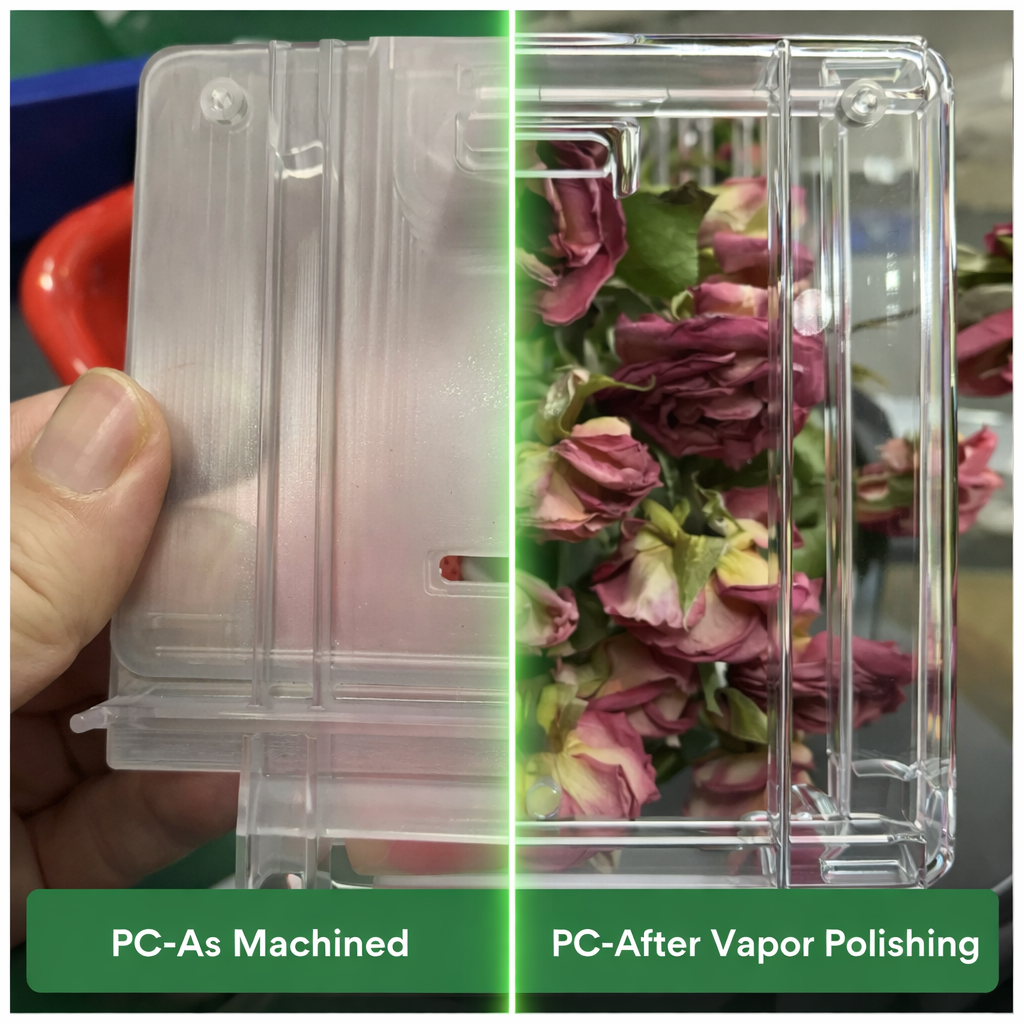
Standard CNC machining leaves visible tool marks and surface haze on polycarbonate, significantly reducing its optical performance. For applications like medical manifolds, optical components, or fluid systems, partial transparency is not acceptable.
We integrate controlled vapor polishing directly into our machining process to restore true optical clarity. By precisely exposing surfaces to chemical vapor, microscopic peaks are reflowed into a uniform, glass-like finish without altering part geometry.
This method is especially effective for internal channels, fine features, and complex geometries that cannot be polished mechanically. The result is a fully transparent, optical-grade component that combines the clarity of glass with the impact resistance of polycarbonate—delivered ready for high-performance optical and medical applications.
Stress-Relief Annealing Eliminates Cracking
Crazing—micro-cracks that appear after machining—is one of the most common and overlooked failure modes in polycarbonate parts. It originates from residual internal stress generated during CNC cutting, and can be triggered later by chemical exposure, mechanical load, or environmental changes, often leading to unexpected cracking or dimensional instability.
To eliminate this risk, we apply a precisely controlled annealing process to every critical PC component. By running parts through a defined thermal cycle, internal stresses are relieved and the polymer structure is stabilized at the molecular level without compromising dimensional accuracy.
The result is a stress-free, structurally stable component that maintains its tolerances over time and resists cracking even under demanding operating conditions. This ensures that parts remain reliable not just at delivery, but throughout their entire service life in real-world industrial and medical applications.
What is Polycarbonate (PC)?
Polycarbonate is a high-performance, amorphous thermoplastic known for its incredible impact resistance, optical clarity, and thermal stability. Often used as a lightweight, shatterproof alternative to glass, it maintains its shape under mechanical stress and varying temperatures, making it ideal for precision CNC machining.
While it is exceptionally tough and versatile, PC is sensitive to internal stress. To prevent “crazing” (micro-cracking) and ensure long-term durability, we utilize specialized machining techniques and stress-relief annealing. Whether in clear, black, or glass-filled grades, our process transforms this resilient polymer into high-quality, functional components for the most demanding industries.
PC Machining Technical Specifications
We machine polycarbonate to strict tolerances, ensuring the mechanical integrity of the material is preserved through specialized stress-relief processes.
| Property (ASTM Test) | General Purpose (Unfilled) | 20% Glass-Filled |
| Tensile Strength (D638) | 9,000 – 9,500 psi | 16,000 psi |
| Flexural Modulus (D790) | 340,000 psi | 796,000 psi |
| Impact Strength (Izod Notched) | 12 – 16 ft-lb/in | 2 ft-lb/in |
| Heat Deflection Temp (@264 psi) | 270°F (132°C) | 295°F (146°C) |
| Hardness (Rockwell) | R118 – R120 | M92 |
| Water Absorption (24 hr) | 0.12% | 0.12% |
Advantages of Polycarbonate (PC)
- High Impact Strength
Extremely tough and shatter-resistant, far stronger than acrylic and glass. - Optical Transparency
Up to 90% light transmission, suitable for clear and visual components. - Lightweight
Much lighter than glass while maintaining strength and durability. - Thermal Stability
Retains mechanical performance at elevated temperatures (~135°C). - Dimensional Stability & Machinability
Low warping and consistent behavior, ideal for precision CNC machining.
Polycarbonate Grades & Variants We Machine
Our PC Machining Facility
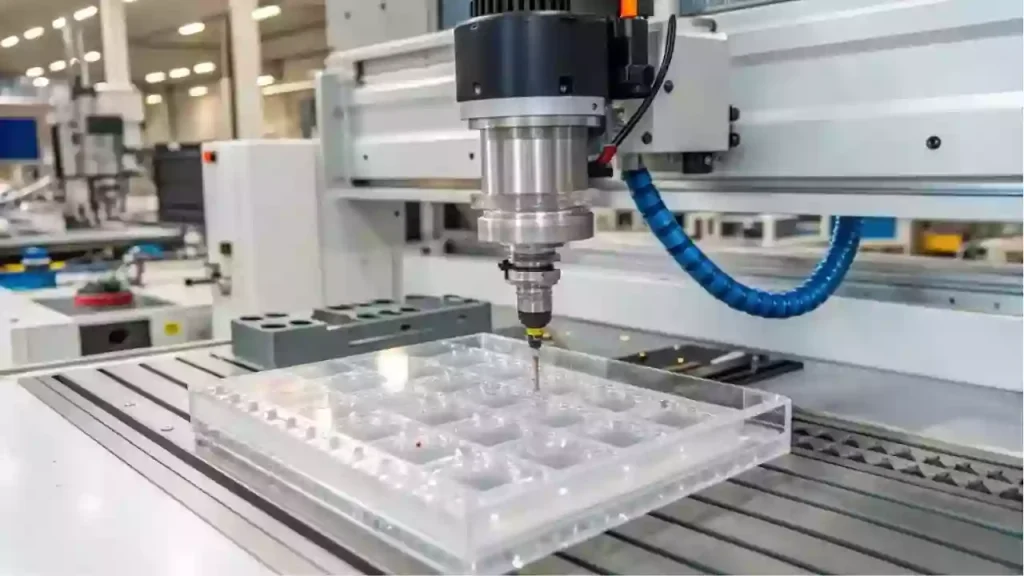
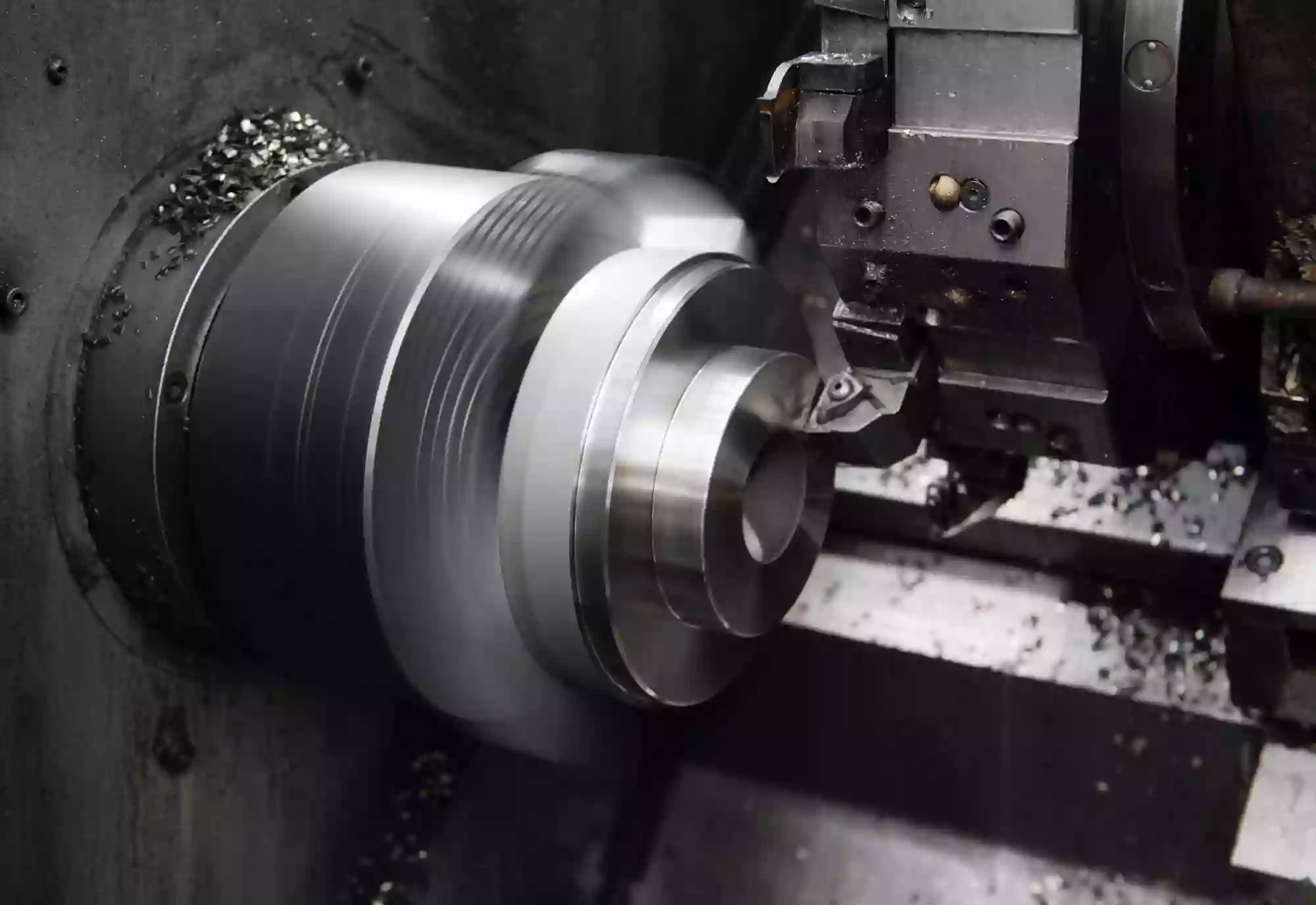
Equipped with high-speed 3-, 4-, and 5-axis CNC machines optimized for polycarbonate, ensuring precise geometry, smooth finishes, and minimal thermal deformation.
Climate-controlled conditions manage temperature and moisture, supported by dedicated vapor polishing areas and annealing processes to reduce internal stress and maintain stability.
Machining strategies tailored specifically for PC, including optimized cutting parameters, tooling, and cooling methods to prevent deformation and surface defects.
Strong DFM approach to refine part geometry and machining paths, ensuring efficient and reliable production from prototype to batch runs.
Engineering Expertise: From Design to Production
Every CAD model is reviewed for wall thickness, stress concentration, and machinability, ensuring optimized designs before production begins.
Tailored machining strategies for polycarbonate, including optimized cutting parameters and thermal control to prevent deformation and internal stress.
Specialized fixtures and processes developed for vapor polishing, annealing, and optical finishing to achieve consistent functional and visual results.
Guidance on material selection, structural design, and assembly challenges, supporting applications across medical, industrial, and high-precision sectors.
Quality Control
Equipped with CMM, optical measurement systems, and precision gauges to verify complex geometries and tight tolerances.
Inspection of internal stress after annealing and optical clarity after polishing to prevent crazing, haze, and micro-defects.
Verified material sourcing with MTR and CoC available, ensuring consistency across medical-grade, flame-retardant, and reinforced PC.
In-Process & Final Control
Critical dimensions are checked during machining, followed by comprehensive final inspection before shipment.
Precise Tolerances & Technical Specifications
Polycarbonate machining requires careful control of thermal behavior and material elasticity to achieve stable, high-precision results. We offer multiple tolerance levels to match different functional and engineering requirements.
Precision Tolerances
- Standard Machining
±0.010″ (±0.25 mm) for general-purpose housings, covers, and structural components. - Precision Grade
±0.005″ (±0.125 mm) achieved through optimized toolpaths and controlled machining conditions for tighter mechanical fits. - High-Precision Capability
Down to ±0.002″ (±0.05 mm) on critical features, subject to engineering review for optical and medical-grade assemblies.
Manufacturing Capabilities
- Lead Time
Rapid prototyping from 3 days, with most production orders completed in ~6 days depending on complexity and finishing. - Minimum Wall Thickness
03″ (0.8 mm), with engineering review recommended for thin-wall or load-bearing structures. - Maximum Part Size
Up to 1200 × 500 × 150 mm, or long-format components up to ~2000 mm depending on geometry and machining strategy.
Surface Finishing Options for Machined Polycarbonate
Why Choose XTPROTO for Polycarbonate CNC Machining?
Industries of CNC Machined Polycarbonate Parts
Automotive & Racing
Medical & Scientific Equipment
Aerospace & Defense
Industrial Equipment & Safety
Electronics & Consumer Products
Optics & Lighting Systems
Polycarbonate CNC Machining FAQ
Is Polycarbonate suitable for CNC machining?
Is Polycarbonate better than Acrylic (PMMA)?
How does vapor polishing improve polycarbonate parts?
Will polycarbonate yellow over time?
What are the size and complexity limits?
Ready to Accelerate Your Polycarbonate Project?
With 600+ CNC centers and a dedicated engineering team, XTPROTO transforms your complex designs into precision parts in as little as 3 days. From optical-grade prototypes to high-volume production, we deliver excellence at scale.