
PEEK vs. PTFE: An Engineer’s Decisive Guide to High-Performance Plastic Selection and Machining
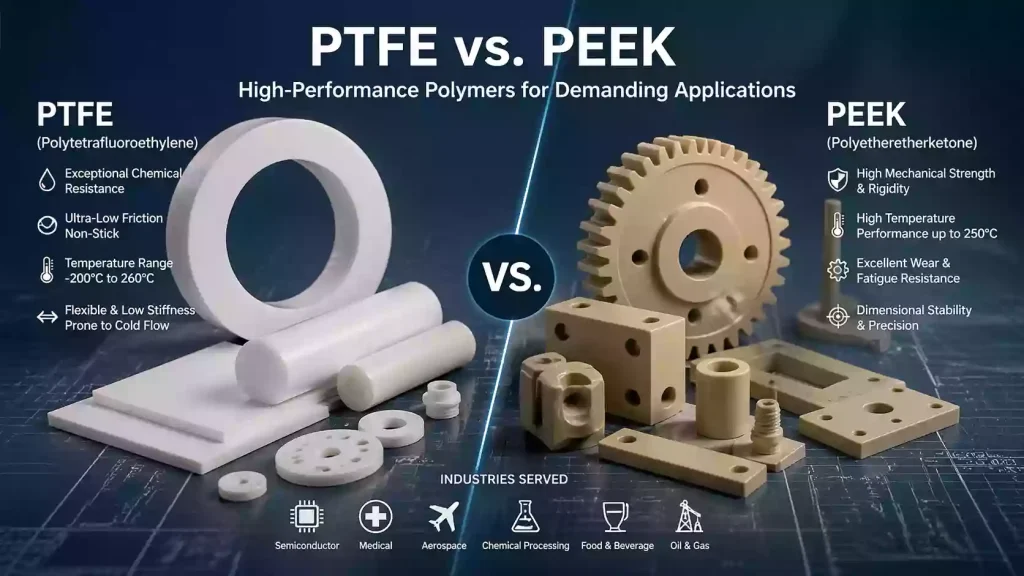
When selecting between PTFE (polytetrafluoroethylene) and PEEK (polyether ether ketone) for high-performance projects, the choice often feels like a delicate balancing act between extreme chemical resistance and structural integrity. These two fluoropolymers sit at the absolute pinnacle of the materials hierarchy, yet they are designed to address fundamentally distinct engineering challenges. When friction must be minimized, or when components are destined for environments saturated with highly corrosive acids—conditions sufficient to degrade almost any other plastic—PTFE is frequently the preferred solution. Its unique molecular structure endows it with nearly unrivaled chemical inertness, making it a staple material in fluid handling and laboratory settings.
However, the very properties that enable PTFE to excel in sealing and sliding applications—namely, its soft and non-stick surface—become its primary limitations when mechanical loads are involved. This is precisely where PEEK steps in as the “heavy hitter” for structural performance. While PTFE may deform or creep under sustained pressure, PEEK retains its original shape and mechanical strength even as temperatures soar toward **250°C**. It behaves more like a metal than a traditional plastic, providing the rigid support required for gears, bearings, and structural housings that must endure in environments subject to extreme stress.
The decision-making process typically hinges on the specific thermal and mechanical performance thresholds mandated by the application at hand. If the primary objective is to ensure a component can withstand the corrosive assault of specific reagents, or to achieve a “zero stick-slip effect” (i.e., smooth, unimpeded sliding) during operation, then selecting PTFE is often the most logical path. Conversely, if a component must endure extremely high rotational speeds or heavy structural loads within a high-temperature vacuum environment—all while maintaining exceptionally tight dimensional tolerances—then PEEK, with its superior performance capabilities, fully justifies its significantly higher cost compared to PTFE. Understanding the subtle transition points regarding the performance applicability of these two materials is the critical first step in ensuring that a component moves beyond the design phase on a computer screen to successfully fulfill its intended service life in the real-world application field.
Thermal and Mechanical Thresholds in Real-World Environments
The performance disparities between PTFE (polytetrafluoroethylene) and PEEK (polyether ether ketone) become particularly pronounced when temperature fluctuations interact with mechanical stress. PTFE is renowned for its exceptional chemical stability; however, at approximately 19°C, it undergoes a unique crystalline phase transition. This transition results in a predictable—yet significant—change in volume; in environments where strict climate control is lacking, this phenomenon often poses substantial challenges to applications requiring ultra-precise tolerances. For components such as seals or gaskets operating within confined spaces, this thermal expansion effect remains largely manageable; however, for high-precision sliding components, it introduces a variable that engineers must thoroughly address during the initial design phase. Furthermore, PTFE exhibits a characteristic known as “cold flow”—the gradual deformation of the material under sustained load, even at room temperature. This characteristic renders PTFE unsuitable for components that must provide long-term structural support or maintain a rigid position while under compressive stress.
In contrast, PEEK demonstrates exceptional dimensional stability, maintaining this consistency across a significantly broader temperature range. Its glass transition temperature is substantially higher than that of PTFE, enabling it to retain its original rigidity and tensile strength in environments where most other polymers would have already begun to soften. It is precisely this superior rigidity that has enabled PEEK to successfully serve as a substitute for metal materials in sectors such as aerospace and medical devices. While PTFE may be the material of choice for manufacturing non-stick liners or low-friction bushings, PEEK stands as the sole and indispensable option for high-speed gears or structural housings that must withstand thousands of cyclic load cycles while maintaining their geometric integrity. This material selection process often entails a performance trade-off regarding elastic properties: compared to the more forgiving and flexible nature of PTFE, PEEK is notably more rigid and brittle. In such application scenarios, an error in material selection entails consequences far beyond mere cost differentials; more critically, it determines whether the component will ultimately undergo brittle fracture upon impact or gradually deviate from its intended geometry over time due to cold flow effects.
The Realities of Manufacturing and the Dynamics of Precision Machining
Machining PTFE (polytetrafluoroethylene) and PEEK (polyether ether ketone) presents two distinct sets of challenges that directly impact the final quality of the components. For PTFE, the primary obstacles stem from its inherent elasticity and low thermal conductivity. Due to its extreme softness, PTFE tends to deform—deflecting away from the cutting tool—during the machining process, rather than being cleanly sheared away. This often results in a phenomenon known as the “stringing” effect, where the material forms long, continuous strands that interfere with the normal machining workflow. Achieving a high-quality surface finish requires the use of specialized tool geometries and exceptionally sharp cutting edges to ensure the material is “cut” rather than merely “pushed aside.” Furthermore, because PTFE absorbs very little of the heat generated during cutting, frictional heat can rapidly trigger localized thermal expansion; if cooling strategies are not precisely controlled, the dimensions of the workpiece may drift.
In contrast, machining PEEK is a more demanding undertaking, as its machining characteristics more closely resemble those of hard metals than those of typical plastics. Due to PEEK’s exceptionally high strength and rigidity, significant cutting heat is generated at the tool tip; if the feed rate and spindle speed are not perfectly synchronized, localized melting or discoloration of the material may occur. Unlike flexible PTFE, PEEK is highly prone to developing internal stresses during the material removal process. If these stresses are not relieved through controlled heating and cooling cycles, the workpiece may still warp or develop micro-cracks days after being removed from the machine tool. The reward for overcoming these challenges is the ability to achieve tighter tolerance control—even stricter than that attainable with PTFE—and to produce a finer surface finish. While the value of PTFE components lies primarily in their functional flexibility and adaptability, the core value of precision-machined PEEK components resides in their exceptional geometric accuracy and their capacity to maintain that precision under demanding mechanical conditions.
Economic Considerations: Balancing Material Costs with Overall Value
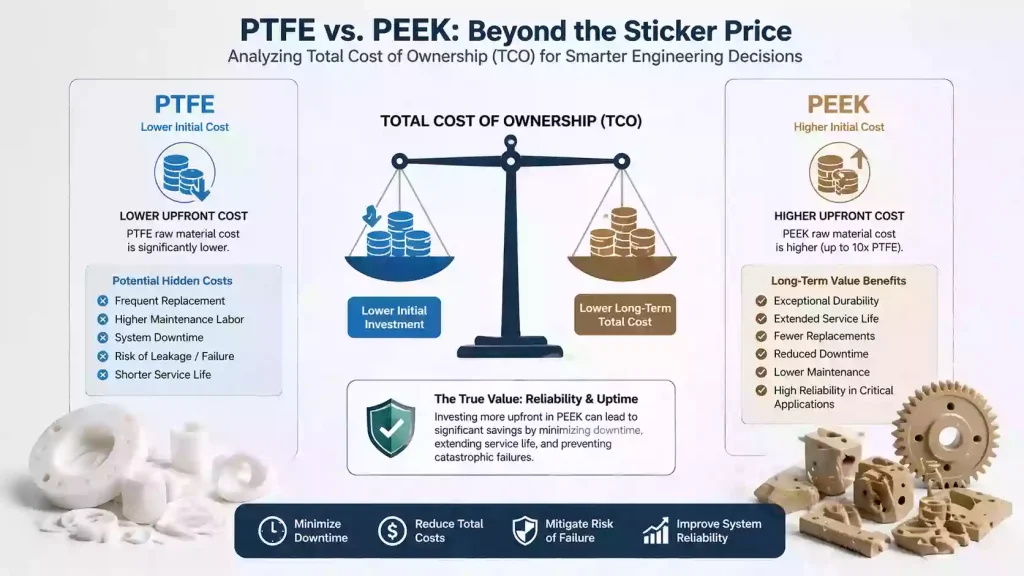
When evaluating the cost disparity between PTFE (polytetrafluoroethylene) and PEEK (polyether ether ketone), the price of raw materials is often the most striking factor. PEEK can cost as much as ten times more than PTFE—a massive gap that frequently compels one to reconsider: are its high-performance attributes truly indispensable? However, limiting one’s perspective solely to the initial raw material invoice can be highly misleading. In the realm of industrial applications, true cost should be measured across the entire lifecycle of a component. For many applications involving chemical media, PTFE seals offer not only exceptional cost-effectiveness but also excellent functional performance; yet, if the operating environment involves high pressure or abrasive particles, such seals may require frequent replacement. In such scenarios, the resulting labor costs, losses due to system downtime, and the potential risk of catastrophic failure can exact a toll far exceeding the savings realized on the material itself.
The decision to invest in PEEK is typically driven by an urgent need for long-term operational reliability within critical or inaccessible systems. Given PEEK’s ability to withstand hundreds of sterilization cycles in medical environments, or to endure years of high-pressure conditions in deep-sea oil extraction equipment, its higher initial procurement cost is fully amortized through exceptionally long periods of trouble-free operation. Conversely, utilizing PEEK for simple chemical isolation components—where loads are minimal and PTFE is perfectly adequate—constitutes a classic case of “over-engineering”; this practice serves only to inflate costs without yielding any tangible practical benefits. The most efficient strategy involves a calm and objective assessment of the component’s operating environment and performance requirements. If the mechanical specifications permit a material with the flexibility and inherent “flow” characteristics of PTFE, then PTFE remains, without question, the most economical choice. However, once the success or failure of a project hinges on a specific critical component consistently maintaining its precise dimensional accuracy under prolonged mechanical stress, the premium paid for selecting PEEK ceases to be merely an “additional expense”—it effectively becomes a vital “insurance policy” against the potentially massive losses that could result from system failure.
Material Performance in Key Industrial Sectors
In the semiconductor industry, the choice between PTFE and PEEK often hinges on striking a balance between “ultra-high purity” and “structural rigidity.” Wafer handling components and carriers rely on the exceptional stiffness of PEEK to ensure that automated robotic systems can achieve sub-millimeter positional repeatability. In these high-precision environments, even the slightest degree of sagging or deformation—a common occurrence with PTFE—could lead to positioning errors and, consequently, significant yield losses. Conversely, in wet etching and cleaning stations—where components are continuously exposed to highly corrosive hydrofluoric acid and various solvents—PTFE remains the material of choice. While even advanced polymers eventually face degradation, PTFE maintains its chemical inertness; this characteristic makes it an indispensable material for ensuring the long-term operational stability of equipment within the industry’s most chemically demanding environments.
The medical and life sciences sectors, meanwhile, shift their focus toward biocompatibility and sterilization resistance. PEEK has emerged as a core material for spinal fusion cages and orthopedic implants, primarily because its elastic modulus closely mimics that of human bone, and it can withstand repeated cycles in high-pressure steam sterilizers (autoclaves) without compromising its mechanical properties. In contrast, PTFE is an indispensable material in the manufacture of catheters and surgical tubing; its near-zero coefficient of friction ensures that catheters can glide smoothly through the body’s delicate vascular pathways. In the food and beverage processing industry, material selection is often dictated by resistance to cleaning agents. While PTFE provides the necessary non-stick surfaces for heat-sealing equipment, PEEK is preferred for high-speed filling valves and scraper assemblies—components that must withstand constant friction and endure high-pressure washdowns involving strong alkaline chemicals.
The aerospace and energy sectors present a distinct set of technical priorities, centering on the comprehensive balance of three key factors: weight, pressure, and temperature. In the realm of deep-sea oil and gas exploration, seals and retaining rings must be capable of withstanding immense hydrostatic pressures. In such application scenarios, PTFE is selected for its excellent sealing and conformal properties, yet it typically requires reinforcement with PEEK components; the latter provides the necessary extrusion resistance to prevent the seal from deforming—or even being crushed—under heavy pressure loads. In the aerospace sector, PEEK is frequently chosen as a metal substitute for engine peripheral components, owing to its exceptionally high strength-to-weight ratio, while PTFE remains the standard choice for fuel line liners and electrical insulation materials. Across all the aforementioned application domains, these two materials are regarded as complementary solutions; the ultimate choice of material depends on whether the primary threat facing the system is chemical degradation or mechanical structural failure.
Engineering Comparison: PTFE vs. PEEK at a Glance
| Performance Metric | PTFE (Polytetrafluoroethylene) | PEEK (Polyetheretherketone) |
| Mechanical Integrity | Soft and flexible; susceptible to cold flow (creep) under load. | Rigid and strong; maintains shape under high structural stress. |
| Thermal Thresholds | Operates up to 260°C but softens significantly as heat rises. | Operates up to 250°C while retaining high tensile strength. |
| Dimensional Precision | Challenging to hold tight tolerances due to elasticity and phase changes. | Excellent for precision machining; holds stable, tight tolerances. |
| Frictional Properties | Exceptionally low; the gold standard for non-stick and sliding surfaces. | Low friction, but significantly higher than PTFE; excellent wear resistance. |
| Chemical Resistance | Near-universal; resistant to almost all acids, bases, and solvents. | Exceptional, though vulnerable to a few specific concentrated acids. |
| Primary Failure Risk | Permanent deformation or “flow” out of position under pressure. | Brittle fracture under sudden impact or internal stress cracking. |
| Machining Character | Tends to “string” and deflect; requires ultra-sharp, specialized tooling. | Behaves like a hard metal; requires strict heat and stress management. |
| Relative Cost | Economical for high-performance chemical applications. | Premium; often 5 to 10 times more expensive than PTFE. |
Selecting the Right Materials for Production
Choosing between PTFE (Polytetrafluoroethylene) and PEEK (Polyether Ether Ketone) is rarely a matter of simply determining which material is “better,” but rather of identifying the primary physical constraints inherent to a specific project. If a component’s success hinges on absolute chemical inertness—or the need for a surface that facilitates nearly frictionless sliding—PTFE remains the most logical and cost-effective choice. Thanks to its unique surface conformability and its ability to maintain performance integrity even when exposed to highly corrosive reagents, PTFE holds an irreplaceable position within the field of sealing technology. However, when the project’s focus shifts to structural reliability—specifically, when a component must serve as a load-bearing element while maintaining precise dimensional stability under extreme temperatures—PEEK often emerges as the only viable solution. Although selecting PEEK entails a higher initial investment, its capacity to serve as a metal substitute—and its ability to significantly extend the service life of critical systems—often translates into far greater long-term value.
Ultimately, transforming a chosen material into a finished component requires a profound understanding of the physical properties these polymers exhibit during the CNC machining process. At XTPROTO, our operational philosophy is built precisely upon this intersection of materials science and precision manufacturing. With a 160,000-square-foot facility and a dedicated team of over 120 engineers, we specialize in addressing the specific challenges discussed in this guide—from managing the expansion caused by phase transitions in PTFE during machining, to executing the complex stress-relief cycles required for PEEK. We do more than simply process materials; we are committed to ensuring that every theoretical advantage of your chosen polymer is fully realized in the final machined component. Whether you are currently in the prototyping phase or preparing for industrial-scale production, our engineering team stands ready to provide the technical guidance and oversight necessary to transform your complex material selection strategies into reliable, tangible hardware.