
How to Achieve Sub-Micron Precision in Optical CNC Machining: A Practical Engineering Guide
In most CNC machining projects, a few microns here or there don’t raise eyebrows. But in optical systems, that same deviation can quietly break everything.
A 1 μm shift might not even be visible under normal inspection, yet it can nudge an optical axis just enough to throw off alignment, reduce signal quality, or introduce stray reflections that weren’t supposed to exist in the first place. The result isn’t always immediate failure—it’s often worse: inconsistent performance, calibration drift, or systems that pass inspection but underperform in real-world use.
That’s the tricky part about optomechanical components. You’re not just machining a part—you’re defining how light behaves inside a system. And light is unforgiving. It doesn’t “average out” errors the way mechanical assemblies sometimes can.
This is where a lot of conventional CNC thinking falls short. Hitting ±0.01 mm might be considered precise in general manufacturing, but for optical applications, it’s simply not enough. The real challenge isn’t just holding tight tolerances on a drawing—it’s making sure those tolerances actually translate into functional alignment after assembly, coating, and operation.
Sub-micron precision, in practice, is not something you “achieve” at the machining stage alone. It’s the result of a chain of decisions—starting from how the part is designed, what material is selected, how it’s machined, how surfaces are treated, and finally how everything is measured and verified.
This guide walks through that entire chain. Not from a theoretical standpoint, but from what actually makes a difference on the shop floor—where small details in process control often decide whether a part performs as intended or becomes a source of optical error.
II. Step 1: Design for Manufacturing (DFM) — Precision Starts Before Cutting
Most precision problems don’t start on the machine—they start in the CAD file.
It’s a common situation: a design comes in with extremely tight tolerances across almost every feature. On paper, it looks “high precision.” In reality, it creates unnecessary complexity, drives up cost, and—ironically—makes it harder to control the features that actually matter.
In optical components, not every dimension is equally critical. What really matters are the features that define alignment: datums, mounting interfaces, and anything that influences the optical axis. If those aren’t clearly prioritized in the design stage, no amount of machining skill can fully recover it later.
One of the biggest issues we see is tolerance stack-up. When multiple features each carry their own small deviation, the combined effect can easily exceed sub-micron requirements. The key is not to tighten every tolerance, but to control how they interact. That usually means simplifying the chain—reducing unnecessary dependencies between features and making sure critical dimensions reference the right datums.
Another often-overlooked point is re-fixturing. Every time a part is removed and re-clamped, you introduce a new opportunity for misalignment. Even with high-end equipment, you’re still dealing with tiny variations in positioning. Good DFM thinking tries to eliminate that from the start—by designing parts in a way that allows as many features as possible to be completed in a single setup.
This is especially important for optical housings, mounts, and components where coaxiality or perpendicularity directly affects performance. If those relationships depend on multiple setups, maintaining sub-micron consistency becomes extremely difficult.
Then there’s GD&T. A lot of drawings rely heavily on dimensional tolerances, but for optical parts, geometric tolerances tell the real story. Flatness, concentricity, perpendicularity—these are what define how the part will actually behave in assembly. Without clear and functional GD&T, inspection might pass while performance still falls short.
At this stage, the goal isn’t to make the design “perfect.” It’s to make it manufacturable in a way that preserves precision where it actually matters. Because once machining starts, you’re no longer designing the outcome—you’re working within the limits of what the process can deliver.
III. Step 2: Material Selection & Stability — Controlling What You Can’t See
Material choice doesn’t usually get much attention at the beginning. A lot of projects default to aluminum, and in many cases, that’s perfectly fine. But when you’re chasing sub-micron precision, the material stops being just a cost or weight decision—it becomes part of the accuracy itself.
Take Aluminum 6061-T6 as an example. It’s widely used for a reason: good machinability, relatively stable, and cost-effective. But it still expands and contracts with temperature, and it still carries internal stress from the way it was produced. Under normal tolerances, that’s manageable. At the sub-micron level, it starts to show.
That’s where materials like Invar 36 come into play. Its thermal expansion is extremely low, which makes it a go-to choice for high-end optical assemblies where dimensional stability matters more than anything else. The trade-off, of course, is cost and machinability. It’s slower to cut, harder on tools, and not always necessary unless the application truly demands it.
So the decision isn’t “which material is best,” but “which material stays stable under the actual working conditions.”
And that brings up something that’s often underestimated: temperature. Even a small change in ambient conditions—just a few degrees—can move dimensions beyond your tolerance window. Not because the machining was off, but because the material itself is responding to the environment. That’s why serious optical machining setups pay close attention to thermal control, both in the workshop and in how parts are handled between processes.
Then there’s internal stress—the part you can’t see, but will definitely feel later.
When raw material is cut, especially in rough machining, those internal stresses start to redistribute. If nothing is done about it, the part may look fine right after machining, but slowly deform over time or after additional processing. For optical components, even that slight movement can shift alignment enough to affect performance.
The way to deal with this isn’t a single step, but a process. Typically, it starts with rough machining to remove bulk material, followed by stress-relief heat treatment. After that, semi-finishing brings the part closer to final geometry, and only then does finishing take place. In some high-precision cases, deep cryogenic treatment is added to further stabilize the material structure.
It sounds like extra work—and it is. But skipping these steps usually means chasing deformation later, when it’s much harder to control.
At this level, precision isn’t just about how accurately you cut the material. It’s about whether the material stays where you put it.
IV. Step 3: Advanced Machining Strategy — Where Precision Is Actually Created
Once the design is sorted and the material is stable, everything comes down to how the part is machined. This is where sub-micron precision either becomes real—or quietly falls apart.
A lot of shops will say they can hit tight tolerances, and technically, many can. But optical parts aren’t just about hitting numbers on individual features. It’s about how those features relate to each other in 3D space. That’s where machining strategy matters more than machine specs on paper.
One of the biggest limitations comes from relying on 3-axis or even indexed 4-axis setups. They can produce accurate features, but usually not in a single setup. That means the part gets repositioned, re-clamped, and re-referenced multiple times. Each step introduces tiny alignment errors. Individually, they’re small. Together, they stack up—and at the sub-micron level, that stack-up becomes the problem.
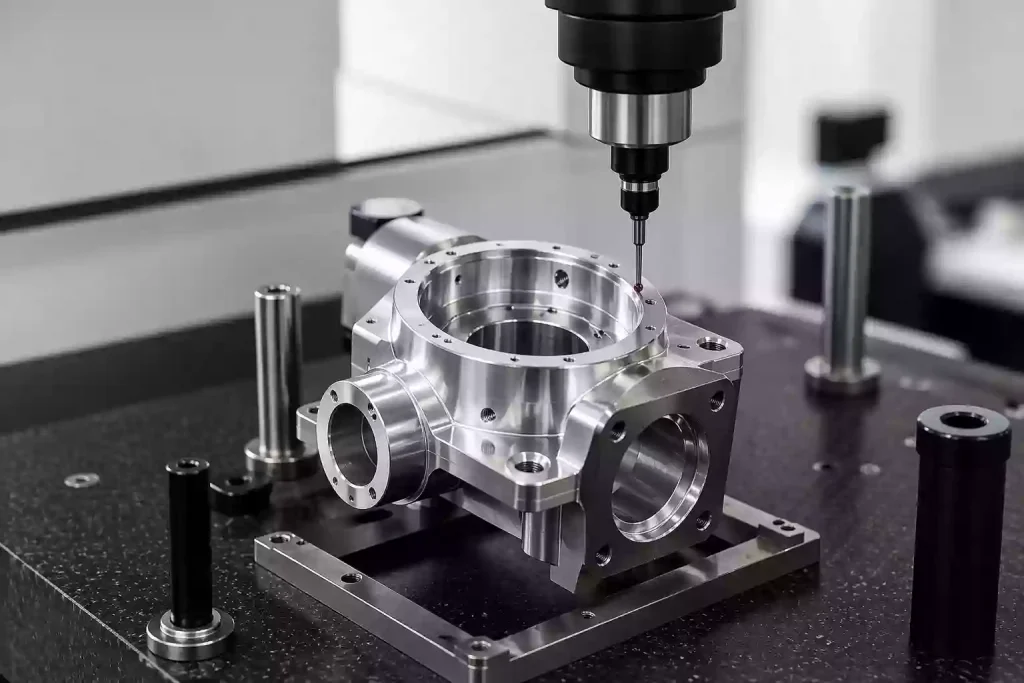
This is why simultaneous 5-axis machining isn’t just a “nice to have” for optical components—it’s often the only practical way to maintain true geometric relationships. With continuous control over both tool position and orientation, you can machine complex features—like lens seats, bores, and angled surfaces—without breaking the reference frame.
Just as important is the idea of single-setup execution. If all critical features can be completed in one clamping, you eliminate most of the positional uncertainty that comes from re-fixturing. The datums stay consistent, and the relationships between features are preserved exactly as programmed. That alone can make the difference between a part that passes inspection and one that actually performs correctly in assembly.
Then there’s the cutting process itself. At this level, you’re not just removing material—you’re managing vibration, heat, and tool behavior in real time. Toolpath strategy plays a big role here. Smooth, continuous toolpaths help reduce sudden changes in cutting forces, which in turn minimizes micro-vibrations that can affect both geometry and surface finish.
Cutting parameters also need to be tuned carefully. Too aggressive, and you introduce deflection or surface damage. Too conservative, and you risk built-up edge or inconsistent finishes. The goal is a stable cutting condition that consistently delivers both dimensional accuracy and surface quality.
For optical components, surface finish isn’t just cosmetic. Achieving something like Ra ≤ 0.4 μm directly affects how light interacts with the part—whether it reflects cleanly, scatters, or gets absorbed. That means tooling, speeds, feeds, and even tool wear all need to be tightly controlled.
In the end, precision at this stage isn’t about having the most advanced machine—it’s about using the machine in a way that preserves alignment, minimizes error sources, and produces consistent results across the entire part.
V. Step 4: Surface Engineering — Where Optical Performance Is Actually Decided
A lot of manufacturers treat surface finishing as a final step—something you do after machining is done. For optical components, that mindset doesn’t really hold up.
Because by the time you get to coating, a big part of the optical behavior has already been decided by how the surface was machined.
Take stray light as an example. The usual solution is black anodizing or some kind of absorbing coating. And yes, that helps. But coatings don’t eliminate reflections—they reduce them. If the base surface is still relatively smooth at a microscopic level, light can reflect before it ever gets absorbed.
That’s where machining strategy comes in.
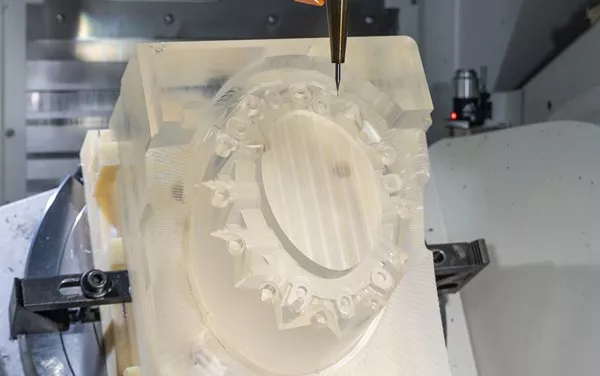
Instead of aiming for a purely “smooth” surface everywhere, certain optical components actually benefit from controlled surface textures. By adjusting the toolpath, you can create fine, directional micro-serrations—essentially tiny grooves that break up and trap incoming light.
These aren’t random marks. Their effectiveness depends on:
- spacing (too wide, and light escapes)
- depth (too shallow, and they don’t trap enough energy)
- orientation (relative to the optical path)
Done properly, this kind of texture reduces specular reflection and helps scatter light into multiple directions, making it easier for coatings to absorb what’s left. In other words, machining and coating start working together, instead of relying on one to fix the other.
Another detail that often gets overlooked is how the surface condition affects anodizing itself. If the machined surface has inconsistent roughness or tool marks, the anodized layer won’t form uniformly. That can lead to variations in absorption, which is the last thing you want in an optical system.
So the goal isn’t just “blacker surface” or “lower Ra.” It’s controlling how the surface interacts with light from the start—through both geometry and finishing.
In practice, the difference is noticeable. Parts that rely only on coating tend to perform adequately. Parts that combine controlled machining textures with proper surface treatment tend to perform consistently.
And in optical systems, consistency is usually what separates acceptable from reliable.
VI. Step 5: Metrology & Validation — Proving the Precision
At sub-micron level, “it should be fine” isn’t acceptable—you need proof.
CMM inspection is the baseline. It verifies critical GD&T features like coaxiality, flatness, and position, making sure the geometry matches the design intent, not just individual dimensions.
But for optical parts, that’s only part of the picture. Surface finish, alignment-critical features, and sometimes even functional checks all come into play. A part can pass basic inspection and still cause issues in assembly if these aren’t controlled.
Traceability also matters more than people expect. Knowing the material batch, machining process, and inspection results isn’t just for documentation—it helps catch problems early and ensures consistency across production.
In short, precision isn’t what you aim for—it’s what you can measure and verify.
VII. Conclusion — Precision Is a System, Not a Step
Sub-micron precision doesn’t come from one “advanced” step—it’s built layer by layer.
You can have a high-end machine, but if the design isn’t optimized, errors are already locked in. You can choose the right material, but without proper stress control, it won’t stay stable. Even with perfect machining, poor surface strategy or weak inspection can still compromise the final result.
What actually works is a controlled chain:
- Design that prioritizes what matters
- Materials that stay stable
- Machining that preserves alignment
- Surfaces that support optical performance
- Validation that proves it all holds together
When all of these are aligned, sub-micron precision becomes repeatable—not just achievable once, but reliable across production.
VIII. Call to Action — Turn Precision Into Performance
If you’re working on an optical project where tolerances are tight and performance matters, it’s worth getting a second set of eyes on the design before cutting begins.
At XTPROTO, we offer:
- Fast DFM feedback focused on optical-critical features
- Practical suggestions to reduce risk and unnecessary cost
- Precision machining backed by full inspection and traceability
Ready to move forward?
Upload your CAD files and get a detailed review and quotation—typically within 24 hours.