All Articles

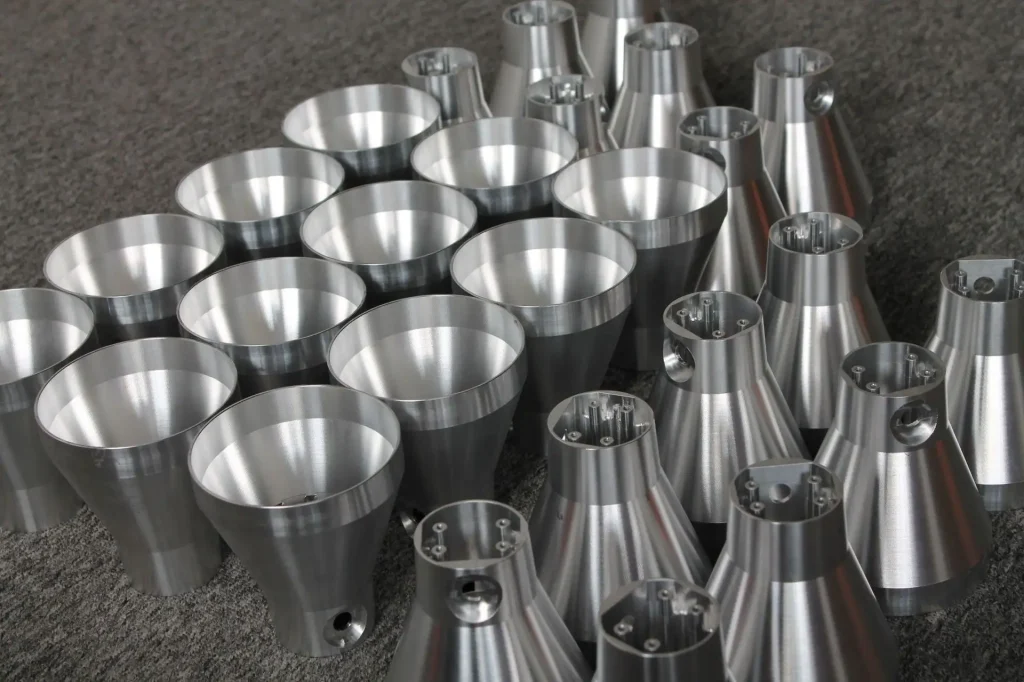
CNC Turning of Conical Metal Parts Aluminum thin wall machining

Surface Treatments to Prevent Corrosion on Aluminum Parts

This guide explores how to protect aluminum components from corrosion in harsh environments, covering the entire process from initial design to final surface finishing. It outlines key preventive strategies—such as selecting appropriate alloys and avoiding design features that allow water accumulation—and details five major protective processes, including anodizing and powder coating, while addressing project budgets and RoHS/REACH compliance. Additionally, the article offers recommendations for routine maintenance to extend component service life and highlights how the contract manufacturer Xtproto combines precision custom CNC machining with high-specification surface finishing to deliver durable, corrosion-resistant, and high-quality solutions.

Surface Treatments to Prevent Corrosion on Aluminum Parts Read More »

cnc boring new

What Is CNC Boring? Process, Machines, Tools, Types, Costs, and Applications

CNC boring is a precision machining process used to enlarge, correct, and finish existing holes, achieving high precision and consistent surface quality. This guide details the CNC boring process, machine types, cutting tools, machining methods, tolerances, materials, costs, design considerations, and application areas, aiming to help you understand how to achieve reliable internal hole machining results.

What Is CNC Boring? Process, Machines, Tools, Types, Costs, and Applications Read More »

Multi Axis Machined Parts Components​

When to Use an As-Machined Finish for Your CNC Parts

This article explains when to use an as-machined finish for CNC parts, highlighting its impact on cost, lead time, and performance. It outlines key factors affecting surface quality, including toolpath strategy, tool condition, material properties, and machine stability.

As-machined finishes are best suited for functional prototypes, internal components, and cost-sensitive parts where surface appearance is not critical, but should be avoided in applications requiring sealing, low friction, cosmetic quality, or optical precision.

The guide also compares as-machined surfaces with other finishing options and provides design recommendations to help engineers optimize manufacturability and surface performance.

When to Use an As-Machined Finish for Your CNC Parts Read More »

silicone ABS products manufacturer scaled 1

ABS Plastic: How to Select the ABS Material

This guide explains how to select the right ABS material through a structured engineering approach, covering application requirements, material specifications, ABS grade selection, and manufacturing processes. It also highlights common selection mistakes, key performance factors, and how different ABS grades and processing methods affect final part performance. XTPROTO provides end-to-end support for ABS material sourcing, selection guidance, and manufacturing services including CNC machining, injection molding, and vacuum forming to ensure reliable, cost-effective, and application-optimized ABS components.

ABS Plastic: How to Select the ABS Material Read More »

PBT CNC Machining services hero

What is PBT CNC Machining?

This article discusses the CNC machining of PBT materials, covering material properties, machining methods, application areas, and manufacturing process selection. PBT is an engineering thermoplastic characterized by high strength, excellent dimensional stability, low moisture absorption, and superior electrical insulation properties; it is widely used in the automotive, electronics, and industrial component sectors. CNC machining utilizes solid stock to produce precision PBT parts and is suitable for prototyping, small-batch production, and the fabrication of complex geometries. CNC-machined PBT parts are frequently employed in electrical housings, automotive components, and industrial systems that demand high stability and durability. Compared to injection molding, CNC machining is better suited for projects requiring small batches, high precision, and rapid delivery, whereas injection molding is more appropriate for mass production.

What is PBT CNC Machining? Read More »

PPA CNC Machining process

How to Prevent Warping When Machining PPA: 5 Proven Shop-Floor Strategies

PPA is a high-performance engineering plastic widely used in demanding automotive and electronic applications, but its semi-crystalline structure makes it highly susceptible to warping during CNC machining. Distortion is typically caused by residual stress release, poor heat dissipation, and excessive clamping pressure. To achieve stable, high-precision PPA components, manufacturers should adopt a controlled process that includes rough machining with allowance, stress-relief annealing, symmetrical material removal, optimized cutting parameters, continuous flood cooling, and low-stress workholding. By combining these proven strategies, shops can significantly reduce dimensional instability and consistently produce flat, accurate, and reliable PPA machined parts.

How to Prevent Warping When Machining PPA: 5 Proven Shop-Floor Strategies Read More »

Bicycles industry

Why CNC Machining is Essential for High-Performance Bicycle Drivetrain Systems

Traditional casting and stamping fail under the extreme mechanical stress of modern bicycle drivetrains. CNC machining solves this by accurately milling complex narrow-wide tooth profiles and intricate shifting ramps directly from solid, high-strength billets (like 7075-T6 aluminum and titanium), ensuring flawless mechanical synchronization and zero structural flaws.By removing dead weight through multi-axis pocketing, CNC machining achieves an optimal strength-to-weight ratio with micron-level tolerances. Additionally, requiring zero upfront tooling costs makes it the ultimate agile solution for rapid prototyping and low-volume production without MOQ barriers.XTPROTO combines precision multi-axis CNC fleets with expert engineering to deliver production-grade, high-performance drivetrain components from prototype to final batch.

Why CNC Machining is Essential for High-Performance Bicycle Drivetrain Systems Read More »

alloy steel cnc machining services for drilling

Alloy Steel vs. Stainless Steel in CNC Machining

This article compares alloy steel and stainless steel in CNC machining from material properties, machining behavior, and cost perspective.

Alloy steel is optimized for strength and fatigue resistance, offering excellent machinability, strong heat-treatment response, and high performance under heavy loads, but it requires protective coatings to prevent corrosion. Stainless steel focuses on corrosion resistance through a chromium oxide passive layer, making it ideal for harsh or wet environments, but it is more difficult to machine due to work hardening, low thermal conductivity, and tool wear issues.

In machining, alloy steel allows faster cutting speeds and longer tool life, while stainless steel requires slower parameters and specialized tooling. In long-term use, alloy steel performs better in high-stress mechanical systems, whereas stainless steel excels in corrosive or sanitary applications.

From a TCO standpoint, alloy steel has lower upfront cost but may require extra surface treatment and maintenance, while stainless steel has higher initial cost but lower lifecycle maintenance.

Overall, the choice depends on balancing strength requirements, environment, machinability, and total cost.

Alloy Steel vs. Stainless Steel in CNC Machining Read More »

lightweight cnc machined motorcycle component

CNC Machined Motorcycle Parts: Design and Manufacturing Guide

CNC machined motorcycle parts are widely used in engine, suspension, braking, and chassis systems where precision, strength, and lightweight performance are essential. This guide explores common motorcycle components, key design considerations, material selection, manufacturing challenges, and surface finishing options, providing an overview of how high-performance motorcycle parts are developed and manufactured.

CNC Machined Motorcycle Parts: Design and Manufacturing Guide Read More »

Scroll to Top